2016 United States Elizabethkingia outbreak
| 2016 United States Elizabethkingia anophelis outbreak | |
|---|---|
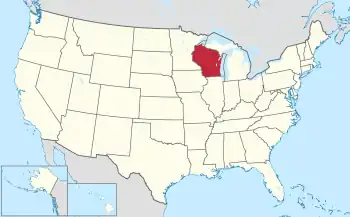 Wisconsin, in red, the location of 63 confirmed cases as of June 16, 2016 | |
| Bacteria strain | Elizabethkingia anophelis |
| Location | Wisconsin, western Michigan, and Illinois, United States[1][2] |
| Date | November 1, 2015 — May 30, 2016[3] |
Type | Disease outbreak |
| Confirmed cases | |
Deaths | 20[4] |
An outbreak of Elizabethkingia anophelis infections centered in Wisconsin [3][5] is thought to have led to the death of at least 20 people in Wisconsin, Michigan, and Illinois.[6][7][1][2]
History
As of March 2016, it was reported to be the largest outbreak of Elizabethkingia anophelis-caused disease investigated by the Centers for Disease Control and Prevention (CDC).[8]
Human infections by E. anophelis involve the bloodstream.[3] Signs and symptoms can include fever, shortness of breath, chills, and cellulitis.[3] Confirmation requires a laboratory test.[3]
Statewide surveillance of the situation in Wisconsin was organized on January 5, 2016.[9] Cases had been reported from Columbia, Dane, Dodge, Fond du Lac, Jefferson, Milwaukee, Ozaukee, Racine, Sauk, Sheboygan, Washington, Waukesha, and Winnebago Counties); Illinois; and western Michigan as of April 13, 2016.[9][1]
Between November 1, 2015 and March 30, 2016, 62 cases of E. anophelis infections were reported to the Wisconsin Department of Health Services, Division of Public Health.[3]
The severity of the outbreak is reflected in a statement by the CDC that "the agency sees a handful of Elizabethkingia infections around the country each year, but the outbreaks rarely involve more than a couple of cases at a time. To have dozens of cases at once — and more than a third of them possibly fatal — is startling".[10]
In 2017, genomics researchers determined that "a disrupted DNA repair mutY gene [...] probably contributed to the high evolutionary rate of the outbreak strain and may have increased its adaptability," but the source was not identified.[5]
References
- 1 2 3 Sarah Kaplan (March 18, 2016). "The mysterious infection that might be behind 17 deaths in Wisconsin has spread to a second state". Washington Post. Archived from the original on March 18, 2016. Retrieved March 18, 2016.
- 1 2 3 Gallardo, Michelle. "Illinois Death Linked to Elizabethkingia Outbreak That Killed 18". ABC 7 Eyewitness News. WLS-TV. Archived from the original on April 14, 2016. Retrieved April 14, 2016.
- 1 2 3 4 5 6 "Elizabethkingia". Wisconsin Department of Health Services. September 28, 2021. Archived from the original on September 2, 2025.
- 1 2 "Multistate Outbreak of Infections Caused by Elizabethkingia anophelis". Centers for Disease Control and Prevention (CDC). June 16, 2016. Archived from the original on April 15, 2016. Retrieved June 19, 2016.
- 1 2 Perrin, Amandine; Larsonneur, Elise; Nicholson, Ainsley C.; Edwards, David J.; et al. (May 24, 2017). "Evolutionary dynamics and genomic features of the Elizabethkingia anophelis 2015 to 2016 Wisconsin outbreak strain". Nature Communications. 8 (1) 15483. Bibcode:2017NatCo...815483P. doi:10.1038/ncomms15483. ISSN 2041-1723. PMC 5458099. PMID 28537263.
- ↑ "A mysterious infection may have killed 18 people in Wisconsin, and health officials aren't sure why". Msn.com. Archived from the original on March 13, 2016. Retrieved March 11, 2016.
- ↑ "Rare Elizabethkingia Bacteria Outbreak Infects 44 in Wisconsin, Killing 18 – ABC News". Abcnews.go.com. March 4, 2016. Archived from the original on March 11, 2016. Retrieved March 11, 2016.
- ↑ Ehlke, Gretchen. "Source of bloodstream infection in Wisconsin unknown". The Washington Post. Archived from the original on March 10, 2016. Retrieved March 11, 2016.
- 1 2 "Cases of blood infection reported in Southeast Wisconsin | 44 cases of Elizabethkingia anophelis reported since Nov. 1". WISN 12 News. March 3, 2016. Archived from the original on March 10, 2016.
- ↑ "CDC offers new call to arms on nightmare bacteria". PBS NewsHour. August 4, 2015. Archived from the original on March 11, 2016. Retrieved March 11, 2016.