The Poké Radar (Japanese: ポケモントレーサーPokémon Tracer, ポケトレPoké Trace for short) is a Key Item introduced in Generation IV. It is used to seek out wild Pokémon hiding in tall grass. Its most notable use is to increase the probability of encountering Shiny Pokémon.
This section is incomplete. Please feel free to edit this section to add missing information and complete it. Reason: In what games is it possible to encounter roaming Pokémon using the Poké Radar?
In all games that it appears in, the Poké Radar is obtained after receiving the National Pokédex.
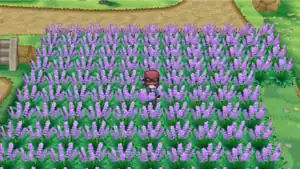
It can only be used in tall grass, while on foot. When used, a tune will begin to play, and up to four patches of grass will shake briefly. Upon entering one of these patches of grass, a battle with a wild Pokémon will begin immediately, even if the player is using a Repel. However, if the player enters a patch just as the repel wears off, the battle will not start until the player attempts to move again. Depending on the game, different patches may shake in a different way, corresponding to rarer species of wild Pokémon. However, all games feature a very rare and distinct type of shaking grass that glows white twice; such a grass patch will always contain a Shiny Pokémon.
Like the Vs. Seeker, the Radar's battery must be charged after use by walking around. It takes 50 steps to fully charge the Poké Radar.
If the wild Pokémon is knocked out or captured in a Poké Ball, a chain will begin; this is the principal mechanic of the Poké Radar and is crucial to increasing the probability of encountering a Shiny Pokémon. When a chain is in progress, the Poké Radar will automatically activate again at the end of the battle, causing up to four more grass patches to shake. Depending on various circumstances, one of these patches may be more likely to contain the same species of Pokémon as the one just encountered; defeating or catching such a Pokémon will continue to increase the chain by 1. If a wild Pokémon of a different species is encountered, or if a battle ends without defeating or capturing the wild Pokémon, or if a wild Pokémon is encountered outside of the Poké Radar, then the chain will break and the Poké Radar will need to recharge before being used again. A chain can also automatically break if the player uses the Bicycle or Roller Skates, if the player scrolls all shaking grass patches off-screen by moving too far away from them, a Pokémon evolves, or an Egg hatches. Depending on the game, the chain may also still break on an encounter with the same Pokémon.
Activating the Poké Radar manually in the middle of a chain will not break the chain, and will simply generate up to four new patches of shaking grass, replacing the old ones. This works even if the player is currently standing on shaking grass. This action is known as "resetting" the Radar. It is commonly used when none of the four patches is deemed likely to continue the chain; this determination varies between games.
As the chain length increases, the probability of finding a Shiny patch also increases, up to a certain maximum. After reaching this maximum, the player no longer needs to attempt to increase the chain, and can simply recharge and reset the Radar over and over until a Shiny patch appears.
Pokémon Diamond, Pearl, and Platinum
The Poké Radar's functions are not explained in detail when it's obtained. In Pokémon Platinum, once the player talks to Dawn/Lucas's sister about mass outbreaks, Dawn/Lucas will give a more practical demonstration on Route 202.
The player can encounter certain Pokémon with the Poké Radar that would not be normally found in that location; these Pokémon are often not native to the Sinnoh regional Pokédex. For example, the Poké Radar is the only way to encounter a Nidoran♀ on Route 201.
In these games, there are two different ways grass patches can shake (roughly, one that shakes vigorously for a short time and one that shakes gently for a slightly longer time); if a chain is started in one type of grass, grass of the other type will have an increased chance of breaking the chain, though it is possible to continue the chain with the opposite type of grass if the same species being chained is encountered. Additionally, the gently shaking grass can only contain Pokémon normally found in that location. For example, Nidoran♀ cannot be encountered on Route 201 in gently shaking grass. This means that gently shaking grass will always break a chain of a species only found using the Poké Radar. Different formations of patches have no apparent bearing on the odds of the chain continuing.[1]
When the Poké Radar is used, the game generates four "rings" around the player, with the first ring consisting of the eight squares surrounding the player, the second ring consisting of the 16 squares surrounding the first ring, and so on for the third and fourth rings. One random square in each ring will be selected, and if that square is a patch of grass, that patch will shake. Therefore, the maximum number of patches that can shake with each use of the Poké Radar is four; if fewer than four patches shake, then one or more of the randomly selected squares were not patches of grass. If all four squares did not contain grass, then the game will display the message "The grassy patch remained quiet..." and any existing chain will automatically break. The patches generated after an encounter are calculated by the game on entering a patch of grass, and if no valid patches are found the chain will break on initiating the encounter. If the chain breaks this way, the "The grassy patch remained quiet..." message will not appear.
When selecting each shaking grass patch during a chain, a hidden variable is set to true or false for each patch. If this variable is true, the patch will be forced to contain the species of Pokémon currently being chained, guaranteeing the chain continues. This forced encounter does not reference what encounters can currently be found in the area, allowing Pokémon that are no longer available due to the time of day changing or a swarm dispersing to still be encountered in that area until the chain ends. The chance this hidden variable is true depends on which distance of ring that patch spawned on. Starting from the closest ring, the chances are 28%, 48%, 68%, and 88%. Catching a Pokémon rather than defeating it will increase these odds by 10% for the patches automatically generated after the battle. If this hidden variable is false, the patch has a 50% chance to shake with the opposite type that the player most recently walked into (fast if the player last encountered a Pokémon in slow shaking grass, and vice versa). This effectively warns the player that the patch of grass is potentially going to end the chain. There is a remaining 50% chance that the hidden variable is false and the patch still uses the most recent type of grass. The only way to tell these patches apart from the ones that are guaranteed to continue a chain is to step into them. If the player steps into a patch of grass where the hidden variable is false, the game will generate an encounter based on that type of grass. If the chain contains the currently chained species, the chain will continue. This may, however, update the type of grass the player most recently went into. If the species encountered is different, the chain will break. This means that the chance the chain will break on any given patch depends on the encounter rate of the species. Even if this hidden variable is true, it is possible for the chain to break on the correct species if the patch is on the edge and fails to select any grass patches for after the encounter.
If the Poké Radar forces a Pokémon to be Shiny due to its increased odds, the game will construct a personality value that fulfils the Shininess requirement.[2] If the Pokémon at the front of the player's party has the ability Synchronize or Cute Charm, the shiny constructed this way will have respective chance to be the same nature or opposite gender to the lead Pokémon. It is possible, although very unlikely, for multiple Shiny patches to appear on one reset.[3] It is always possible for non-flashing patches to contain a Shiny Pokémon as well due to the normal, completely random chance of a Pokémon being Shiny.
The probability for a patch to be a shiny increases with the chain length (up to a maximum of 40), according to the following formula:[4][5][6]
The probability of a patch containing a Shiny Pokémon, as calculated by this formula, are listed in the following table. As the table shows, the odds of finding a Shiny Pokémon increase slowly at first, but eventually they increase by larger and larger amounts until reaching the maximum of an approximately chance of finding a Shiny Pokémon for a chain of length 40 or more. These odds do not exceed the odds of the Masuda method until a chain length of 33 is reached.
When selecting each grass patch, each patch will only have a chance to be shiny if the hidden variable to guarantee the chain continues is set to true. This means that shiny patches are guaranteed to force an encounter with the chained species, and will never break the chain as a result unless they are also on the edge and fail to select any valid grass patches for after the encounter. This also means that each grass patch selected by the Poké Radar has a different chance to be shiny, based on how far away it is from the player. This effectively means that the chance a shiny patch appears is 28% times the chance the shiny check succeeds for patches on the ring one tile away from the player, 48% for tiles on the ring two tiles away, 68% times the shiny patch chance for tiles three away, and 88% times the shiny patch chance for tiles four away.[7] The 10% increase to each of these percentages for patches that spawn directly after catching a Pokémon also means that there is a slight increase to spawn a shiny patch by being more likely for the hidden variable to be true. At a chain of 40 or above there is a chance that the shiny patch check succeeds. If all four patches spawn, this gives an approximate 1.160% chance that a shiny patch will spawn, or a 1.353% chance if all four patches spawn directly after a catch with the 10% increase. The chance that each distance of patch will spawn as a shiny patch at each chain length is as follows:
Chain length
Shiny probability per patch
Shiny patch probability 1 tile away (approximate)
Shiny patch probability 2 tiles away (approximate)
Shiny patch probability 3 tiles away (approximate)
Shiny patch probability 4 tiles away (approximate)
Total Shiny patch probability per Radar use (approximate)
Total Shiny patch probability directly after encounters with 10% catch bonus (approximate)
Relative odds (out of 65536)
Probability (approximate)
0*
8
0.012%
0.000%
0.000%
0.000%
0.000%
0.000%
0.000%
1
9
0.014%
0.004%
0.007%
0.010%
0.012%
0.032%
0.038%
2
9
0.014%
0.004%
0.007%
0.010%
0.012%
0.032%
0.038%
3
9
0.014%
0.004%
0.007%
0.010%
0.012%
0.032%
0.038%
4
9
0.014%
0.004%
0.007%
0.010%
0.012%
0.032%
0.038%
5
10
0.015%
0.004%
0.007%
0.010%
0.013%
0.035%
0.041%
6
10
0.015%
0.004%
0.007%
0.010%
0.013%
0.035%
0.041%
7
10
0.015%
0.004%
0.007%
0.010%
0.013%
0.035%
0.041%
8
10
0.015%
0.004%
0.007%
0.010%
0.013%
0.035%
0.041%
9
11
0.017%
0.005%
0.008%
0.012%
0.015%
0.039%
0.046%
10
11
0.017%
0.005%
0.008%
0.012%
0.015%
0.039%
0.046%
11
11
0.017%
0.005%
0.008%
0.012%
0.015%
0.039%
0.046%
12
12
0.018%
0.005%
0.009%
0.012%
0.016%
0.042%
0.049%
13
12
0.018%
0.005%
0.009%
0.012%
0.016%
0.042%
0.049%
14
13
0.020%
0.006%
0.010%
0.014%
0.018%
0.046%
0.054%
15
13
0.020%
0.006%
0.010%
0.014%
0.018%
0.046%
0.054%
16
14
0.021%
0.006%
0.010%
0.014%
0.018%
0.049%
0.057%
17
14
0.021%
0.006%
0.010%
0.014%
0.018%
0.049%
0.057%
18
15
0.023%
0.006%
0.011%
0.016%
0.020%
0.053%
0.063%
19
15
0.023%
0.006%
0.011%
0.016%
0.020%
0.053%
0.063%
20
16
0.024%
0.007%
0.012%
0.016%
0.021%
0.056%
0.065%
21
17
0.026%
0.007%
0.012%
0.018%
0.023%
0.060%
0.071%
22
18
0.027%
0.008%
0.013%
0.018%
0.024%
0.063%
0.073%
23
19
0.029%
0.008%
0.014%
0.020%
0.026%
0.067%
0.079%
24
20
0.031%
0.009%
0.015%
0.021%
0.027%
0.072%
0.084%
25
21
0.032%
0.009%
0.015%
0.022%
0.028%
0.074%
0.087%
26
22
0.034%
0.010%
0.016%
0.023%
0.030%
0.079%
0.092%
27
24
0.037%
0.010%
0.018%
0.025%
0.033%
0.086%
0.101%
28
26
0.040%
0.011%
0.019%
0.027%
0.035%
0.093%
0.109%
29
28
0.043%
0.012%
0.021%
0.029%
0.038%
0.100%
0.117%
30
30
0.046%
0.013%
0.022%
0.031%
0.040%
0.107%
0.125%
31
33
0.050%
0.014%
0.024%
0.034%
0.044%
0.116%
0.136%
32
37
0.056%
0.016%
0.027%
0.038%
0.049%
0.130%
0.152%
33
41
0.063%
0.018%
0.030%
0.043%
0.055%
0.146%
0.171%
34
47
0.072%
0.020%
0.035%
0.049%
0.063%
0.167%
0.196%
35
55
0.084%
0.024%
0.040%
0.057%
0.074%
0.195%
0.228%
36
66
0.101%
0.028%
0.048%
0.069%
0.089%
0.234%
0.274%
37
82
0.125%
0.035%
0.060%
0.085%
0.110%
0.290%
0.340%
38
110
0.168%
0.047%
0.081%
0.114%
0.148%
0.390%
0.456%
39
164
0.250%
0.070%
0.120%
0.170%
0.220%
0.580%
0.678%
40
328
0.500%
0.140%
0.240%
0.340%
0.440%
1.160%
1.353%
*A chain length of 0 corresponds to the first use of the Poké Radar—the Poké Radar cannot force a Pokémon to be Shiny at this point (which would result in a flashing patch),[8] but the patches still have the default chance of encountering a Shiny Pokémon.
The Poké Radar is not normally obtainable in the main game; however, a primitive version of the Poké Radar exists on the bundled Pokéwalker.
The Pokéwalker's Poké Radar costs 10 Watts to use and is the only way to encounter any wild Pokémon at all on the device. Similar to Pokémon Diamond, Pearl, and Platinum, these Pokémon are often difficult or impossible to otherwise find in the main game.
When used, four patches of grass will appear on-screen, one of which will randomly display a '!' symbol for a short period of time. If the player successfully selects that grass patch before the '!' disappears, then either a battle with a wild Pokémon will begin or there will be a delay and another random grass patch will display a second '!'. Again, if the player successfully selects the '!' patch before it disappears, a battle may begin or a third patch may display '!!'. Yet again, if the player successfully selects the '!!' patch, a battle may begin or a fourth patch may display '!!!'; the fourth patch will always start a battle should the player reach that point. Patches with greater numbers of exclamation points indicate rarer wild Pokémon; the mechanics and precise timing required may be considered a primitive form of chaining.
Pokémon X and Y
After being absent in Generation V, the Poké Radar returns in Pokémon X and Y. The basic mechanics are similar to prior iterations of the Poké Radar, with some some notable exceptions.
The Poké Radar cannot be used while using the Bicycle or Roller Skates. If the player uses either while chaining (including using the circle pad instead of the D-pad), the chain is reset, and the Poké Radar must be recharged. Additionally, it cannot be used in Long grass, and it cannot be used in the Friend Safari, (despite the Friend Safari containing standard tall grass). However, it can be used in flower beds the same way as in standard tall grass.
Unlike in Diamond, Pearl, and Platinum, there are no Pokémon species exclusive to the Radar. All wild Pokémon encountered will be the same as those encountered normally in the area.
Mechanics
This article is incomplete. Please feel free to edit this article to add missing information and complete it. Reason: Table for effective shiny rate vs chain length, table for IVs vs chain length
When the Poké Radar is used, the game generates shaking grass patches in 4 square rings of tiles centered around the player, starting with the innermost ring, and ending with the outermost ring[9][10][11][12][13][14]:
A use of the Poké Radar in the purple flowers on Route 5 with a weakly shaking and regular shaking patch on ring 1, violently shaking patches on ring 2 and 3, and a sparkling patch on ring 4.The 1st (innermost) ring consists of 8 tiles, all directly adjacent to the player
The 2nd ring consists of 16 tiles, in a 2 tile radius from the player
The 3rd ring consists of 24 tiles, in a 3 tile radius from the player
The 4th (outermost) ring consists of 32 tiles, in a radius of 4 tiles from the player
The game rolls a random number to decide if the chain will continue for each ring. If this roll passes, a "Violently Shaking" grass patch will generate. Otherwise, a "Shaking" grass patch is generated.
After all four rings attempt to generate a shaking patch, the game randomly chooses to place a "weakly-shaking" grass patch within one of the prior rings.
If the selected tile in a given ring has no grass/flowers, no shaking patch will be generated for that ring. If all four rings fail to generate a shaking patch, the chain ends immediately.
Violently shaking, regular shaking, weakly shaking and sparkling patches in each type of tall grass and flowers. Note the red flower sparkling patch using the regular shaking red flower animation due to the 20% chance to change animation.
These shaking patches of grass/flowers have different properties and chances to occur:
"Violently Shaking" patches have an animation that shakes violently both "side-to-side" and "up-and-down", accompanied by a loud rustling sound.
These patches are guaranteed to contain the same species as your current chained species, and uses the Shiny rate determined by the current chain length.
If the chain length is 0, all Violent Grass patches are forced to contain standard non-Shiny Pokémon.
If the game determines a Shiny should be generated, the patch will be forced to contain a Shiny Pokémon, and will visibly sparkle and glow, becoming a "Sparkling" patch.
If this shiny roll fails, the Pokémon will be forced not to appear as Shiny.
If the previous encounter was KO'd, the chances for Violent Grass to appear in each ring are are 23%, 43%, 63%, and 83% for rings 1, 2, 3, and 4, respectively.
If the previous encounter was caught, the chances for Violent Grass to appear in each ring are 33%, 53%, 73%, and 93% for rings 1, 2, 3, and 4, respectively.
These rates persists until the next encounter, even if the Poké Radar is used to refresh the locations of the shaking patches.
"Shaking" patches have an animation that shakes "side-to-side", accompanied by a light rustling sound.
These patches contain a random species using the standard encounter rates for that patch of grass/flowers.
If the Pokémon encountered in a "Shaking" patch is the currently chained species, the chain can continue if the Pokémon is caught or KO'd.
If the Pokémon encountered in a "Shaking" patch is not the species currently being chained, the chain ends.
These patches use the standard shiny rate, unaffected by the current chain, but still affected by the Shiny Charm.
"Weakly Shaking" patches have an animation that faintly shakes "side-to-side", accompanied by a very light rustling sound.
These patches contain no Pokémon, and result in the message "Huh? But there don't seem to be any Pokémon around...", ending the chain immediately.
If the game attempts to generate a "Weakly shaking" patch where it would overlap with an existing "Violently Shaking" or "Shaking" patch, or on a tile with no grass/flowers, the "Weakly Shaking" patch does not generate.
"Sparkling" patches have an identical animation as the "Violently Shaking" patches, with an additional sparkle and glow effect, and plays the same audio cue as the in-battle animation played for when a Shiny Pokémon appears.
These patches always contain a Shiny Pokémon matching the currently chained species.
"Sparkling" patches cannot generate at a chain of 0.
The chance for a "Sparkling" patch to generate is determined by the current chain length, beginning at 1/8100, with the denominator reduced by 200 with each additional successful encounter, up to a maximum of 1/100 at a chain length of 40.
If the Shiny Pokémon is caught, the chain does not end, however the chance for another "Sparkling" patch to appear resets to 1/8100.
If the Shiny Pokémon is KO'd, (or the player uses the Poké Radar again by mistake), the chain does not end, nor does the shiny rate reset.
There are some additional mechanics that affect the appearance and behavior of these patches:
"Violently Shaking" and "Shaking" patches have a small chance to disguise themselves as the opposite type of patch.
"Violently Shaking" patches have a 20% chance to disguise itself as a "Shaking" patch, despite retaining all the traits of a "Violently Shaking" patch.
This can occur even on "Sparkling" patches.
"Shaking" patches have a 10% chance to disguise itself as a "Violently Shaking" patch, despite retaining all the traits of a "Shaking" patch.
Whenever the player leaves an encounter that continued the current chain, there is a 2% chance (4% on the player's birthday) that the typical background music will change to an alternate "upbeat" version.
While this music is active, the chance for a "Sparkling" patch to appear is temporarily boosted to 1/100.
Every time the Poké Radar is used, or a Pokémon is encountered, there is a 50% chance of the music returning to normal afterwards.
If a "Sparkling" patch is encountered while this music is active, catching the Shiny Pokémon does not reset the chance for "Sparkling" patches to appear back to 1/8100, preserving the current chain length's shiny rate.
Additionally, at a chain lengths of 21-40, each Pokémon generated is guaranteed to have at least 1 IV set to 31. This bonus increases at chain lengths 41-60, resulting in 2 guaranteed IVs, and again at a chain length of 61+ to 3 guaranteed IVs for each subsequent Pokémon generated in the chain.
Once per day, the player can speak to the scientist who gave the Poké Radar, and he will assign a species of Pokémon for the player to study. If the player successfully makes a chain of that Pokémon and returns, the scientist will reward the player with an item, (or items, if the player is eligible for multiple rewards at once).
The scientist at the Pokémon Lab will give items depending on the player's highest chain length of the Pokémon he requests data of that day. The player can earn more than one item at once, but each different item can only be given once per day.
The Poké Radar returns in Pokémon Brilliant Diamond and Shining Pearl, behaving almost identically to how it did in Pokémon Diamond, Pearl, and Platinum, with a few minor changes.
The Poké Radar will now always generate 4 patches or shaking grass, and multiple patches of shaking grass can now appear on the same ring.
The first Pokémon the player encounters in a chain will always appear in any subsequent patch of shaking grass, eliminating the chance that a chain will end by encountering the wrong Pokémon.
Patches of grass that shake vigorously (Have much bigger blades of grass shaking off) no longer indicate what Pokémon can be found in it. Instead it indicates the Pokémon inside of the patch has its Hidden Ability. The chance of a patch of grass having this is 1/128 regardless of the length of the chain. This means every use of the Radar has at least a 4/128 chance of spawning this patch of grass, with an approximately 3.089% chance of spawning at least one such patch on any use.
Certain milestones while chaining will now guarantee Pokémon encountered will have a certain amount of perfect individual values.
Despite saying so in the item description, the Shiny Charm does not boost the likelihood of encountering a Shiny Pokémon through the Poké Radar.
In the version 1.1.2 update, a change was made so that the 10% bonus chance of a chain continuing from catching a Pokémon now only applies on patches of grass found on the fourth ring.
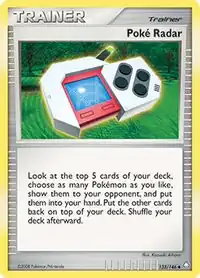
The Poké Radar was introduced as a Trainer card in the Pokémon Trading Card Game during the English Diamond & Pearl Series (the Japanese DP Era). First released in the Cry from the Mysterious expansion, the Poké Radar later debuted in English in the Legends Awakened expansion, with both prints featuring an illustration by Kazuaki Aihara. This Trainer card allows the player to look at the top five cards of their deck and keep any Pokémon after showing them to their opponent; the remaining cards are then shuffled back into the deck.
Merchandise
A toy designed after the Poké Radar has been released as part of the Pokémon Trainer's Kit Diamond & Pearl 2 toy line by Bandai in December 2007.







 Pokémon Trainer's Kit Diamond & Pearl 2
