Moodiness: What is moodiness, what are its consequences, and how can it be managed?
Overview
Figure 1. Sculpture of a crying man.
Case study: Penny's journey through emotional turbulence
Client Profile:
Name: Penny
Age: 19
Presenting Concerns: Mood swings, family conflict, interpersonal tension
Background
Penny (19): Nursing student at the University of Canberra, about to start her first placement. She experiences growing anxiety about her emotional reactivity in stressful environments. She reports feeling “on edge most of the time” and reacts intensely over minor triggers, but struggles to understand why. Attempts to express her concerns to her mother often result in major arguments.
History of moodiness: Penny’s mother first noticed abnormal mood swings around age 13. Initially attributed to typical teenage behaviour, her reactions escalated over time, sometimes resulting in screaming matches and extended silent treatment.
Family dynamics:
Mother: Concerned but often responds defensively or critically, escalating conflicts.
Father: Largely absent due to work commitments, limiting support and buffering within the family.
Brother (Noah, 13): Frequently acts as bystander or mediator in tense situations; has developed panic attacks and heightened sensitivity to arguing due to exposure to family conflict.
Overall dynamic: Chronic conflict between Penny and her mother has created a stressful home environment, impacting Penny’s emotional regulation, contributing to family tension, and affecting her brother’s mental health.
Psychological and Emotional Context
Penny’s moodiness and conflictual relationships are explored through several psychological principles:
Adolescent Emotional Development: Penny’s emotional intensity began in early adolescence, a time when the brain experiences significant changes in areas that control emotion regulation such as the amygdala and prefrontal cortex. During this period, emotional responses are intensified and simultaneously, regulatory systems are still being developed. This can lead to mood swings and impulsivity.
Family Systems Theory:Figure 2. Cycle of conflict.Within the family system, Penny's emotional dysregulation has had a ripple effect. Her mother responds to Penny’s moodiness with criticism, potentially reinforcing a cycle of negative communication. Meanwhile, Noah, at a formative age, is exposed to a home environment where emotional conflict is frequent, which could impact his own emotional development and sense of safety.
Current Impact
Academic Stress: Penny reports difficulty concentrating and managing stress related to her studies.
Emotional Distress: Feelings of guilt, confusion, and isolation are common, particularly after arguments.
Sibling Relationship: Noah has become quieter and more avoidant, often retreating to his room during family conflicts. Penny feels responsible but unsure how to change things.
Parental Strain: Her mother feels “helpless” and “burned out,” unsure how to support Penny without escalating tension.
Moodiness is defined as the way one feels at a particular time.
Psychological science can help determine common scenarios and variables that lead to moodiness.
Once these elements can be identified, science can be used to help people manage moodiness using evidence based-practices.
People with mood disorders can use these practices to improve their day to day lives and improve functioning overall.
Focus questions
What is moodiness?
What are its consequences?
How can it be managed?
What are the implications of current strategies?
What does the current literature propose as solutions?
What is moodiness?
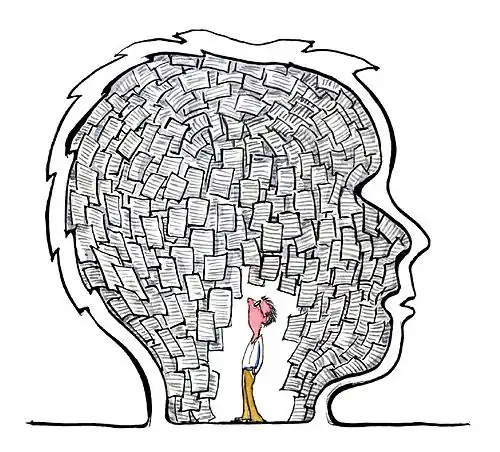
Figure 3. What is going on in the mind to cause different moods?
Moodiness...
Have you ever felt moody for no reason?
Or have you ever been in a mood for a long period but just cannot figure out why?
The study of moodiness from the psychological science perspective incorporates the psychosocial and biological factors that contribute to mood and the prolonging of negative mood. Implementing science and strategies based on psychological science can help people struggling with mood disorders to improve functioning.
The social understanding of mood is an interpretation, response and influence of emotions (Clark et al., 2018). A social perspective looks at the interaction of a person's mood in the context of their social and physical environment (Wuff, 2024). It is symbiotic in nature, as the external factor impacts a person's emotions and their mood, as does a person's mood having the ability to inform and impact the environment around them (Clark et al., 2018). Another component of the social perspective is that mood is communicative and can act as a signal or a behavioural response (Lee and An, 2023). Mood can be expressed not only verbally, but via social cues as well such as facial expressions, tone of voice and body language. These expressions can signal moods and in turn can impact the social environment.
The biological perspective looks to the physiological and neurological factors that contribute to mood (Price, and Drevets , 2010). These could be an interaction of chemicals in the brain or even the structural make up of the brain (Das, 2018). Neurotransmitters are chemical messengers that pass information between neurons, and there are several neurotransmitters that play a part in moods and mood regulation (Electricwala, 2024). Serotonin functions to regulate mood broadly, as well as sleep and appetite (Electricwala, 2024). Low levels of serotonin are correlated with depressive mood disorders and irritability (Electricwala, 2024). Dopamine is key in feelings of reward, motivation and pleasure, and as such low levels of dopamine are associated with anhedonia (the loss of pleasure) and low mood (Electricwala, 2024). Finally, another key neurotransmitter is norepinephrine which is involved in alertness and arousal (Electricwala, 2024). Dysregulation of this can lead to fatigue and depressed moods, whereas high levels contribute to anxiety or agitation (Electricwala, 2024).
The structures of the brain that contribute to moodiness include the prefrontal cortex, amygdala, hippocampus and anterior cingulate cortex (Mendoza, 2024).Figure 4. Diagram of Important Brain Structures that Contribute to Mood from the Biological Perspective.
There are also hormonal components of mood, including the interaction of cortisol with the brain (Berga and Smith, 2012). Cortisol is largely known as the ‘stress hormone’ which can result in irritability, anxiety and ultimately low mood if prolonged production (Berga and Smith, 2012). Another is thyroid hormones which when unbalanced can lead to depression or irritability (Berga and Smith, 2012).
Further, research demonstrates that genetic factors can also influence the biology behind mood (Naoi et al., 2025). Findings determine specific genes can influence neurotransmitter systems and can increase susceptibility to mood disorders (Chen et al., 2024). This has been demonstrated in twin and family studies which have found that genetics have an approximately 30-40% contribution to the risk of major depressive disorder (Gordovez and McMahon, 2020). For bipolar disorders, the genetic component accounts for approximately 60-80% (Gordovez and McMahon, 2020).
Finally, the biological perspective has two prominent theories at the forefront of research in the area. These are the Monoamine hypothesis which stipulates there is a linkage to depression with serotonin, norepinephrine or dopamine deficiencies (Brown et al., 2023). The other theory is the neuroplasticity hypothesis which suggests chronic stress or depression can lead to reduced neural connectivity and the brain’s ability to learn the way to adapt, thus impacting mood regulation (Price and Duman, 2020).
The psychological perspective of mood combines both the social and biological perspectives, and employs the nature versus nurture debate to determine what causes moodiness and mood regulation (Wood and Coan, 2023). This perspective also takes into account cognitive processes and emphasises the roles of thoughts and their influence on mood (Forgas, 2017). Cognitive distortions are thought to be heavily involved in mood swings. These distortions can look like mind sets that are ‘all-or-nothing’, or resort to catastrophising (Friedman, 2023).
Consequences of moodiness can lead to interpersonal tensions and conflict amongst a person and the people close to them. It can result in irritability, miscommunication and provocation. This can ultimately lead to conflict amongst families, friendships and relationships, and also professional relationships in the workplace. There may be a sense of distrust and isolation, where others perceive the moodiness as unpredictable, and thus the person may be considered unreliable and unstable. A cycle of conflict or escalation may ensue, whereby a person’s moodiness can be triggering for others and increase hostility. Ultimately, this may lead to social isolation, in an effort to avoid confrontation, parties of the other side may begin to withdraw from the relationship to avoid further conflict.
Further consequences include mental health conditions. As historically accepted, mood may be a result of underlying mental health conditions, such as depressive disorders, as well as anxiety and bipolar disorders, and personality disorders (Costello et al., 2002). As discussed, the biological perspective stipulates that chronic low mood and stress can be a leading cause of mental health conditions, persistent low mood can lead to depressive disorders and moodiness with chronic worry and stress can evolve into anxiety disorders. Moodiness that is persistent and severe may be an indication of an underlying condition, such as bipolar disorder whereby there are high and low periods, often marking unconventional behaviours (Hurley et al., 2022).
c. Impact on individual and collective functioning - potential harm.
The impact of mood on an individual’s functioning can mean that they face cognitive difficulties, every day tasks can seem overwhelming, they may face difficulty with concentration and decision-making, often appearing flighty in their thinking (Forgas, 2017). Moodiness may impact their ability to work productively in work or in school, which may impact their performance, and could result in a loss of achievements integral to their work. This is a cycle that can disrupt their ability to care for themselves with day-to-day living, and ultimately their moodiness may mean they lose their social support network (Mendoza, 2024).
Impacts on collective functioning could mean their social environments are impacted such as their family unit, social group of friends and also their workplace circle (Eisenberg et al., 1997). This could impact each group significantly, and conflict may be the end result. Group harmony may not be able to withstand the moodiness, and may lead to relationship breakdowns (Andrewes and Jenkins, 2019). Ultimately, the moodiness of a person may result in their social isolation.
How can it be managed?
a. Micro level management.
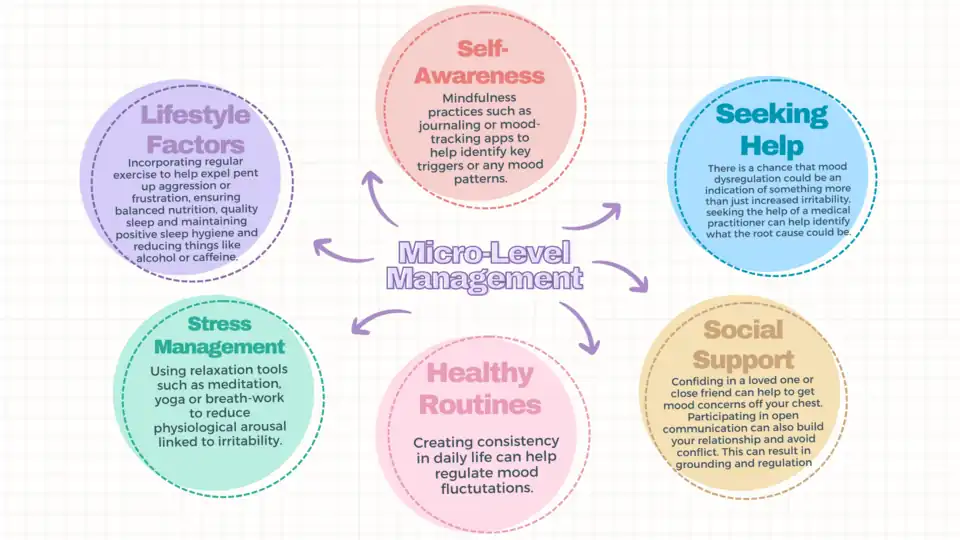
There are many micro-level strategies that a person experiencing moodiness can incorporate to help manage irregular mood swings. Figure 4. A Diagram of Micro-Level Management Tools to Manage Stress.
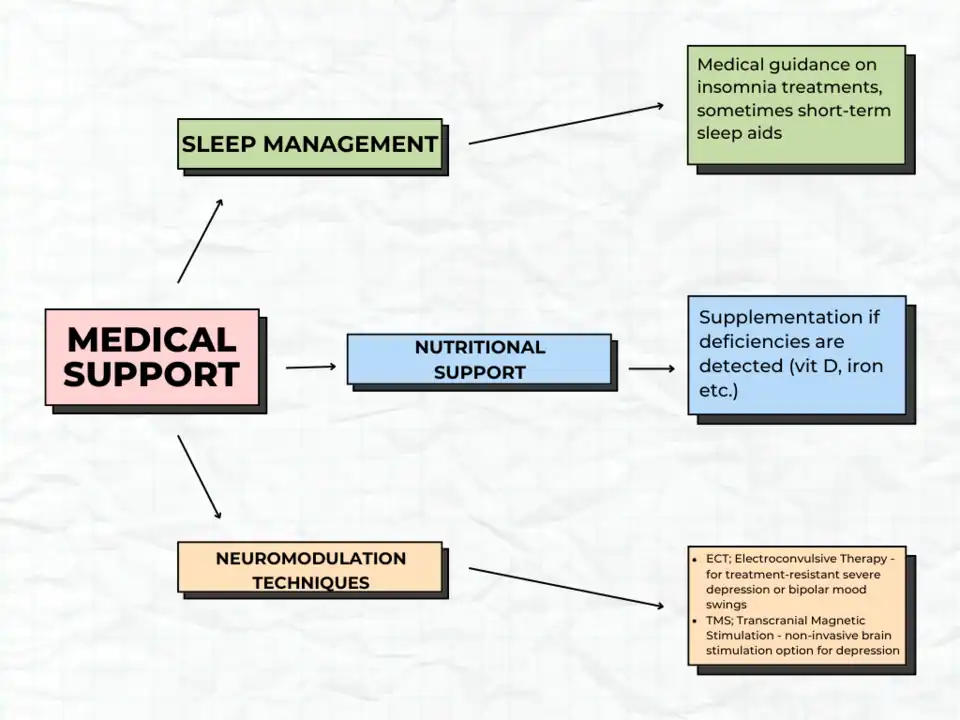
There is a strong correlation with moodiness as a symptom of an underlying mental health condition (Wang and Cao, 2024). Seeking medical intervention can be the first step in finding which management option is the most suitable (Tate, 2020). Medical practitioners can help to instigate a process by which further investigation or therapies can be put in place to treat moodiness. Further, moodiness can be a symptom of other underlying medical conditions, such as thyroid disorders, vitamin D deficiencies, hormonal issues or neurological issues (Bernardes et al., 2024). By implementing this intervention, the root cause could be something that is simple to treat. There are further screening tools that can be used to determine if the moodiness is a result of a mental health condition (Umass Chan Medical School, 2022). Medications can also help to manage moodiness, such as anti-depressants or anti-anxiety medication to help improve functioning, and counter overbearing moodiness . Further medical support can look like help with sleep management, nutritional support or neuromodulation techniques (ECT or TMS) (Lucido and Dunlop, 2025).Figure 6. Medical Interventions to Aid in Managing Moodiness.
c. Therapeutic based intervention.
Further therapy based interventions are also available. Cognitive Behavioural Therapy is a common approach to target the reframing of automatic/learned cognitive thinking patterns (Tolin, 2024). Psychologists can help develop new conscious thinking tools to disrupt negative self-talk which has proven to improve affect (Tolin, 2024). Mood can be positively impacted by this because it encourages realistic reframing and behavioural activation Awadalla and Glazebrook, 2025). Emotion-focused and insight-based approaches can also be beneficial as it can help find tools to regulate strong emotions rather than restoring to suppression of avoidance of such emotions Shah et al., 2017). Interpersonal and relational therapies can help improve relationships that have been impacted deeply by the onset of moodiness, and having a dedicated time to talk through emotions and the implications of mood swings can help build stronger connections and empathy (Lucido and Dunlop, 2025).
What does the current literature propose as solutions?
a. Prevention and early intervention.
Often moodiness can be put down to increased stress in work or personal life, but when it starts to impact daily life, relationships and work, people are often alarmed. Prevention and early intervention are ideal strategies where possible (Jirakran et al., 2025). This looks like education and psychoeducation around emotional regulation, stress management and healthy ways to cope with mood swings (Jirakran et al., 2025). Literature on the topic also urges that having an understanding of what is normal in a person’s affect is important in understanding when moodiness is a regular response or if something deeper is at play (Berenbaum and Oltmanns, 2003). Other beneficial interventions include skill building programs such as social-emotional learning in schools that spreads awareness and helps implement mindfulness, emotional regulation and problem solving from a young age (Do and Giang, 2024). Finally, the maintenance of a well-balanced lifestyle can help prevent mood-related problems (Shah et al., 2017). This can look like consistent sleep, balanced nutrition, exercise and stress reduction (Shah et al., 2017).
b. Addressing vulnerable populations and demographics.
The literature also emphasises that interventions should be tailored to those at the highest risk. Adolescents and young adults can be specifically prone to mood swings as a result of physiological changes such as puberty where hormonal, social and identity-related changes are prevalent (Awadalla et al., 2025). Mental health awareness and management programs in schools are found to be particularly effective in conjunction with strong social support from friends, teachers and family Awadalla et al., 2025).
For individuals with a history of mental health conditions, they have a vulnerability to mood regulation struggles (Jirakran et al., 2025). The literature recommends ongoing monitoring of symptoms and engaging in ongoing therapeutic support to help manage the conditions (Jirakran et al., 2025).
Socioeconomically disadvantaged groups are also susceptible to mood challenges, and accessibility to help can be a barrier (Jespersen et al., 2025). People in this category often face stress such as financial insecurity, poor housing and discrimination (Jespersen et al., 2025). These elements can have an impact on mood and create instability. Community based programs and access to affordable mental health services are paramount interventions that often need to be implemented with the help of governmental or institutional agencies (Jespersen et al., 2025).
c. Enhancement of understanding of psychological components.
The literature also details that research and education of the psychological mechanism behind mood is paramount (Sanchez-Sanchez et al., 2025). Emotional regulation research that enhances understanding around cognition and emotional reactivity can help inform coping strategies and guide therapy and educational programs that will counter issues of ambiguity in the area (Sanchez-Sanchez et al., 2025). The integration of biological research with mood helps to provide a deep understanding of the ‘why’ (Sanchez-Sanchez et al., 2025). Research shows that often understanding the scientific and biological reasoning for mental health can be an enlightening insight for those struggling, and can prevent further negative self talk, preventing poor cognitive patterns (Wang and Cao, 2024).
What are the different kinds of mood?
Solution
Joyful, Sad, Anxious, Irritable, Guilty, Relaxed, Excited, Boring, Creative.
Anders Jespersen, Rebecca A Madden, Heather C Whalley, Rebecca M Reynolds, Stephen M Lawrie, Andrew M McIntosh, Matthew H Iveson, Socioeconomic status and depression—a systematic review, Epidemiologic Reviews, Volume 47, Issue 1, 2025, mxaf011, https://doi.org/10.1093/epirev/mxaf011
Andrewes, D.G., Jenkins, L.M. The Role of the Amygdala and the Ventromedial Prefrontal Cortex in Emotional Regulation: Implications for Post-traumatic Stress Disorder. Neuropsychol Rev 29, 220–243 (2019). https://doi.org/10.1007/s11065-019-09398-4
Awadalla, S., Davies, E. B., & Glazebrook, C. (2025). A pre–post study evaluating an online CBT-based intervention to improve academic performance in students with low mood. Humanities and Social Sciences Communications, 12(1), 1-9.
Berga, S. L., & Smith, Y. R. (2012). Hormones, Mood and Affect. In Handbook of Neuroendocrinology (pp. 551-571). Academic Press.
Bernardes, B. M., de Oliveira Borba, M. C., Moreira, S., Sartori, C. S., da Silva Júnior, I. F., de Souza, M. T. L., ... & Berquo, J. M. (2024). Relationship between mood disorders and thyroid changes. Brazilian Journal of Implantology and Health Sciences, 6(2), 2241–2256.
Bowen, M. (1974). Alcoholism as viewed through family systems theory and family psychotherapy. Annals of the New York Academy of Sciences, 238, [page numbers if known]. https://doi.org/10.1111/j.1749-6632.1974.tb40288.x
Brown, S. L., Bleich, A., & Van Praag, H. M. (2023). The monoamine hypothesis of depression: The case for serotonin. In Role of serotonin in psychiatric disorders (pp. 91-128). Routledge.
Cambellis, J. E., Watson, S., & Friston, K. J. (2018, February 26). What is mood? A computational perspective. Psychological Medicine. https://doi.org/10.1017/S0033291718000371
Chen, M., Wang, Z., Xu, H., Li, W., Teng, P., & Ma, L. (2024). Genetics of mood instability and risk of cardiovascular diseases: a univariable and multivariable Mendelian randomization study. Journal of Affective Disorders, 347, 406-413.
Costello, E. J., Pine, D. S., Hammen, C., March, J. S., Plotsky, P. M., Weissman, M. M., ... & Leckman, J. F. (2002). Development and natural history of mood disorders. Biological psychiatry, 52(6), 529-542.
Do, T.-T. and Giang, T.-V. (2024). Mindfulness-based social-emotional learning program: Strengths and limitations in Vietnamese school-based mindfulness practice. Heliyon, [online] 10(12), p.e32977. doi:https://doi.org/10.1016/j.heliyon.2024.e32977.
Do, T.-T., & Giang, T.-V. (2024). Mindfulness-based social-emotional learning program: Strengths and limitations in Vietnamese school-based mindfulness practice. Heliyon, 10(12), e32977. https://doi.org/10.1016/j.heliyon.2024.e32977
Eisenberg, N., Guthrie, I. K., Fabes, R. A., Reiser, M., Murphy, B. C., Holgren, R., Maszk, P., & Losoya, S. (1997). The relations of regulation and emotionality to resiliency and competent social functioning in elementary school children. Child Development, 68(2), 295–311. https://doi.org/10.2307/1131851
Electricwala, M. (2024). Neurotransmitters: Roles, Functions, and Impact on Mental Health. Mave Health. Retrieved September, 18, 2024.
Forgas, J. P. (2017). Mood effects on cognition: Affective influences on the content and process of information processing and behavior. Emotions and affect in human factors and human-computer interaction, 89-122.
Friedman, H. H. (2023). The thinking traps that ruin your happiness: How to recognize, challenge, and overcome cognitive distortions. Challenge, and Overcome Cognitive Distortions (December 20, 2023).
Gordovez, F. J. A., & McMahon, F. J. (2020). The genetics of bipolar disorder. Molecular psychiatry, 25(3), 544-559.
Hurley, A. D., Levitas, A. S., & Bertelli, M. O. (2022). Mood disorders. In Textbook of Psychiatry for Intellectual Disability and Autism Spectrum Disorder (pp. 557-581). Cham: Springer International Publishing.
Jespersen, A., Madden, R. A., Whalley, H. C., Reynolds, R. M., Lawrie, S. M., McIntosh, A. M., & Iveson, M. H. (2025). Socioeconomic Status and Depression - A Systematic Review. Epidemiologic Reviews, mxaf011. https://doi.org/10.1093/epirev/mxaf011
Jirakran, K., Almulla, A. F., Jaipinta, T., Vasupanrajit, A., Jansem, P., Tunvirachaisakul, C., ... & Maes, M. (2025). Increased atherogenicity in mood disorders: a systematic review, meta-analysis and meta-regression. Neuroscience & Biobehavioral Reviews, 106005.
Krishanu Kumar Das. A Study on Evolutionary Perspectives of ‘Emotions’ and ‘Mood’ on Biological Evolutionary Platform. Psychology and Behavioral Sciences. Vol. 7, No. 5, 2018, pp. 89-96. doi: 10.11648/j.pbs.20180705.12
Lucido, M. J., & Dunlop, B. W. (2025). Emerging Medications for Treatment-Resistant Depression: A Review with Perspective on Mechanisms and Challenges. Brain Sciences, 15(2), 161–161. https://doi.org/10.3390/brainsci15020161
Mendoza, J. (2024). Circadian disruptions and brain clock dysregulation in mood disorders. Nature Mental Health, 2(7), 749-763.
Naoi, M., Maruyama, W., Shamoto-Nagai, M., & Riederer, P. (2025). Type A monoamine oxidase; its unique role in mood, behavior and neurodegeneration. Journal of Neural Transmission, 132(3), 387-406.
Price, R. B., & Duman, R. (2020). Neuroplasticity in cognitive and psychological mechanisms of depression: an integrative model. Molecular psychiatry, 25(3), 530-543.
Sanchez-Sanchez, H., Konstanze Schoeps, & Inmaculada Montoya-Castilla. (2025). Emotion Regulation Strategies and Psychological Well-Being in Emerging Adulthood: Mediating Role of Optimism and Self-Esteem in a University Student Sample. Behavioral Sciences, 15(7), 929–929. https://doi.org/10.3390/bs15070929
Shah, A. K., Becicka, R., Talen, M. R., Edberg, D., & Namboodiri, S. (2017). Integrative medicine and mood, emotions and mental health. Primary Care: Clinics in Office Practice, 44(2), 281-304.
Tate, A. (2020). Matter over mind: how mental health symptom presentations shape diagnostic outcomes. Health, 24(6), 755-772.
Wang, Y., Li, Z., & Cao, X. (2024). Investigating the network structure and causal relationships among bridge symptoms of comorbid depression and anxiety: A Bayesian network analysis. Journal of Clinical Psychology, 80(6), 1271–1285. https://doi.org/10.1002/jclp.23663
Wood, A., & Coan, J. A. (2023). Beyond nature versus nurture: The emergence of emotion. Affective Science, 4(3), 443-452.
Wulff, H. (2024). Introduction The Cultural Study of Mood and Meaning. In The Emotions (pp. 1-16). Routledge.
Zahn Waxler, C., Klimes Dougan, B., & Slattery, M. J. (2000). Internalizing problems of childhood and adolescence: Prospects, pitfalls, and progress in understanding the development of anxiety and depression. Development and Psychopathology, 12(3), 443–466. https://doi.org/10.1017/S0954579400003102