Tochio's Computation on the Soroban/Addition
ADDITION.
TABLE.
| 1 plus 9 are 10 | 6 plus 4 are 10 |
| 2 plus„ 8 are„ 10 | 7 plus„ 3 are„ 10 |
| 3 plus„ 7 are„ 10 | 8 plus„ 2 are„ 10 |
| 4 plus„ 6 are„ 10 | 9 plus„ 1 are„ 10 |
| 5 plus„ 5 are„ 10 |
Rule 1.—Addition.—Add from left to right, commencing from the highest column.
Note.—Observe that the addition and substraction on Soroban are performed in a contrary manner to the Occidental method.
What is the sum of 357 and 823?
Fig. 4.
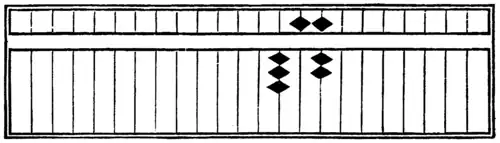
Place 357 as in the above figure. First of all, add 800. 8+2 are 10; therefore, take 2 off the hundreds column and insert 1 in the preceding column. Next is to add 20. Increase the tens column by 2, by raising 2 pieces to the beam. Now to add 3. 3 plus 7 are 10; therefore clear 7 from the last column and carry 1 forward into the preceding column. 1180 is the required sum.
Whenever a column becomes full, that being 10, always carry 1 forward into the preceding column; if lower column is full, clear the pieces and pull down the 5-piece to the beam.
Give sum of 9731 and 269.
Fig. 5.

The figure 5 shows the addition at the close, the black pieces representing 9731 and white pieces 269.
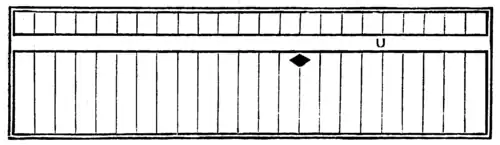
The last column being full, the pieces are cleared (in such case, do not fill in 9 as in the figure, but clear 1 and carry 1 forward to the higher column, saying 9 plus 1 are 10) and I is carried to the preceding column which is now full. Clear the tens column and carry 1 into the hundreds column. It is again full and 1 is carried forward to the column ahead. The thousands column being now also full, the preceding column gets one. The Soroban stands lastly as below, showing the sum to be 10,000.
Fig. 6.
Note.—Addition of numbers of different denominations may be effected by allowing so many columns to each denomination as the largest number will require, and as soon as figures in any denomination exceed the equivalent of the next higher unit, by taking off the equivalent and carrying 1 forward to the next higher denomination.
Thus:—
Fig. 7.
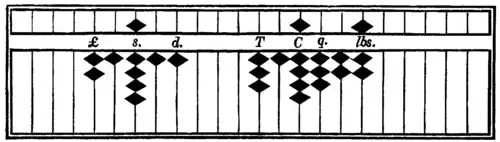
However, when many items of numbers of different denominations are added up quickly, it is better to allow to each denomination so many columns as the ultimate sum would probably occupy and forwarding numbers to higher denominations only at the close of addition.
Remark.—In Japanese offices where hands are many, two men operate on Soroban for addition or substraction and one man calls out amounts. And, if the 2 sums agree, it is taken as correct; if only one operator is available, the sum is verified by another operation.
In this connection it may be stated that, in calling out numbers, "teens" are ambiguous to "tys" (sixteen, seventeen, etc.—sixty, seventy, etc.) and perhaps words like "tenty" or "decaty" may be usefully substituted.