The New International Encyclopædia/Italy
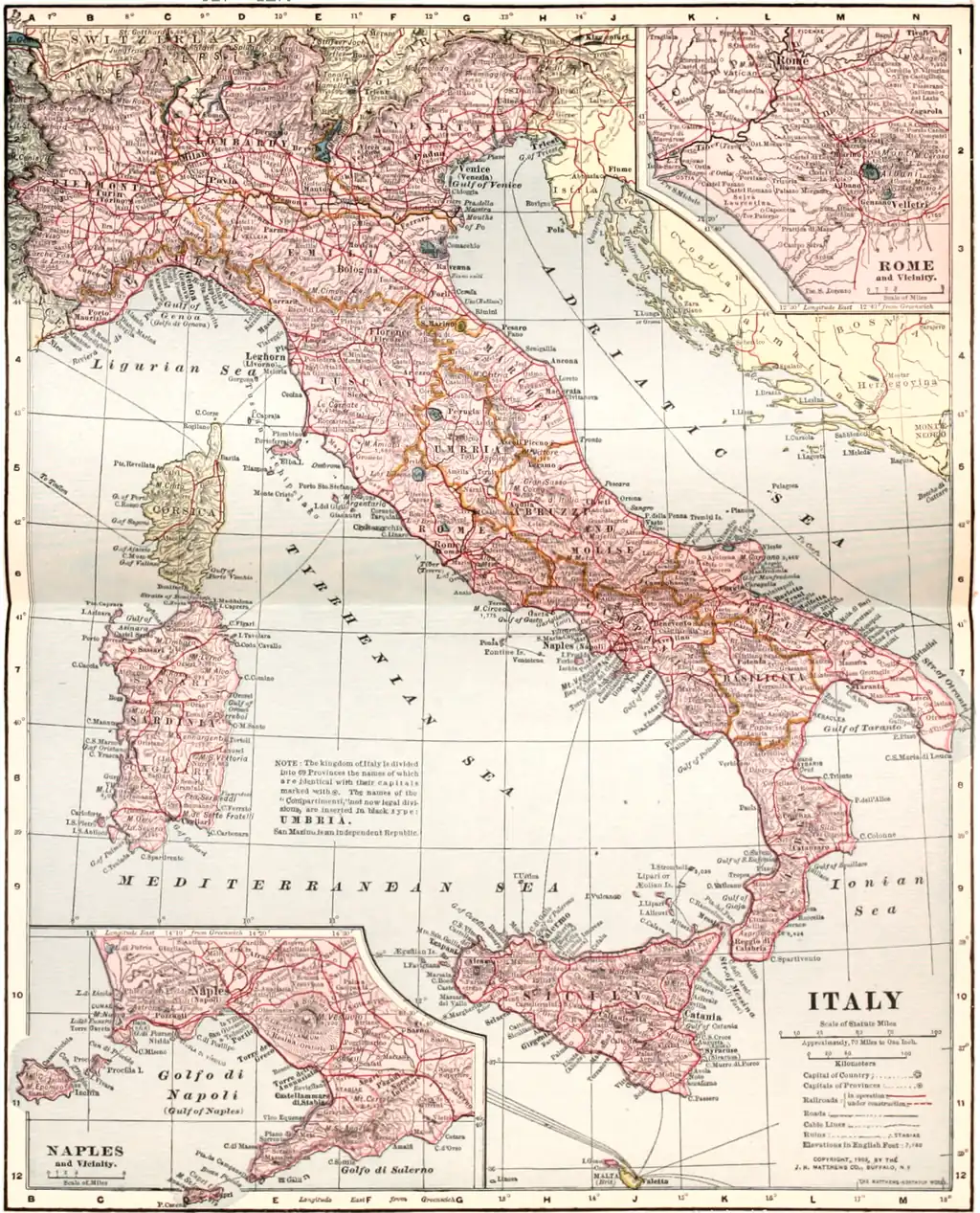
ITALY. The central of the three great peninsulas of Southern Europe. It stretches out in a southeast direction, and is bounded on the north by Switzerland and Austria-Hungary; on the east by Austria-Hungary, the Adriatic, and the Ionian Sea; and on the southwest and west by the Mediterranean and France. It is separated from the Balkan Peninsula by the Strait of Otranto, 47 miles in width, and is nearly walled off from the great body of the Continent by the lofty ranges of the Alps. With its continuation, the island of Sicily, it nearly reaches across the Mediterranean, and is thus exceptionally favored with convenient commercial routes in all directions. Its position also especially adapts Italy for a large sea trade, because it is a part of the shortest route from West and Central Europe to Oriental countries. Though Italy is separated from the northern lands by the Alps, they are no longer a barrier to Italy’s commerce, for several lines of railroad cross the mountains. Extending from northwest to southeast about 700 miles, and with an average breadth, except in the extreme north, of 100 miles, the mainland has an area of 91,000 square miles; to this Sicily, Sardinia, Elba, and smaller islands add 19,684 squares miles, making the total area of the Kingdom 110,684 square miles. The mainland is about twice as large as Pennsylvania or New York, and extends from the parallel of 38° north latitude to that of 46° 40′, and between the meridians of 6° 30′ and 18° 30′ east longitude.
Topography. The coast, over 4000 miles in length (inclusive of the islands), is easily accessible from every part of the country. No settlement is remote from salt water, four-fifths of the Kingdom being within 62 miles of the sea. In the north of the Adriatic the coast is low and sandy, bordered by shallow waters, and, except at Venice, not easily accessible to large shipping. Farther south, near Rimini, spurs from the Apennines reach the shore, which becomes high and rocky. The south and west coasts are generally high, rocky, and picturesque, with many bold promontories. The middle of the west coast, however, has three stretches of low and marshy land, known as the Maremma, the Campagna, and the Pontine marshes. The west coast is varied by bays, gulfs, and other openings, and is therefore most favorable for commerce. In the northwest is the Gulf of Genoa, on which the wealthy city of Genoa stands. About the middle is the deep embayment with the fortress port of Gaeta. Next is the Bay of Naples, celebrated for its beauty. Beyond this is the Gulf of Salerno, at the head of which stands the port of Salerno. The southeastern end of the Peninsula is deeply indented by the Gulf of Taranto, which cuts off the so-called heel of Italy (ancient Calabria) from the ‘toe’ (modern Calabria). The population is dense on all coasts where fever does not prevail, about 17 per cent. of the inhabitants of Italy living within three miles of the sea.
The Kingdom of Italy falls geographically into two parts, differing from each other in surface features and climate, and, as a consequence, in productions. One part to the north is continental; the other to the south consists of a peninsula and various islands. The northern portion contains the great plain of Lombardy, the Valley of the Po, bordered on the west and north by the Alps. The Alpine region in the extreme northwest of the Kingdom is known as Piedmont. The Peninsula is almost completely filled by the Apennines, which stretch through Central and Southern Italy and are continued through Sicily.
The Alps, beginning at the Gulf of Genoa, extend first to the west, then to the north, and finally to the east, towering in lofty summits covered with snow-fields. Their slopes are deeply scored by valleys, and they present a very abrupt face toward the plain of the Po. The rainfall on them is, as a result, rapidly transferred to the plain, making protective works along the river-banks necessary in order to restrain the periodical floods.
The Northern Apennines, which touch the Ligurian Alps, curve round the Gulf of Genoa and extend to the source of the Tiber. They do not rise above 7220 feet. The Central Apennines, beginning at the source of the Tiber, soon divide into several chains, forming the rugged mountain district of the Abruzzi, on the eastern verge of which is the Gran Sasso (9580 feet), the highest peak of the Apennines. The Southern Apennines stretch to the southeast from the Abruzzi to the coast of the Gulf of Taranto, where they assume a southerly direction, with summits rising to a height of more than 7000 feet. The rugged and unfertile Apennines form the watershed of the Peninsula; they are bordered, especially on the western side, by lower and more productive mountain districts that are grouped under the name of the sub-Apennine region. A number of passes through the Apennines are utilized by the highways across the Peninsula. The Italian Peninsula contains the only active volcano on the Continent of Europe, Vesuvius.
The mountain regions of Italy, with their ruins, cloisters, storied castles, towered cities, the quietude of their rural scenes, and their aspects picturesque or grand, are among the great charms that draw tourists to Italy. The beauty of the country is enhanced by the singular clearness of the air, which causes the lines of tower and church and castle to stand out with clear-cut perfection, and makes mountains that are miles away appear to be almost within touch.
The Italian islands are also mountainous. Sicily, nearly filled with the continuation of the Apennines, has the loftiest volcano in Europe (Mount Etna, about 10,800 feet). It has not, however, figured so prominently in the history of volcanoes as Vesuvius, near Naples. The mountains of fertile but unhealthful and neglected Sardinia rise only a little over 5000 feet in height. The Lipari Islands are wholly volcanic in character.
Only about one-third of the surface is made up of plains, most of it being the great Plain of Lombardy, or the Plain of the Po. This plain, about 37,000 square miles in area, is encircled by a steep mountain wall in the form of an arch. The largest and richest farming area, and the greatest industrial development of Italy, belong to this low, almost flat plain. It is watered by the rivers of the Po system, which are fed by many Alpine and Apennine streams, with which the cereal and other crops are irrigated. The plain was at one time a bay of the Adriatic Sea, and was formed of the alluvial deposits of streams from the Alps and Apennines. It is steadily encroaching on the sea, because the Po for centuries has been extending its delta into the Adriatic. During six centuries the Po Delta has increased 198 square miles in area. Recent surveys show that the increase is actively maintained at the present day. According to the calculations of Professor Marinelli, it will take over one hundred centuries at the present rate of increase for the Po to fill up the whole of the Northern Adriatic above latitude 40° 45′ N. The former port of Adria, which gave its name to the Adriatic, now stands about 15 miles inland. The Lombard Plain has a more dense population, and far more active manufacturing and business interests than the Peninsula. Among the small plains of the Peninsula are those of Tuscany and Apulia, the fertile plain to the north of Naples (the Campania of the ancients), that bordering
|
| COPYRIGHT, 1903, BY DODD, MEAD & COMPANY. |
Hydrography. Italy has many streams, although it has only one great river, the Po. The most important streams, the Po and the Adige, flow into the Adriatic Sea. The Po is fed on one side by the snows of the Alps, on the other by the heavy rains of the Apennines, and drains an area of 27,000 square miles, of which nearly 11,000 are level, and, indeed, almost flat. Its course marks the line at which the sediment and débris from the Alps meet the sediment and débris from the Apennines. The Po is navigable to Turin, and with its tributaries affords about 600 miles of navigation. The Adige enters Italy from Tyrol, and flows eastward to the Adriatic. The beds of both these rivers are constantly being elevated by the boulders and alluvial deposits brought down from the mountains. The rivers of the Peninsula are of little importance for navigation or industry. The beds of most of them are dry in summer, so that they cannot be relied upon for water-power. The most important among them are the Arno, which rises in the Apennines and flows west past Florence and Pisa through a lovely and well-cultivated valley. It has a short course of only 150 miles. The Tiber rises not far from the sources of the Arno, the two rivers being connected by a canal through the tributary called the Chiana, whose waters flow partly into the Arno and partly into the Tiber. The canal system is thoroughly developed in the basin of the Po, and is utilized not only for transportation, but also for the irrigation of hay and rice, so that the farmer in the great plain is almost independent of rain. There are many lakes where the mountains merge into the great plain; also a considerable number in the Peninsula, some of which are crater lakes. The chief lakes of Northern Italy are, in the order of their size, Garda, Maggiore, and Como. Each of them sends down a large tributary to the Po. Lago di Garda covers an area of 140 square miles, and is very deep. Lago Maggiore is longer than Como, but not so large as Garda; a part of this lake is in Switzerland. Lago di Como is one of the loveliest lakes in the world. Other considerable lakes are Lugano and Iseo.
Climate. Italy may be divided into four climatic regions—northern, eastern, western, and southern. The first, coinciding with the valley of the Po, has a warm summer and a large daily range of temperature. The greatest extremes of temperature are in the Po basin; but even here, except in Piedmont, the mean winter temperature does not descend below 35° F. Peninsular Italy is divided climatically into the eastern and western regions. The extremes of temperature diminish toward the south; on the eastern slope of the Apennines the mean annual temperature is about 57°, while the western slope is a trifle warmer. South Italy, Sicily. and Sardinia form the last climatic division, with a mean annual temperature varying from 61° to 64° F., the difference between summer and winter being only 25°. The mean summer temperature at any station in the whole Kingdom does not exceed 80° F., and, except in the elevated valleys of Piedmont, it is nowhere lower than 70°. As in all the Mediterranean countries, the largest rainfall occurs in the fall and winter months, after the growing season, so that irrigation is required in nearly all parts of the Kingdom. The soils of Italy are excellent, particularly in the Lombard Plain, which is among the richest agricultural lands in the world. Many once fertile parts of the Apennines, however, have been denuded of their soil. The greatest climatic drawback of Italy is found in the swampy lands of the lower Po, the Maremma, the Campagna, the Pontine marshes, and some other regions where intermittent malarial fevers prevail during the summer months. Only six of the provinces, including Genoa and Florence, are wholly free from malaria. Large sums of money have been spent in attempts to overcome this evil by means of drainage canals and pumping-machines, and recently by draining the breeding-places of the mosquito. The extensive planting of the eucalyptus is believed also to have had a favorable effect upon the salubrity of these malarial regions.
Flora. The flora of the central and southern lowlands is typical of the Mediterranean countries, with the olive as the most characteristic tree. The great extent of the mountains and highlands, however, causes the myrtle, olive, and other evergreens to be confined to the coasts, especially in North Italy, where the olive is excluded from the plain by the colder winter weather. In the northern plain are maize, wheat, vines, and mulberries. Rice is grown on the irrigated fields near the Po. The flora of the Apennines is very much like that of Central Europe. The shores of the Tyrrhenian Sea present almost a continuous growth of orange, olive, and lemon trees. In the extreme south the vegetation is subtropical; the sugar-cane, the Indian fig, and the date-palm are found. Forests have almost everywhere been destroyed, but the chestnut-tree clothes the sides both of the Alps and the Apennines, the nut in some districts supplying the chief tood of the inhabitants.
Fauna. Italy is very low in the scale of European countries with regard to its fauna. The bear, genet, weasel, and some rodents are almost the only conspicuous examples in the way of mammals. The Alps and Apennines, and the swampy maremme of Rome and Tuscany, afford some refuge for wild life; but otherwise almost everything above an insect is killed for food or wantonly by the people. This has been the rule so long that the country is nearly bare even of small birds. Upon certain great estates a few animals, such as the native fallow deer, are preserved. Were not Italy, by its extension toward the south, a highway of migration to and from Africa for the birds, their absence would be still more complete. The autumn flight of quails from Tunis is a period of feasting. The sea life along the shores of the southern part is wonderfully varied and plentiful.
Geology. In its geological structure Italy represents a portion of the great system of mountain folds which extend across the Eurasian continent, and which are here diverted from the normal east and west direction to north and south. There is reason for believing that the Peninsula once formed a continuous land bridge across the Mediterranean, thus uniting the ranges of the Alps with the Atlas. The uplifting of the Apennines took place at a comparatively recent geological period; Mesozoic and Tertiary strata including limestones, marls, and sandstones are the predominant formations. The islands off the coast of Tuscany, together with Corsica, Sardinia, and Northeastern Sicily, represent a much older land mass (Tyrrhenia), which, previous to the Tertiary period, occupied a large part of the depression now filled by the Tyrrhenian Sea. The great crustal movements that have determined the present configuration of Italy were accompanied by volcanic eruptions on an enormous scale. Evidences of these ancient outbursts are found in the Euganean and Brescian hills, near Padua; in the numerous vents along the western coasts of Middle Italy, including Monte Amiata and the Alban Hills; and in the Phlegræan Fields of Campania. On the mainland Vesuvius is the only volcano now active, although eruptions have occurred in the Alban Hills within historical times. Sicily contains the great cone of Mount Etna (q.v.), and the Lipari Islands are dominated by Stromboli—both active volcanoes.
Mineral Resources. Italy has no great mineral wealth comparable to that of Great Britain, Germany, or even France, as coal, which is the basis of a well-developed mining industry, occurs on the Italian Peninsula only in limited deposits. A small quantity of anthracite is mined in Piedmont and lignite in Umbria, Tuscany, and Sardinia; the total output of coal in 1900 was 479,896 metric tons, valued at $708,471. The most important mineral found in Italy is sulphur, the output of which constitutes in value more than one-half of all the mineral product. The richest sulphur-mines are in the Sicilian provinces of Girgenti, Catania, and Caltanissetta; but smaller deposits occur on the mainland, in the provinces of Forli, Ancona, Avellino, and Pesaro e Urbino. Over 32,000 persons are engaged in the extraction of this mineral, among them a considerable number of young children working under conditions very injurious to health. Almost the entire world’s supplies of sulphur are drawn from the Italian mines. The output has increased about 225 per cent. in the last 40 years, reaching in 1900 a total of 544,119 metric tons, valued at $10,212,903. The island of Elba yields an especially good quality of iron ore, which is largely exported to other countries. In 1900 the output of iron ore was 247,278 tons, valued at $917,104. Rich deposits of zinc ore are worked in Lombardy and Sardinia; the output of this mineral ranks second in value to that of sulphur, the total in 1900 being 139,679 tons, valued at $3,281,696. Quicksilver is mined in Tuscany, copper in Piedmont, Tuscany, and the Venetian Alps, and lead in the provinces of Genoa, Lucca, and in Sardinia. Small quantities of gold, silver, and antimony are also produced. Sicily and Calabria contain deposits of rock salt, while sea-salt is made along the coast of Sicily and Sardinia. The marble-quarries of Carrara, Massa, and Serarezza have a world-wide reputation, and give employment to about 7000 laborers; in 1900 the output of crude marble was valued at $2,409,410, while the exports for the same year were $3,490,862.
Mineral waters suited for medicinal and bathing purposes are found at numerous localities in the Apennines and the volcanic regions. Among the popular resorts are Abano, Acqui, Bonino, Bagni di Lucca, Ischia, San Giuliano, San Pellegrino, Montecatini, and Posetta.
Fisheries. The sea and fresh-water fisheries of Italy are considerable, the Mediterranean furnishing immense quantities of tunny, anchovies, sardines, mullet, pilchards, and mackerel. The Italian fisheries yielded about $2,500,000 in fish in 1899, but the imports of fish exceed the exports. The number of boats engaged in the industry for the same year was 23,668, which was larger than for any previous year. But while the extent of the fisheries annually increases, the value of the catch tends to diminish. Coral-fishing nets over $300,000 per annum. It is carried on mainly along the coasts of Sicily and Sardinia. Sponges are obtained around Trapani and off the coast of Tunis.
Agriculture. Agriculture is the principal industry of Italy. Only a little over one-sixth of the total area is unproductive, the 70,929,667 acres of Italian territory being classed as follows: 50,119,293 acres, or 71 per cent., under cultivation; 9,326,522 acres, or 13 per cent., not under cultivation, but productive; 11,483,851 acres, or 16 per cent., unproductive land.
The most fertile and best cultivated lands are in the northern plain, drained by the Po, in Tuscany, in Campania, and in Northern Sicily, near Palermo. The poorest agricultural sections are in the country east of the Apennine Mountains, the marshy lowlands of Southern Tuscany and Rome, the plains of Apulia, and the hilly interior of Sicily. The extensive swamp areas, and the large, unproductive stretches of arid land which could be turned into fertile gardens and fields with proper irrigation have made it necessary for the Government to undertake large drainage and irrigation works which, when completed, will add millions of acres to the available agricultural area of Italy, and at the same time rid it of great danger to health and life. The work is carried on mostly under the immediate supervision of the Government, which contributes part of the cost of the undertaking, the remainder being covered by the local government of the districts affected and by the landowners benefited by the change. Before the end of the nineteenth century nearly 1,700,000 acres of land were rendered fit for cultivation by drainage, and over 4,000,000 acres by irrigation. Some 3,500,000 acres of land may be yet reclaimed by irrigation.
Crops. Wheat is raised over all the Kingdom. Italy is favored above most countries by climatic conditions, and is comparable to California in the great range of crops that can be grown, including both temperate-zone and tropical varieties. Like Florida, its peninsular position gives it the advantage of an insular climate, and though it is in a more northern latitude (Naples being on the same parallel with New York), it is not subject to severe freezes such as sometimes occur in Florida, the Alps to the north protecting it from the southward sweep of cold northern winds. From the agricultural table appended it will be seen that the recent wheat production has fallen somewhat below the average for earlier years. The production does not meet the domestic demand, and annual importations are necessary. Corn is also raised throughout the Kingdom, the two most important districts being the provinces of Milan and Caserta, each producing an average annual crop of about 4,200,000 bushels. The other important provinces are Brescia, Cremona, Udine. Treviso, and Padua. This crop also scarcely holds its own as compared with earlier years, and does not supply the home consumption, necessitating importations. The cultivation of rice, the subtropical grain which is raised in Italy for export as well as for home consumption, is constantly diminishing owing to competition of other countries, as will be seen in the table given below. Rice is raised principally in Lombardy, Piedmont, Venetia, and Emilia. Oats, barley, and rye are also important cereal crops. Potatoes, turnips, beet-root, and sugar-beet are of considerable importance. The production of hay, both from the natural grass meadows and the various cultivated varieties, is very extensive. Some hemp and flax are grown, but cotton cultivation has been reduced to insignificance.
In the agricultural economy of Italy, fruit plays a more important part than cereals. The vine crop alone has an annual value of about $150,000,000, only $20,000,000 less than the wheat crop. The Government is spending large sums of money in combating the phylloxera and maintaining schools for teaching the art of winemaking. The vine is grown all over the country, especially in the provinces of Bari, Alessandria, Lecce, Foggia, Rome, Catania, and Florence. The wines of Italy are of many kinds, but, owing to the defective methods of preparing them, they deteriorate with age and are to a great extent unfit for export. The best-known wines are the Marsala of Sicily, the Chianti of Tuscany, and the Asti of Piedmont. These are quite largely exported. The olive-tree thrives best in Liguria and throughout Central and Southern Italy, as well as on the islands of Sardinia and Sicily. It occupies an area nearly one-third as large as that under the vine.
Luxuriant groves of orange and lemon delight the eye of the traveler in Sicily and Sardinia, adorn the coasts of Liguria, and thrive in the coast provinces of Southern Italy. The provinces of Messina, Palermo, Catania, Syracuse, Trapani, Calabria, Salerno, Catanzaro, Foggia, Caserta, and Naples are famous for the delicious fruit they produce. Italy had more than 16,000,000 orange and lemon trees at the end of the nineteenth century—nearly twice the number in the State of California. Almonds are grown in Southern and insular Italy, and other fruits, such as figs, dates, melons, and pistachio-nuts, are produced in large quantities and exported. Silk culture is no less prominent, the annual yield of raw silk being valued in 1899 at $32,350,000, giving Italy first place in Europe as a raw silk producer, and second only to China and Japan in the world. Its output makes up 80 per cent. of the total European production and nearly one-fifth of the world’s product. Silkworms are raised chiefly in Northern and Middle Italy. The cultivation of mulberry-trees is extensive, having developed in connection with the silk industry. The following table shows the fluctuations in the chief crops during the last three decades of the nineteenth century:
| YEAR | Wheat (bushels) |
Corn (bushels) |
Rice (bushels) |
Wine (gallons) |
Olive oil (gallons) |
Silk cocoons (lbs.) |
Tobacco (lbs.) |
| 1870-74* | 144,448,524 | 88,471,812 | 27,806,724 | 727.497,763 | 87,783,691 | ... | 8,340,974 |
| 1879-83* | 132,142,956 | 84,188,018 | 20,663,478 | 971,088,920 | 89,553,630 | 91,651,636 | 13,531,281 |
| 1890 | 131,456,160 | 74,974,284 | 17,887,914 | 778,165,569 | 81,522,862 | 89,890,360 | 5,057,815 |
| 1895 | 117.774.162 | 70,490,244 | 17,010,972 | 640,506,582 | 76,450,798 | 92,756,340 | 14,865,532 |
| 1900 | 127,795,140 | 86,275,200 | 16,886,100 | 789,868,300 | 39,440,581 | 111,342,300 | 12,401,148 |
| *Annual average | |||||||
There do not seem to be any noteworthy changes in the orange and lemon industry, the average output for the years 1879–83 having been 37,766,000 hundred, and the yield in 1900, 38,520,000 hundred.
In speaking of the economic aspects of Italian agriculture it is necessary to distinguish between North and South Italy. The northern part is the more progressive section. The agricultural and industrial methods prevailing there are essentially the same as in other countries of Western Europe, being characterized by the intensive cultivation, the use of modern machinery, and the employment of the best methods of irrigation and fertilization. On the contrary, Southern Italy, though essentially an agricultural country, suffers from crude, primitive methods of cultivation. The Italian peasant is among the poorest in Europe. The prevalence of large estates and the presence of tenants and hired laborers who cultivate the land are characteristic features of Italian agriculture. No definite statistics are gathered on the subject, but it is estimated that the agricultural producers are made up of 40 per cent. laborers, 40 per cent. tenants, and 20 per cent. owners. The cultivation of the soil by owners is most common in Venetia. Other regions in which peasant proprietorship is most prevalent are the northern districts of Piedmont and Liguria, and to a considerable extent also the provinces of Rome, Abruzzi e Molise, Campania, Calabria, Apulia, and Potenza, and the islands of Sicily and Sardinia.
The system of rent varies greatly in the different regions, and often in the same region, but it is almost always some form of grain or share rent. Only in a few places is the cash system well known. Sometimes the owner not only supplies the land and bears the burden of the taxes, but in addition furnishes the stock, implements, and seed, and also sometimes free house-rent, in which case the bulk of the product goes to the owner. Indeed, the owner much more commonly has a share in supplying the requisites for the running of the farm than is the case in America. According to some systems, however, the renter supplies some or all the requisites and sometimes pays a portion of the taxes. The rent period varies in length with the different systems, but is most often short.
Stock-Breeding. This industry is in a backward state. The only branch that may be said to be carried on in a rational way is the breeding of horses and horned cattle in the northern part of the country. The exports of horses, cattle, sheep, and swine, though small, exceed the imports. The production of wool is nearly 10,000,000 kilograms annually, but this is not sufficient to satisfy the domestic demand. Sheep-raising is carried on most extensively in the poorer provinces of Southern Italy. In Northern or Continental Italy extensive methods of cattle raising are followed, and stall feeding is common, but in peninsular and insular Italy open-
field grazing prevails. In the north there is a considerable trade in dairy products, especially cheese—Gorgonzola, Parmesan, and Stracchino being among the famous brands. Coöperative methods are extensively used in the dairy industry. The raising of goats is confined to the hilly regions. Poultry and eggs are produced in large quantities and exported. The following table shows the number of live stock in Italy at different periods:
| YEAR | Horses | Mules | Asses | Cattle | Sheep | Goats | Swine |
| 1875-76 | 657,544 | 293,868 | 498,766 | 3,489,125 | 6,977,104 | 1,688,478 | 1,553,582 |
| 1881-82 | 660,123 | 302,428 | 674,246 | 4,783,232 | 8,596,108 | 2,016,307 | 2.064,000 |
| 1890 | 720,000 | 300,000 | 1,000,000 | 5,000,000 | 6,900,000 | 1,800,000 | 1,800,000 |
| 1894 | 702,390 | 327,615 | |||||
The value of the products of the live-stock industry of Italy is estimated at about $285,000,000 per annum.
Forestry. About 11,000,000 acres, or 15.72 per cent. of the total area of Italy, are under forests. Of this total area, 1,018,052 acres (1.44 per cent.) are in chestnuts. Only 143,318 acres of forests belong to the Government, but a great part of the forest land is under Government supervision, which is exercised by the Ministry of Agriculture through a staff who are unable, however, to prevent the devastation of forests. Since 1867 the Government has been trying to offset the loss by planting new trees. The total value of the forest products is nearly $17,000,000 per annum.
Manufactures. The manufacturing industries of Italy are still in a poor condition. Factory production on a large scale has taken root only in a small number of industries, where it is indispensable. The most important branch of manufacture is the production of raw silk, which has been referred to under Agriculture in this article. The industry thrives especially in Piedmont, Lombardy, and Venetia. More than 500,000 people are employed in the raising of silkworms. Silk spinning and weaving is carried on mostly in the north-Lombardy, and especially the Province of Como, being the centre of the industry. It employs altogether more than 172,000 workmen. The spinning and weaving of wool and cotton is on the increase, but the production is not sufficiently large to satisfy the home demand. The same is true of the manufacture of linen and jute articles. The iron and steel industry employs about 90,000 people exclusive of those employed in the mines. While it has reached such proportions, no great progress can be recorded in regard to its growth, owing largely to Italy’s lack of sufficient mineral deposits.
In the manufacture of small metal ware, and especially of finer articles of bronze, silver, and gold requiring high artistic skill, Italy has long enjoyed a wide reputation, the beautiful work turned out by the workshops of Milan, Venice, Genoa, Rome, and Naples finding ready purchasers among lovers of art throughout the world. The same may be said of the finer varieties of pottery and glassware, especially the terra-cotta, majolica and faïence, and the mosaic, enamel, and pearl work of Venice, Genoa, Leghorn, Florence, and Rome. The marble and alabaster products are no less famous. Altogether some 90,000 people are employed in the above industries. The chemical industry employs over 5000 persons, and the value of its annual production exceeds $8,000,000, the most important article of that industry being sulphuric acid, the annual output of which exceeds 140,000 tons. The paper and leather industries employ about 20,000 people, and the manufacture of straw hats and other straw-plaited goods gives employment to several thousand persons.
The manufacture of tobacco and of salt are Government monopolies. The annual output of the former fluctuates between 37,500,000 and 40,000,000 pounds; that of the latter increased from 267,000 tons in 1871 to 389,000 tons in 1881, 419,000 tons in 1891, and 481,000 tons in 1898. The manufacture of alcohol, beer and liquors, sugar, glucose, chicory, powder and other explosives, mineral oils, matches, gas, and electricity is subject to Government supervision. None of these industries, however, has reached any large proportions. The sugar industry shows more signs of vitality than any other, although but of recent date in Italy. In 1898 there were only four sugar refineries, with an annual output of 8000 tons; in 1902 the number of refineries and mills increased to 46, and their output to 55,000 tons.
Transportation. At the close of the nineteenth century Italy had a railway system with a total length of nearly 10,000 miles. The mileage is the smallest of any leading country in Europe, and is less per square mile of area than is common in Western European countries. As a result of the peninsular position of Italy, the traffic of its railroads is mainly local, which has not justified the construction of a large mileage, and is partly responsible for the financial difficulties which have overtaken the operation of the system, as below described. The Apennines, extending through the length of Italy, divide the railway system into two distinct groups, called the Mediterranean and Adriatic, respectively. Each of these, as well as the respective lines of Sicily and Sardinia, is operated under the law of 1885 by separate companies. The first railway in Italy was built in 1839, to connect the city of Naples with Portici, a distance of five miles. In 1860 there were 1118 miles, about one-fifth of which belonged to the State, the remainder being owned by seven railway companies. In 1869 the State undertook the construction of new railways, and by 1870 owned nearly two-thirds of the total, 3962 miles. By 1879 the mileage had increased to 5228 miles, and as the growth of the system did not keep up with the needs of the country, there was a popular clamor for a more rapid construction of railways by the Government. In 1879 a law was enacted with a view to meeting this demand, providing for the construction of upward of 3728 miles, at an expense of about $240.000.000. As the Government found insuperable financial difficulties in trying to carry out this provision, it was compelled to give up the undertaking in a few years. In 1885 an agreement was reached with three private railway companies, whereby the latter were to take over the three principal lines of the Kingdom, and were to be designated as the Mediterranean, the Adriatic, and the Sicilian Railway companies. By virtue of this agreement these companies have the operation of the Government lines for a period of sixty years, either side, however, to have the right to terminate the contract at the expiration of twenty-year periods. The companies pay the Government the total sum of $53,000,000—$28,800,000 to be rebated by the latter for the extension and improvement of existing lines, and the remainder to be spent for the purchase of additional rolling stock and the construction of new lines. The companies pay all operating expenses, and, in addition, from 10 to 15 per cent. of the gross revenue of each road is put into a reserve fund to offset the wear and tear on roads and rolling stock. The State receives, moreover, 27½ per cent. of the gross revenue of the continental roads, and 3 per cent. on the Sicilian roads as rent, besides an equal share of all profits in excess of an annual dividend on the capital stock of 7½ per cent. The Government may demand from the companies an annual expenditure of not more than $20,000,000 for new railway construction. The money is raised by issuing 3 per cent. bonds guaranteed by the Government. When the lines revert again to the Government, the companies are to be reimbursed the sums originally paid by them for the railways, with due allowance for the depreciation of the property.
This scheme has not resulted in a more rapid development of the railway system of Italy, the cost of construction having proved so high that it has involved the Government in financial difficulties. A Parliamentary commission appointed in 1895 to investigate the method employed in the construction of nine lines elicited the information that the actual expense incurred exceeded the amount originally authorized by $30,000,000, the respective figures being $70,600,000 and $40,600,000, making an excess of 74 per cent. over the sum authorized. The total cost of the railway system up to 1898 was $993,933,000. The number of passengers carried annually increased from 34,040,515 in 1881 to 54,415,294 in 1897.
Highways. Italy has an elaborate system of highways, divided into national, provincial, and communal, according to the source of their maintenance. At the end of the century the length of the roads was about 65,244 miles, of which 4297 miles were national, 24,810 provincial, and 35,996 communal.
Communication. The postal and the telegraph systems are both in the hands of the Government, though certain concessions are granted to railway and tramway companies in the telegraph service. For the year ending June 30, 1899, the number of letters and post-cards transmitted, not including the governmental official letters, was 276,921,850. The number of private telegrams inland for the same year was 7,896,081, and an additional 1.164,403 were sent or received from abroad. The telegraph system includes a large number of submarine cables which connect different parts of the country. A net revenue is realized annually from the operation of the postal and telegraph systems. Both systems have been greatly extended and their use increased in recent years.
Commerce. The volume of Italian commerce is less than that of any other great European power. In 1900 it amounted to $607,696,383. The growth of Italian commerce during the last three decades of the century was as follows:
| YEAR | Imports | Exports |
| 1871 | $192,739,688 | $217,091,913 |
| 1880 | 245,128,834 | 226,457,838 |
| 1890 | 275,457,286 | 192,520,070 |
| 1895 | 238,916,321 | 211,801,939 |
| 1900 | 340,047,133 | 267,649,250 |
The above figures apply to special commerce only, i.e. imports for home consumption and exports of domestic products. The transit trade is equal to about one-tenth of the special commerce. In 1888 a law was passed regulating the foreign commercial relations of Italy. This law, with some additional clauses, has remained in force down to the present time, and is of a protectionist character. In 1891 and 1892 special treaties were concluded with Germany, Austria-Hungary, and Switzerland. They have proved beneficial to Italy. On the other hand, the commerce with France has fallen off considerably. Coal, raw cotton, wheat, and other cereals constitute three-tenths of the import trade. Next in importance are machinery, silk (unbleached, raw, or twisted), timber for building purposes, hides (raw or dried), raw wool, and fish. Silk constitutes a little over one-fourth of the total exports. Next in the order of importance are: Wine, eggs, sulphur, raw hemp and flax, olive oil, and fruit. The United Kingdom occupies the first place in the Italian import trade, with 21 per cent. of its total imports. The United States follows with 13 per cent. Then come Germany, Austria-Hungary, France, and Russia. The largest exports go to Germany and Switzerland, about 16 per cent. and 15 per cent. respectively. Switzerland secures its high rank in the export trade of Italy by virtue of its large importation of raw silk. Next in order of importance are France, Austria-Hungary, Great Britain, and the United States.
In our own foreign commerce, Italy holds the tenth place in the import trade and the eighth place in the export trade. The table below shows the development of Italian-American commerce in the last decade of the century:
| YEAR | Exports to United States |
Imports from United States |
| 1891 | $21,678,208 | $16,046,925 |
| 1893 | 26,250,241 | 13,019,539 |
| 1895 | 20,851,761 | 16,363,125 |
| 1897 | 19,067,352 | 21,502,423 |
| 1899 | 24,832,746 | 25,034,940 |
| 1900 | 27,924,176 | 33,256,620 |
The largest item of export to the United States is raw silk, amounting in 1900 to over one-third of the total exports to this country. Lemons and sulphur ranked next in importance. Unmanufactured cotton annually makes up about one-half of the total imports from the United States.
Shipping and Navigation. Italy has a large and active merchant marine. In 1900 it numbered 409 steamers of 315.000 tons capacity, and 5665 sailing vessels of 558,000 tons. The tonnage of sailing vessels is on the decrease, while the steam tonnage is increasing, as is shown by the table below. The peninsular position of Italy fits it admirably for a commercial nation. In the medieval times, when the Oriental trade was prominent in European commercial life, the Italian ports attained to the first rank. But with the decreasing relative importance of the Mediterranean traffic, when new trade routes were opened and new commercial fields became important, the Italian cities ceased to play a leading part in the world’s commerce, and the Italian merchant marine is now inferior to that of either Germany or France.
| The Merchant Marine of Italy | ||||||
| YEAR | Total vessels |
Net tonnage |
Steamers | Sailing vessels | ||
| No. | Net tonnage |
No. | Net tonnage | |||
| 1878 | 8,590 | 1,029,000 | 152 | 63,000 | 8,438 | 966,000 |
| 1890 | 6,732 | 821,000 | 290 | 187,000 | 6,442 | 634,000 |
| 1897 | 6,238 | 786,644 | 366 | 259,817 | 5,812 | 526,827 |
| 1900 | 6,074 | 873,000 | 409 | 315,000 | 5,665 | 558,000 |
These figures show a general decline, which was
not checked until 1897. Even the increased tonnage in 1900, viz. 873,000 tons, was less than that
for 1885, and was far below the 1,000,000-ton
mark, which was exceeded in 1878. Still, Italy
does a much larger part of its own shipping than
some nations having a larger maritime trade. In
the foreign steam shipping of Italy, England has
the first place, carrying over 60 per cent. of the
incoming and 43 per cent. of the outgoing merchandise. Italy itself controls about 14 per cent.
of the incoming and 22 per cent. of the outgoing
tonnage. The remainder is distributed chiefly
among Greece, Austria-Hungary, Norway, Germany, Spain, and Denmark. In coastwise shipping Italy controls about 94 per cent. of all the
steamer shipping and 99 per cent. of the sailing
vessel transportation. About 250,000 persons are
employed in the merchant marine—an increase of
about 15 per cent. in the last decade, and of about
30 per cent. in the last twenty years. Millions of
dollars have been ineffectively paid out of the
Italian treasury in ship subsidies to ship-owners.
The chief ports are Genoa, Leghorn, Naples, Messina, Catania, Palermo, and Venice. Ancona and
Brindisi are also well-known seaports.
Banking. The banking system of Italy has been very unsatisfactory, owing to the general financial distress of the country and to mismanagement. Previous to 1893 there were six banks of issue: the National Bank of the Kingdom, the Bank of Naples, the National Bank of Tuscany, the Tuscan Bank of Credit, the Roman Bank, and the Bank of Sicily. In 1892 disclosures of illegitimate manipulations of bank funds and the collapse of the Bank of Rome precipitated a financial crisis. This institution was put into liquidation in 1903, and, by the law of that year, the National Bank of the Kingdom and the two Tuscan banks were consolidated as the Bank of Italy. The right of issuing bank-notes was limited to this bank, the Bank of Naples, and the Bank of Sicily, which were chartered for twenty years from January, 1894. The amount of bank-note circulation allowed to these banks was fixed at $219,400,000, which is to be gradually reduced to $172,800,000 within fourteen years. The allotment to the Bank of Italy was $160,000,000, to be subsequently reduced to $126,000,000, or 78¾ per cent. of the total, the remainder being divided between the other two banks. The banks, however, may issue notes in excess of their allotment when they have sufficient security in bullion or when advancing money to the Government. The Bank of Italy was soon charged with the gratuitous handling of all the fiscal transactions of the Treasury in the provinces, saving to the State $240,000 annually. Thus, without being really a State bank, it performs some of the functions usually intrusted to such banks in other countries of Europe, and is under strict Government control and regulation. The capital stock of the Bank of Italy is nominally $60,000,000, although the paid-up capital amounts to only about $42,000,000, part of the difference having been absorbed by the losses of the Bank of Rome. The combined capital of the other two banks exceeds $12,000,000. The financial condition of the three banks of issue in the last year of the century was as follows: Cash and reserve, $127,000,000; deposits, $334,800,000; notes in circulation, $227,400,000; total assets and liabilities, $740,000,000 each.
In addition to these Italy has developed, with great success, a system of popular coöperative banks. These are associations of people of small means who combine their savings for mutual loans and credit, and do a general banking business on a comparatively small scale, discounting commercial paper, workingmen’s liens, treasury checks, etc.; keeping current accounts, and advancing loans ‘on honor,’ i.e. without any security whatever, to needy people who can bring recommendations of two members of the association.
The first bank of this kind was opened in 1865 in Milan as the result of the agitation of Sig. Luzzatti. Ten years later there were 82 such banks with a membership of more than 77,000 and a capital and reserve fund of more than $9,000,000. In 1886 their number increased to 516, the membership to more than 250,000, and their working capital to nearly $18,400,000. In 1899 they numbered 819, with a proportionately increased capital and membership. Other banks operating in Italy are credit banks, agrarian credit companies built on the plan of the popular coöperative banks, crédit-foncier banks, savings banks, and Government postal savings banks.
In 1900 there were 5143 post-office savings bank offices with 3,993,340 depositors and total deposits amounting to $136,400,000. There were in the same year 464 offices of the ordinary savings banks, with 1,664,666 depositors and deposits aggregating $293,011,310. In 1895 the coöperative savings banks and ordinary credit companies had 793 offices, 374.294 depositors, and deposits aggregating $53,210,606.
There are six clearing houses in Italy, which increased in volume of business in the ten years 1889–99 from $3,382,754,000 to $7,173,917,600, or more than 100 per cent.
Finances. The condition of Italian finance is the country’s blight. The enormous debts that the Government of United Italy had to assume, the costly wars waged to bring about the unification, the new debts incurred for public works, and the constantly growing expenditure for the army and navy, have all led to the accumulation of such heavy burdens that there is a distressing state of affairs. Although the annual budgets of the Government usually show a surplus, this is often achieved with the help of loans and other objectionable means, and always through burdensome taxation. The indirect taxes include excise, customs, and octroi duties. To these should be added the revenues derived from the tobacco, salt, quinine, and lottery monopolies. These taxes and revenues altogether yield more than forty per cent. of the total revenue. The direct taxes, including a land, an income, and a house tax, furnish about 28 per cent. of the total revenue. The inheritance tax, registration and stamp duties bring in about thirteen per cent. more. The remainder (19 per cent.) is obtained from incomes from all kinds of public property and Government works, such as public domains, railways, telegraphs, posts, etc.
The largest item of expenditure is the interest on the public debt—nearly $140,000,000 per annum, or 42½ per cent. of the total ordinary expenditure. The next largest item is the army and navy, which exceeded $76,600,000 in 1902 (or 23½ per cent. of the total expenditure). By contrast the expenditure on public instruction during the same year was $9,600,000 (or less than 3 per cent.), and on agriculture, industry, and commerce combined, but $2,000,000 (or about one-half of one per cent.). Since 1885 the revenue and expenditure of the Government have remained practically the same, as is shown by the following table of the budget since the existence of the Kingdom in its present limits:
| YEAR | Revenue | Expenditure | Surplus (+) or deficit (−) | ||
| 1871 | $249,847,591 | $241,243,022 | + | $8,604,568 | |
| 1881 | 303,707,093 | 293.529,645 | + | 10,177,447 | |
| 1885-86 | 349,103,182 | 346,119,667 | + | 2,983,515 | |
| 1891-92 | 349,590,318 | 359,218,079 | − | 9,627,761 | |
| 1895-96 | 367,950,702 | 368,277,331 | − | 326,629 | |
| 1899-1900 | 349,585,629 | 348,543,552 | + | 1,042,097 | |
| 1901-02 | 362,384,902 | 358,191,956 | + | 4,192,946 | |
To what an extent all other public interests have been neglected for the sake of military expenditure may be seen from the table below, which shows the increase of expenditure for military purposes, for the payment of the debt, and the total expenditure:
| YEAR | Expenditure army & navy |
Service of public debt |
Total expenditure |
| 1871 | *33 | *88 | *241 |
| 1881 | 45 | 97 | 293 |
| 1891-92 | 67 | 128 | 359 |
| 1895-96 | 86 | 138 | 368 |
| 1901-02 | 77 | 138 | 358 |
| *Millions of dollars | |||
It will be observed that the expenditure for military purposes decreased since 1896, due to the defeat of the troops in Africa and the consequent contraction of military operations. But the increase of expenditure on that item in the twenty-five-year period from 1871 to 1896 was 162 per cent., while the increase in the total expenditure was kept down to 53 per cent., to the detriment of such vital interests as public institutions, sanitation, industry, agriculture, commerce, etc. The interest on the public debt amounts to about two-fifths of the total expenditure.
Local Finances. In both commune and province, expenditure is classified as ‘obligatory’ and ‘optional,’ the former including the maintenance of roads, education, police, and matters considered indispensable. In 1899 the revenue of the communes of Italy amounted to $128,401,829, while that of the provinces was $26,335,265. The largest items in the communal revenue are (1) the gate tax or octroi, which is partly a duty on certain articles not otherwise taxed, and partly a surtax not to exceed 50 per cent. of that levied upon certain commodities at the frontier; and (2) a surtax upon lands and buildings, also limited to a maximum of 50 per cent. of that levied by the State. Of less importance are the levies made upon family incomes, live stock, etc. The bulk of the provincial tax is secured from a surtax upon land and buildings, which is likewise limited to 50 per cent. of the State assessment. The expenditure and indebtedness of both the communes and the provinces have greatly increased during the last two decades.
As an illustration of the immense tax burden in Italy may be cited the land tax, which altogether, national, provincial, and communal, amounts to nearly one-fourth of the land-owner’s revenue. Under the cadastral survey which served as the basis of the land assessment prior to 1886, the burden of this tax fell with great inequality upon different parts of the country. But a law passed in 1886 authorized a new survey, which was quickly made in the provinces which were unjustly burdened, thereby securing a measure of relief. But the provinces which would not profit by the survey have been slow to make it (in some provinces the increase amounted to over 90 per cent.). Hence the revenue yielded by the land was lessened in consequence of the law. The income tax, which is proportional, does not apply to incomes obtained from the land, but only upon those from movable capital and from labor.
Public Debt. The growth of Italy’s debt and interest charges thereon since 1870 has been as follows:
| YEAR | Debt | Interest |
| 1871 | $1,663,744,800 | $77,682,800 |
| 1880 | 1,966,627,800 | 87,035,600 |
| 1890 | 2,413,513,400 | 111,468,600 |
| 1900 | 2,529,057,800 | 115,967,000 |
(The seeming discrepancy between the interest figures in the above table and the one preceding is due to the fact that the one gives the interest charges only, while the other gives the total service of the debt, which includes amortization.) The table shows that the debt increased more than fifty per cent. within thirty years, making it the fourth largest public debt in the world. It is next to that of France, of Great Britain, and of Russia, all of which countries have far greater resources than Italy. In fact the per capita debt of Italy, $81.10 in 1900, is greater than that of any of the countries mentioned except France, where it was $150.60 during the same year. It is, however, less than in some countries, for instance Spain, where the figure is $95.50; Portugal, $143.80; Argentina, $129; Netherlands, $90.70.
Defense. The often repeated invasion of Italy from the north has shown that the Alps cannot be depended upon as a protection against invasion. To guard against the possibilities of invasion, a large number of fortifications have been established in the northern part of Italy. In the first line of fortifications there are four groups which guard the French frontier, namely, the Cuneo group, the Ligurian group, the Northern Turin group, and the Dora Baltea group. Fortifications are being constructed to defend the Switzerland frontier, as, for instance, a large fort at Varzo in the valley of the Vedra. Numerous small fortifications defend the valleys which lead into Austria.
The second line of fortifications includes Alessandria, Casale, Genoa, Piacenza, Verona, Peschiera, Mantua, and Venice. There are but few strongly fortified points in the interior of the peninsula, the principal ones being Bologna, Aulla, Grosseto, Capua, and Rome. The coast fortifications, in addition to Genoa and Venice, are: on the east Ancona; on the south Taranto; on the west Gaeta, Civitavecchia, Spezia, and Genoa; Messina on the island of Sicily; Maddalena in Sardinia; and Portoferrajo and Porte Longone on the island of Elba. For a description of the army and navy forces, see Armies; Navies.
Government. The present Constitution of Italy is based on the Statuto granted by Charles Albert, King of Sardinia, to his subjects in 1848. When Sardinia expanded into the Kingdom of Italy, its Constitution was taken over as the fundamental law of the new State. Curiously enough, it contains no provision for amendment and has never been formally changed. Many of its provisions have, however, been indirectly changed by custom, and even by decree of the King, and it seems now to be settled that the power of amendment without limit belongs to the King and Parliament. The Constitution provides with much more detail than that of France for the organization of the Government, and contains a bill of rights intended chiefly to serve as a limitation upon the powers of the King. The Constitution vests the executive power in a King who is hereditary in the House of Savoy, according to the principle of agnatic lineal succession. The sovereign attains his majority at eighteen years of age, and his person is inviolable. He is the supreme head of the State, commander of the army and navy, declares war, negotiates all treaties. But treaties which impose financial burdens upon the State, or which alienate the national territory, must be approved by the Chambers. The King appoints all officers; issues decrees and ordinances for the execution of the laws under the limitation that he cannot suspend or dispense with existing laws; he sanctions and promulgates the laws; may veto absolutely any project of law; and finally has the power to grant pardons and commutations of penalties. While the Constitution confers these powers upon the King, it provides that no official act of his shall be valid unless countersigned by a Minister who thereby assumes the responsibility for the same. The responsibility of the Ministers is to the Lower House of Parliament. They are appointed by the King, and may or may not be members of Parliament. Whether members or not, they are entitled to seats in either Chamber, but may vote only in the Chamber of which they are members. In Parliament, the Ministers take the lead in the debates. They initiate the measures of the Government, and, in fact, all the more important bills, and seek to have them enacted into law. They also defend the policy of the Government against attack from the opposition, but when an important measure which they have advocated is voted down by the Chamber, or when a resolution expressing lack of confidence in the Ministry is adopted, they either resign or request the King to dissolve the Chamber and order a new election, in the hope that the people will sustain their policy and elect representatives who will support them. In addition to their duties in Parliament, the Ministers have charge of the several administrative departments. At present there are eleven of these, viz.: The Interior, Foreign Affairs, the Treasury, Finance, Justice and Religion, War, Marine, Commerce and Industry and Agriculture, Public Instruction, Posts and Telegraphs, and Public Works.
The Constitution vests the legislative power in a Senate and Chamber of Deputies with substantial equality of powers in legislation, except that revenue measures must originate in the Chamber of Deputies. The Senate is composed of princes of the royal blood who have attained their majority, and of an unlimited number of members who have attained the age of forty years, appointed by the King for life from certain classes designated by the Constitution. These classes are the archbishops and bishops; members of the Royal Academy of seven years’ standing; Deputies who have served three terms of five years; certain high civil and military functionaries, such as Cabinet Ministers, ambassadors, councilors, judges, generals, admirals, etc.; citizens who pay over 3000 lire in taxes; and citizens illustrious on account of service to the State or for distinction in science, literature, or art. At present there are about 340 Senators, nearly two-thirds of whom belong to the class of ex-Deputies and large taxpayers.
The Chamber of Deputies is composed of 508 members chosen by citizens over twenty-one years of age who can read and write, and who have passed an examination in the elementary branches of the school curriculum. The examination, however, is not required of professional men, members of academies, college graduates, those who pay a direct tax of not less than nineteen and four-fifths lire (about four dollars), and those who pay annual rents of a certain amount. Persons actively enlisted in the military or naval service are not permitted to vote. Since 1891 the members have been chosen by districts and on single ticket. The only qualification for membership in the Chamber of Deputies is the attainment of the age of twenty-five years. Disqualified, however, are priests in active service, and all officials in the pay of the Government, with a few exceptions. Army and navy officers, ministers, and certain other high functionaries to the number of forty are eligible. The tenure of the Deputies is five years, unless the Chamber is dissolved. Neither Senators nor Deputies receive compensation for their services, but are allowed free passes over the railroads of Italy.
The powers and privileges of the two Chambers are substantially the same, except that the Senate is a court for the trial of Ministers who are impeached by the Chamber of Deputies, for the trial of cases of treason and attempts against the safety of the State, and for the trial of its own members. Senators and Deputies are privileged from arrest unless with the consent of their respective Chambers, except in case of flagrant crime, and enjoy absolute freedom of speech while in the discharge of their duties. The Senate elects its minor officers, but its president and vice-president are appointed by the King; the Chamber of Deputies elects all of its officers, and both Houses are the judges of the election and qualifications of their members. The King may dissolve the Chamber of Deputies at any time, but he must order new elections and summon the new Chamber within four months. Dissolution of the Chamber has the effect of proroguing the Senate. The sessions of both Chambers begin and end at the same time, and must be public. A quorum is an absolute majority of the members; every project of law must be referred to one of the bureaus of the Chamber in which it originated, and must receive the approval of both Chambers and the King before it becomes law.
The administrative system, both central and local, is fashioned largely after that of France. Historical subdivisions have been replaced by artificial areas, and local self-government is superseded by a centralized administration. The power of the higher administrative officials to issue ordinances for the purpose of supplementing the statutes has been carried even further than in France, and in many cases has the effect of suspending or displacing the statutes. An organ of restraint upon the action of the Government in this respect is found in the Council of State and the several Courts of Accounts. The former is chiefly an advisory organ, but it also has power to prevent arbitrary action of the central Government in the removal of local officials; the Courts of Accounts exercise supervision over various activities of the administration, and their approval is necessary to the validity of all decrees and orders which involve the expenditure of more than 2000 lire. The seat of government of Italy is Rome. From 1865 to 1871 the capital was Florence, which had superseded Turin.
For the purpose of local government Italy is divided into artificial circumscriptions called provinces, circondari, mandamenti, and communes. The chief executive officer in each province is the prefect, appointed by the King, and under the control of the Minister of the Interior. He is therefore the agent of the central Government, and in this as in other respects corresponds to his French prototype. He is charged with the publication and execution of the laws; takes measures for the public safety; disposes of the armed forces; issues police ordinances; and supervises and directs the subordinate officials of the province. To advise and assist him in the discharge of his duties a prefectural council over which he presides is provided. The deliberative assembly of the province is the Provincial Council, chosen for five years by an electorate which is somewhat restricted, but which has been extended. The size of the Council varies according to the population of the province. It meets at the capital of the province once a year; it elects its own officers; and all resident taxpayers are eligible to its membership. Its sessions are opened by the prefect, who has the right to preside over them and to suspend them for a limited period. It has a wide power of local legislation relating to such matters as the creation of highways, establishment of societies, public institutions, the care of provincial property, schools, poor relief, the budget, loans, besides a supervisory authority over the civil service. There is also in each province a provincial deputation elected by the Provincial Council and presided over by the prefect. It represents the Council during its recess, superintends the enforcement of its resolutions, prepares the budget, exercises a disciplinary control over inferior officers, and performs a variety of local duties under the direction of the Council.
The circondario plays an unimportant part in the local administration. Its chief officer is an under-prefect, who represents the central power. The mandamento is a judicial district for the pretor, and, like the circondario, is of little consequence as an administrative area.
The commune is the lowest administrative unit, and, like the province, has its own elected council. The chief executive officer in the commune is the syndic or mayor. By a recent law the syndics of all the communes, irrespective of their population, are chosen by the Communal Councils from their own membership. The functions of the syndic are twofold: he is the local municipal magistrate, and at the same time the agent of the central Government in the commune. As mayor he presides over the Council, executes its ordinances, is the custodian of communal property and institutions, and takes measures for the public health and safety. As agent of the central Government he publishes and executes the national laws and ordinances, and performs various duties which relate to matters of central concern. The Communal Council is chosen by the same electorate as that which selects the Provincial Council and for the same term. It meets ordinarily twice a year, and is presided over by the syndic. It is subject to central control, and may be dissolved by the King. Its duties include a large control over the communal civil service, the care and management of communal property and institutions, and the administration of a large number of purely local matters. In each commune is also an organ known as the municipal junta, composed of the syndic and a number of assessors elected by the Communal Council. It corresponds to the deputation in the province, i.e. it conducts the affairs of the commune when the Council is not in session.
The judicial system of Italy, like the administrative system, is modeled largely on that of France. The lowest judicial functionaries are the consigliatori, one of whom is appointed by the King for each commune. He serves for three years and without pay. His jurisdiction extends to civil actions in which only a small amount is involved. Above this officer is the pretor, whose territorial jurisdiction is the mandamento, a district comprising several communes. His competence in civil matters extends, among others, to all actions in which the amount involved does not exceed 1500 lire, and he has an appellate jurisdiction over the decisions of the consigliatore. In criminal matters his jurisdiction extends to all misdemeanors and crimes punishable by imprisonment for a period not exceeding three months, or banishment not exceeding one year, or by fine not exceeding $200. Above the Court of the Pretor is the Civil and Correctional Tribunal, which is divided into chambers, one of which sits in each of the most important cities of Italy. Its jurisdiction in civil matters extends to appeals from the decisions of the pretor and to those civil actions for which neither the pretor nor the consigliatore is competent. Together with a number of men prominent in trade and commerce, it sits as a court for the adjudication of commercial disputes. It is also a criminal court for offenses not cognizable by the pretor, and has appellate jurisdiction over appeals from the decisions of the pretor.
There are twenty courts of appeal in Italy, each of which is divided into chambers. Their appellate jurisdiction extends to decisions of the civil and correctional tribunals. In each appellate court district there are one or more courts of assize, composed of a judge of the Court of Appeal and two assessors, and generally a jury of fourteen men. The criminal jurisdiction of the Court of Assize extends to crimes punishable by imprisonment for a long period of time, to offenses against the security of the State, and to press offenses.
The highest judicial tribunals in Italy are the courts of cassation, of which there are five, one at Florence, one at Naples, one at Palermo, one at Turin, and one at Rome. Each is composed of a first president, several presidents of sections, and from eight to sixteen judges. Each is divided into two chambers, one civil, the other criminal. Each is the court of last resort within its own district, but, unlike the Supreme Court of the United States, has power only to quash the decisions of the lower courts on account of errors in law, and send them back for rehearing. Like all European courts, they have no power to declare statutes null and void on account of their repugnance to the Constitution. As in France, the so-called separation of justice from administration exists, and a series of administrative tribunals, modeled after those of France, have been created. The highest of these is the judicial section of the Council of State. A source of danger to the Italian judiciary is its lack of independence as over against the administration. The judges are irremovable after three years of service, but they may be transferred to less desirable judicial stations by the Minister in the ‘interest of the service.’ It is claimed that this power has been abused to the detriment of the judicial service.
Colonies. The history of the colonial expansion of Italy is the same as of its military expansion—an attempt to keep abreast with the great powers in the most costly and ruinous of activities without having first developed the productive sources at home. The colonial policy has been advocated by Italian statesmen as a means of increasing foreign commerce, because in other countries it has served as an outlet for overflowing industry and trade. The result has been disastrous to the Government and country alike. After spending about $75,000,000 on the African possessions Italy has been forced to abandon most of its ambitious schemes. See section History in this article. The present Italian possessions include the colony of Eritrea on the Red Sea, with an area of about 95,000 square miles, and a population in 1899 of more than 329,500; and Italian Somaliland, with an area of 100,000 square miles, and a population of 400,000. A trading company known as “Società Anonima Commerciale Italiana del Benadir” has charge of most of the administration of the latter colony, but, although the company is supposed to derive a considerable revenue from its operations in Africa, the Government has to contribute more than $1,000,000 annually to cover the deficit of administration.
Money, Weights, and Measures. As a member of the Latin Union, Italy has the same monetary system as France (so far as the standard of money and coinage is concerned, not the method of issuing paper money). The amount of fractional silver coinage to which Italy is entitled under the provisions of the Union has been fixed at about $46,000,000. The coins are the same in value, size, and fineness as those in France, except that the name lira (plur. lire) is substituted for franc, and centesimo for centime. The metric system applies to all weights and measures.
Population. Italy ranks sixth among the countries of Europe with respect to population, coming after France. The following table shows the area and population by provinces in 1881 and 1901.
| Provinces and Compartimenti | Area in square miles |
Population 1881 |
Population 1901 |
| Alessandria | 1.950 | 729,710 | 812,022 |
| Cuneo | 2,882 | 635,400 | 641,172 |
| Novara | 2.553 | 675,926 | 745,357 |
| Turin | 3.955 | 1,029,214 | 1,127,760 |
| Piedmont | 11,340 | 3,070,250 | 3,326,311 |
| Genoa | 1,582 | 760,122 | 935,483 |
| Porto Maurizio | 455 | 132,251 | 145,461 |
| Liguria | 2.037 | 892,373 | 1,080,944 |
| Bergamo | 1,098 | 390,775 | 457,983 |
| Brescia | 1,845 | 471,568 | 537,690 |
| Como | 1,091 | 515,050 | 576,276 |
| Cremona | 695 | 302,138 | 327,802 |
| Mantua | 912 | 295,728 | 312,329 |
| Milan | 1,223 | 1,114,991 | 1,442,767 |
| Pavia | 1,290 | 469,831 | 496,916 |
| Sondrio | 1,232 | 120,534 | 126,425 |
| Lombardy | 9,386 | 3,680,615 | 4,278,188 |
| Ancona | 762 | 267,338 | 302,460 |
| Ascoli Piceno | 796 | 209,185 | 245,883 |
| Macerata | 1,087 | 239,713 | 261.953 |
| Pesaro e Urbino | 1,118 | 223,043 | 254,453 |
| Marches | 3,763 | 939,279 | 1,064,749 |
| Umbria, Prov. Perugia | 3,748 | 572,060 | 644.367 |
| Latium, Prov. Rome | 4,663 | 903,472 | 1,206,354 |
| Aquila degli Abruzzi | 2,484 | 353,027 | 397,645 |
| Campobasso | 1,691 | 365,434 | 366,341 |
| Chieti | 1,138 | 343,948 | 371,293 |
| Teramo | 1,067 | 254,806 | 307,086 |
| Abruzzi e Molise. | 6,380 | 1,317,215 | 1,442,365 |
| Avellino | 1,172 | 392,619 | 402.898 |
| Benevento | 818 | 238,425 | 257,101 |
| Caserta | 2,033 | 714,131 | 783,495 |
| Naples | 350 | 1.001.245 | 1,135,906 |
| Salerno | 1,916 | 550,157 | 562,978 |
| Campania | 6,289 | 2.896.577 | 3,142,378 |
| Bari delle Puglie | 2,065 | 679,499 | 823,998 |
| Foggia | 2,688 | 356,267 | 418,510 |
| Lecce | 2,623, | 553,298 | 706,915 |
| Apulia | 7,376 | 1,589,064 | 1,949,423 |
| Basilicata, Province Potenza | 3,845 | 524,504 | 490,000 |
| Belluno | 1,293 | 174,140 | 191.400 |
| Padua | 823 | 397,762 | 443,100 |
| Rovigo | 685 | 217,700 | 222,005 |
| Treviso | 960 | 375,704 | 410,684 |
| Udine | 2,541 | 501,745 | 594,334 |
| Venezia | 934 | 356,708 | 400,030 |
| Verona | 1,188 | 394,065 | 422,355 |
| Vicenza | 1,052 | 396,349 | 446,521 |
| Venetia | 9,476 | 2,814.173 | 3,130,429 |
|
| |||
| Bologna | 1.448 | 457,474 | 527,642 |
| Ferrara | 1,012 | 230,807 | 271,467 |
| Forlì | 725 | 251,110 | 279,072 |
| Modena | 987 | 279,254 | 322,617 |
| Parma | 1,250 | 267,306 | 294,312 |
| Piacenza | 954 | 226,717 | 245,049 |
| Ravenna | 715 | 225,764 | 235,766 |
| Reggio nell' Emilia | 876 | 244,959 | 275,827 |
| Emilia | 7,967 | 2,183,391 | 2,451,752 |
| Arezzo | 1,273 | 238,744 | 272,359 |
| Florence | 2,265 | 790,776 | 937,786 |
| Grosseto | 1,738 | 114,295 | 144,825 |
| Livorno | 133 | 121,612 | 124,088 |
| Lucca | 558 | 284,484 | 318,610 |
| Massa e Carrara | 687 | 169,469 | 195,840 |
| Pisa | 1.179 | 283,563 | 320,020 |
| Siena | 1,471 | 205,926 | 234,626 |
| Tuscany | 9,304 | 2,208,869 | 2,548,154 |
| Catanzaro | 2,030 | 433,975 | 482,788 |
| Cosensa | 2,568 | 451,185 | 462,893 |
| Reggio di Calabria | 1,221 | 372,723 | 430,079 |
| Calabria | 5,819 | 1,257,883 | 1,375,760 |
| Caltanissetta | 1,263 | 266,379 | 330,972 |
| Catania | 1,917 | 563,457 | 711,923 |
| Girgenti | 1,172 | 312,487 | 371,471 |
| Messina | 1,246 | 460,924 | 548,898 |
| Palermo | 1,948 | 699,151 | 785,016 |
| Syracuse | 1,442 | 341,526 | 427,429 |
| Trapani | 948 | 283,977 | 353,557 |
| Sicily | 9,936 | 2,927,901 | 3,529,266 |
| Cagliari | 5,204 | 420,635 | 482,000 |
| Sassari | 4,090 | 261,367 | 307,314 |
| Sardinia | 9,294 | 682,002 | 789,314 |
| Kingdom of Italy | 110,623 | 28,459,628 | 32,449,754 |
The following list shows the increase of population, during the nineteenth century, within the present territory of the Kingdom:
| 1816 | 18,383,000 |
| 1848 | 23,617,000 |
| 1861 | 25,000,000 |
| 1871 | 26,801,154 |
| 1881 | 28,459,628 |
| 1901 | 32,449,754 |
Thus there has been an increase of 4,000,000 people, or about 14 per cent., in twenty years. With respect to density of population, over 293 people per square mile, Italy ranks third among the countries of Continental Europe, coming after Belgium and the Netherlands. In general, the northern portion of Italy, extending as far south as Florence, is more densely populated than the remaining portions. The population is remarkably homogeneous, the number of distinctly non-Italian inhabitants being small and concentrated in a few districts; as, for instance, the 80,000 people of French origin in the Province of Turin; 90,000 Albanians in Sicily and Southern Italy; 30,000 Greeks in Calabria and on the Adriatic coast; 30,000 Slavs in Northeast Italy, in the vicinity of the Austrian frontier; 11,500 Germans living mostly in the north, and some 10,000 Spanish in Sardinia.
The number of foreigners residing temporarily in Italy is very small—about 66,000 in 1901. Contrary to the experience of most European countries, there is a slight excess of males over females in Italy. The following table includes all towns having a population of over 100,000 in 1901:
| 1894 | 1901 | |
| Naples | 527,000 | 564,000 |
| Rome | 464,000 | 463,000 |
| Milan | 443,000 | 491,000 |
| Turin | 345,000 | 336,000 |
| Palermo | 281,000 | 310,000 |
| Genoa | 220,000 | 235,000 |
| Florence | 204,000 | 205,000 |
| Venice | 154,000 | 152,000 |
| Bologna | 148,000 | 152,000 |
| Messina | 148,000 | 150,000 |
| Catania | 123,000 | 150,000 |
Emigration. The unsatisfactory condition of public affairs is responsible for the enormous tide of emigration. More than 2,000,000 Italian emigrants are living in foreign countries, and their number increases from year to year by hundreds of thousands. The growth of emigration in the last quarter of the nineteenth century was as follows:
| 1876 | 108,771 |
| 1880 | 119,901 |
| 1885 | 157,193 |
| 1891 | 293,631 |
| 1896 | 307,482 |
| 1898 | 283,715 |
| 1900 | 352,782 |
It will be seen that the emigration increased more than threefold in the period indicated. As the conditions responsible for this exodus from the country do not seem to improve much, there are no reasons to expect any decline of emigration in the near future. The region contributing most to the emigration is the less productive and more poorly developed southern portion of the Peninsula from Naples southward, and the emigrants are chiefly peasants or representatives of other lower classes. The Province of Genoa contributes more than any other province in the north to the stream of emigration. The country most vitally interested in this question is the United States. As late as 1888 less than 12 per cent. of all the Italian emigrants went to the United States, while more than 33 per cent. went to Brazil, and about 23 per cent. to Argentina, Uruguay, and Paraguay. In 1900 the proportion was reversed, the number of immigrants to the United States, Brazil, and Argentina being 136,000, 11,500, and 72,000, or 38.5, 3.3, and 20.4 per cent., respectively. About one-half go to European countries, especially France, Switzerland, Austria, and Germany. The majority of these ultimately return home, and the remainder finally embark for America.
Births, Deaths, and Marriages. The birthrate of Italy, although fully up to the normal, has been slowly declining. While it annually exceeded 37 per 1000 inhabitants prior to the last decade of the nineteenth century, in 1897 it was only 35.11. On the other hand, the deathrate has declined much more rapidly, having decreased from 28.10 per 1000 inhabitants in 1887 to 22.16 in 1897, the Italian Government justly priding itself on the sanitary improvements which have made such results possible. The excess of births over deaths, which was only 7.19 per 1000 inhabitants in 1872, increased to 12.94 in twenty-five years.
Religion. The great bulk of the inhabitants of Italy belong to the Roman Catholic Church. Especial prominence attaches to the Church in Italy from the fact that the seat of the central administration of the Church is in Rome. The welfare and harmony of the Church, however, suffered greatly through the bitter contention that arose over the question of temporal power of the Pope and the possession of property by religious orders. There is still a Clerical Party, the influential portion of which consists of the clergy, who would have the temporal power of the Church reëstablished. Pius IX. refused to recognize the validity of the claims of the Italian Government to the possession of the Papal territories, and always insisted upon the rights of the Papacy to the States of the Church. Leo XIII. has steadily pursued the same course, and declined the consideration of any modus vivendi which does not admit the Papacy’s rights to the temporal power. This unyielding attitude against compromise has considerably hampered the political work of the Government in internal affairs, and weakened it in its policy against the alarming aggressiveness of the Socialist Party. The great majority of the upper classes are strongly opposed to the realization of the claims of the Clerical Party. It is probable that the antipathy to the political ambition of the Clericals is largely responsible for the indifference which the majority of the better classes show toward all religious principles, and for the widespread prevalence of free thought. The clergy, however, have a very considerable following from the ranks of the ignorant classes of the population. Miracles and mysteries play an important part in the worship of the lower classes, particularly in Southern Italy. In 1866 a law suppressing all religious houses was passed, applicable to the entire Kingdom. Their property was sold by the State, the greater part of the proceeds being turned into an ecclesiastical fund for the support of public worship, though a part of the proceeds is granted as pensions to some members of the suppressed religious institutions. In 1899 there were still over 13.000 persons receiving pension funds. Although their property was taken from them, the religious Orders still have a large membership. The last census figures available (1881) return 62,000 Protestants and 38,000 Jews. Over a third of the Protestants were Waldenses. They are strongest in Piedmont. The Greek Orthodox Church also has a small representation in Italy.
Social Betterment. The large agricultural population of Italy still live on a very low plane, a great portion of them being scarcely able to eke out an existence. The inferior condition of the food consumed by the peasants has given rise to a disease known as the pellagra. It is most prevalent in Venetia and Lombardy. In recent years the disease is becoming less prominent. In some regions certain classes of agricultural laborers receive as low as tenpence a day. With the growth of the manufacturing industry along modern lines, the condition of the laborers has in a measure improved. With the new industrial conditions labor organizations have developed, and strikes have become a very important factor in the industrial situation of Northern Italy. In some instances even the agricultural population have participated in strikes. In order to facilitate improvements in agriculture, laws have been passed to make possible the granting of State loans to land-owners and agricultural unions, the issuing of agrarian bonds, and the establishing of agrarian banks. (For the statistics of provident institutions, see paragraph on Banking.) In the first decades of the nineteenth century a large number of coöperative societies were organized in the north of Italy. The majority of them were for distributive purposes. These distributive societies follow the policy of selling their commodities at cost, without trying to secure dividends. There are a large number also of productive coöperative societies which undertake various kinds of labor contracts.
Charities. The extreme poverty of the population in Italy has given occasion for much activity in order to prevent distress. Formerly the income derived from the property of the religious Orders was liberally, though not always wisely, spent for charitable purposes. Indeed, the belief that the sort of charity which the religious Orders dispensed tended to foster pauperism was one of the motives which led to the selling of their possessions. The responsibility for the care of the poor now falls more definitely upon the State, which has become very active not only in the usual sphere of charitable endeavor, but also in the matter of improving the industrial and social conditions (see below). A large part of the Government’s annual expenditure for charitable purposes is by grants to charitable institutions which have permanent charitable endowments. In the course of years a large number of these have been established, the investigation of 1880 showing 21,866, with an aggregate capital of about $400,000,000. Large additions have been annually made since that time. In 1890 a law was passed to secure a better administration of these establishments. The charitable institutions include different kinds of hospitals and asylums, almshouses, workhouses, etc. Outdoor relief is also extensive, and includes assistance in food or money, medical attention, and other objects, one of the most important being the giving of marriage portions. The Minister of the Interior is at the head of the charitable administrative system, the larger institutions being directly under charge of the provincial governments, and the smaller ones in charge of the communes.
Education. Italy compares very unfavorably with Northern European countries in respect to the general diffusion of education. Since the nation is overburdened with debt and is lacking in national wealth, the educational system has not had the financial support necessary to its proper development. It would have been difficult to establish a high educational standard even had the Government not been financially handicapped. It required much effort and time to do away with the extremes of illiteracy existing in some of the provinces when the present Kingdom was established. In whole regions two-thirds of the population were illiterate, and in Reggio di Calabria and Catania the illiterates amounted to 93 per cent. of the total population. A better condition generally prevailed throughout the north of Italy. The Government, desirous of improving the educational status, made elementary education free, and in 1877 passed a law making education compulsory between the ages of six and nine years. This has had a very beneficial influence, although, excepting in the northern provinces of Piedmont and Lombardy, the law has not been strictly enforced. Attendance is much the greatest in the winter months, when the schoolhouses are often overcrowded. The reduction of illiteracy has been aided by the introduction of the policy of giving elementary instruction to illiterate conscripts. The percentage of illiterates married decreased for males from 57.73 in 1871 to 33.80 in 1900, and for females from 76.73 in 1871 to 47.95 in 1900. In the Province of Cosenza the male illiterates at the time of marriage were still in 1900 over three-fourths of the total.
The national scheme of education comprehends the entire scope of education, including kindergarten, primary, secondary, technical, and higher instruction. In 1899 there were 346,837 children in attendance at kindergartens. Private societies and citizens, besides the communes, support the kindergartens. The primary course of instruction is divided into two grades. The first grade corresponds to the compulsory period, or the first three years of a child’s school life. The second grade is a supplementary course of two years, but comparatively few pupils continue in this grade, the enrollment being less than a tenth of that in the lower grade. The attendance at the public primary schools in 1898–99 was 2,444,288, and at the private schools of the same rank 192,669. The private schools are required to follow the same programme as do the State schools. Many of the communes have established night or Sunday schools for the special benefit of children who do not continue into the second grade of the primary course, and also for the benefit of adults. The enrollment at these schools in 1898–99 was 138,181, which was less than was at one time attained, the attendance having decreased since the cessation of the State subsidies. A still higher grade of schools has been established for the benefit of girls who wish to prepare for normal schools or for a practical career, the instruction including bookkeeping and technical branches. The attendance at these in the above years was 7459.
There is a large number of convitti for females (1456 in 1895–96, attended by about 49,467 pupils). Most of these institutions are endowed or private. Instruction in these schools is, as a rule, given by nuns, and in some the instruction is free. The elementary school buildings are generally throughout the rural districts of a very inferior and inadequate kind. Often rooms are rented for school purposes, and their selection is not infrequently made by officers who are incompetent, or who subserve their personal interest. In many cities, however, the buildings and their equipment are of the most approved type. In 1877 religion was eliminated from the State schools. Religious instruction is only given when demanded by parents of the pupils. The private schools are generally in charge of religious Orders. In the last years of the nineteenth century much progress was made in the introduction of agricultural courses into the elementary school system. The communes bear the main burden of elementary education, although the State assists and to a small extent the provinces assist also. The State, provinces, and communes share in varying proportions in the support of other branches of education, the local Chamber of Commerce also sometimes aiding in the support of special schools. A large number of the secondary institutions are supported by religious denominations.
The attention given to higher education is remarkable, considering the backward condition of elementary education. In the last quarter of the nineteenth century the gain in graduates from the twenty-one Italian universities has been about seven times the corresponding rate of increase of the Italian population. This result is largely due to the fact that public offices must be entered by way of the universities. The State maintains seventeen universities, as follows: Naples, Turin, Rome, Padua, Bologna, Palermo, Genoa, Pisa, Pavia, Catania, Modena, Messina, Parma, Cagliari, Siena, Sassari, Macerata, which, together with the four free universities in Perugia, Camerino, Urbino, and Ferrara, had a total enrollment of 22,475 in 1901. The first nine of these exceeded an enrollment of 1000 each, and Naples had 5144. Besides the foregoing, there are thirteen university institutions. Italy is known internationally for its art institutions, of which there were thirteen Government and thirteen non-Government in 1898, with aggregate enrollments of 2198 and 1688, respectively. There are six Government and a number of private music conservatories. There are also a number of commercial, agricultural, and other industrial schools of academic rank.
For the training of teachers there are about 150 normal schools, the greater part of them being under the control of the Government. The attendance at these in 1899 was 21,488, of whom 20,034 were females. Compared with American or even Northern European standards, the teachers are underpaid, but their salaries do not compare unfavorably with those received by other classes of the Italian population. Male teachers of a superior degree receive from $200 to $264 a year in the cities, while female teachers of an inferior degree receive from $112 to $130 in the country. The provision of the law that calls for an increase in salary every six years of uninterrupted service is evaded by dismissing teachers before the expiration of that period. Provisions are made for the pensioning of teachers, both the communes and the teachers’ salaries being levied upon for the pension fund.
The secondary educational system is divided into two groups—the classical and the technical, the latter having greatly increased in popularity during recent years. There are two kinds of classical schools, the ginnasii and the licei, the former being a five years’ course, and receiving pupils of the age period ten or eleven to fifteen or sixteen. The latter is only a three years’ course. A few of the licei have recently reformed their curriculum by substituting mathematics and a modern language at the expense of Greek and the sciences. In 1895–96 there were 708 ginnasii, with 59,578 pupils, and 332 licei, with 17,689. The technical instruction is given at technical schools, of which there were 361 in 1895–96, with 37,305 pupils, and at technical institutes, of which there were 74 in the same year, with an attendance of 10,274.
Ethnology. Of the so-called earliest Paleolithic epochs or culture stages of Europe there are no relics in Italy. Exceptional finds belonging to later periods occur north of the Po. The northern slopes of the Apennines are said to be rich in chipped implements called coups de poing, which correspond to the chipped disks found in Ohio mounds. Scrapers also abound, and leaf-shaped objects of Solutréan type, but little of the later Paleolithic form. In places favorable to such life cave-dwelling is not without its witnesses. The stone-workers of the earliest human occupation of Italy were followed in the Neolithic period by dolichocephalic potterymakers and builders of pile dwellings on the lakes of the northern borderland, and by mound-builders in the Po Valley, who on the marshy lowlands built tumuli, called Terramare (q.v.), with level tops, and on them erected dwellings and villages, which were protected by ditches. The germ of Italian culture lay in this epoch. The peoples were many, though in the regions separated by the Po they belonged to only two races. Industrialism had taken the place of savagery. The polished axe, the scraper, weights, and spindles of terra-cotta, coarse and fine pottery, slate ornamented with etchings, toilet articles and domestic utensils of bone and antler, linen fabrics, acorns, hazelnuts, and seeds of flax, wheat, barley, poppies, and apples, all show that a mixed people then existed. Italian antiquities cannot be classified rigidly by means of those in France or other European countries. There are three reasons for this. In the first place, the progress of industrialism depends on physical geography in its widest sense. As no two areas are alike in this respect, no two culture growths can be identical. In the second place, the primitive inhabitants of Italy, though they may show racial traits of early peoples of France and the Balkan Peninsula, had their own varietal peculiarities. In the third place, the pedagogic influence of outside suggestions cannot be the same with any two races, however small an area they may occupy. In the product of activity there will be a mixture of ingredients, the one furnished by the people accultured, the other by their foreign teachers. The most ancient peoples of Italy known to the historian belonged to a dolichocephalic race. They may be classed in the Mediterranean species and called Ligurians. They were akin to the Iberians of Spain and the Pelasgians of Greece, a colony of whom, greatly modified by local mixture, became Etruscans. Toward the close of the Neolithic period there came into the north of Italy a brachycephalic people who brought with them copper, and occupied most of the Po Valley, founding there the Umbrian dominion. This short-headed race modified the biological characters, the customs, and the speech of this northern region. Thus arose a sharp division of the Peninsula into two distinct ethnic areas, that of the broad-headed Alpine or Celtic type of Central Europe, north of the Apennines, and the true long-headed Mediterranean or Ligurian type in the south. Later on appeared the tall, blond race from what is now the German Empire, and from the regions farther east, Cimbri, Goths, Ostrogoths, Visigoths, Saxons, and Lombards. These conquerors were long-headed also, like the Pelasgians. They did not profoundly modify the physical characters of the population. The skulls of the peoples along the Po are varied from place to place. Biologically the two divisions of Italy exist as they did before the Teutonic invasions. Venetians are 1.666 meters or 65.5 inches in stature, and the proportion of head-width to head-length among the Piedmontese is .86. In the other ethnological division of Italy, Sardinian soldiers are only 1.619 meters or 63.68 inches in stature, and the ratio of head-width to head-length is .77.
History. When Metternich, in 1845, said that Italy “represents simply a group of independent States, united under the same geographical term,” he was describing a state of affairs which had existed ever since the downfall of the Roman Empire in the fifth century. This lack of unity makes it almost impossible to present the history of Italy under one head, but necessitates a study of the separate States. (See especially the articles on Venice; Florence; Genoa; Milan; Lombardy; Savoy; Tuscany; Naples; Rome; Sicily; Papal States.) Through the repeated invasions of the barbarians into Italy during the fifth century, many portions of the country had been depopulated and government had become very weak. The old free population had long since disappeared, and the land was chiefly in the hands of powerful nobles, who were able to maintain bands of retainers by means of which they could protect themselves against marauders. Finally in 476 the last independent Emperor of the West, Romulus Augustulus, was dethroned by Odoacer, a chief of the German tribe of the Heruli. This event is usually taken as marking the end of the Roman Empire and the beginning of the Middle Ages. As a matter of fact, there was no abrupt transition; for Odoacer and his Germanic successors continued the old Constitution, which, however, had ceased to be effective for some time before 476, and gradually disappeared, though for centuries it was invoked by all rulers of Italy. Odoacer did not enjoy his crown long, but was treacherously murdered in 493 by Theodoric the Great (q.v.), under whose leadership the Ostrogoths had invaded Italy. For the last time in many centuries Italy was prosperous; for Theodoric was just and wise, and the natives were treated mildly, being judged equitably and allowed to retain, to a large extent, their property. But the Italians, who were largely Catholics, were discontented under their Arian masters. The result was that, forgetting or underestimating Byzantine despotism, they welcomed the attempts of Belisarius (q.v.) and Narses (q.v.), the generals of the Byzantine Emperor Justinian, to drive out the barbarians after the death of Theodoric, in 526. In 552 the last of the Gothic Kings, Teja, fell in the terrific battle at Mount Vesuvius, and the remainder of the Goths disappeared among the Italians.
The Byzantine sway was of short duration; for after the recall of the capable Narses in 567, the Lombards (q.v.), a Germanic people, invaded Italy, according to the account of Paulus Diaconus (q.v.), called in by Narses himself in revenge for his recall. Their King was Alboin, who made Pavia his capital, and from that city as a starting-point continuous expeditions were sent in all directions, so that soon nothing was left to the Byzantine Empire except the south and the Exarchate of Ravenna. After the death of Alboin, in 573, the Lombards for a long time had no King, but separate bands united under various leaders, known as ‘duces.’ They were Arians, as the Goths had been before them, and hence there was continuous strife between them and the native Italians, which increased as the popes became more powerful and the real rulers of Rome. Finally a new King, Agilulf, who ruled from 590 to 616, became a convert to Catholicism, and for some time comparative harmony prevailed. But the Lombards from political necessity were driven to seek possession of the city of Rome, and thereupon the popes called in the Franks to aid them. These under the vigorous leadership of Pepin (q.v.) and Charles the Great conquered the Lombards, and finally in 774 Desiderius, the last King of the Lombards, was sent to die in a monastery, and Charles the Great had himself crowned with the Iron Crown (q.v.). This proved to be little more than a change of rulers, for, as generally in the Middle Ages, the laws of the victors were not imposed upon the conquered. Out of gratitude for the royal title which the Pope had bestowed on him after the deposition of the last of the Merovingian kings, Pepin granted to the Holy See the possession of a strip of territory in Central Italy, comprising the Exarchate of Ravenna, the March of Ancona, and the Romagna, the former two conquered from the Lombards. This donation of Pepin (q.v.), later confirmed by the donation of Charles the Great, was momentous for the history of Italy in that it marked the beginning of the temporal rule of the popes, and introduced into Italy one of the most powerful factors of national activity. On Christmas Day, 800, Charles the Great was crowned Emperor by Pope Leo III., and for centuries the history of Italy turned upon the conflict and interrelation between the two great powers which disputed with each other the primacy in medieval life, the Empire and the Papacy. By the Treaty of Verdun (843), in which the Frankish realm was partitioned between the grandsons of Charles the Great, Italy was included in the share given to Lothair. During the years of confusion that followed, the Saracens overran Southern Italy, and even threatened Rome. The history of Italy for many years is nothing but the rise of one petty king after another, many of them aspiring to the Imperial title. Among these may be mentioned Guido of Spoleto, Berengar of Friuli, and Hugo of Provence. With them the Papacy intrigued and plotted, for the successor of Peter was now the puppet of different factions in Rome.
The period of anarchy ended in 962, when Otho the Great (q.v.), after obtaining possession of Northern Italy and the Lombard crown, was crowned Emperor. This marked the establishment of the ‘Holy Roman Empire of the German Nation’ (see Holy Roman Empire), and until the end of the Middle Ages the Emperor theoretically ruled over Italy, though the Imperial authority was completely set aside by the beginning of the fourteenth century. For a long time the emperors came to Rome to be crowned by the Pope, and until that had been done their title was not considered to be complete. Meanwhile the south of Italy was still in the possession of the Byzantines, whom the Germans were unable to oust, until finally in the eleventh century they were driven out by the Normans, who in 1127 united their conquests in Italy with Sicily, which they had wrested from the Saracens. (See Saracens; Normans; Guiscard, Robert.) In the time of the Emperor Henry IV. (1056–1106) the Papacy had become strong and powerful again, and the great investiture struggle broke out, the Papacy finding an indomitable champion in Gregory VII. See Investiture.
Simultaneously with the increasing power of the popes a great barrier to the continued rule of the Germans was being erected in the rising city States. In Italy the feudal system had never attained the high development so characteristic of France and Germany, which was due, to a great extent, to the survival of Roman traditions and the many cities in Italy, for feudalism was chiefly rural, not urban. The cities of Lombardy defied the power of the Emperor Frederick Barbarossa, of the House of Hohenstaufen, who waged bloody wars with them to no purpose. In 1167 the Lombard League (q.v.) was formed. In 1176 Frederick was vanquished at Legnano, and in 1183, in the Peace of Constance, the cities secured the recognition of their liberties. A last attempt to crush both the Papacy and its allies was made by Frederick II., the last great ruler of the House of Hohenstaufen (1215–50), but, though he controlled Naples and Sicily, as well as the Empire, even his great ability was unable to change the state of affairs. Italy itself was rent by the struggles between the opponents and the partisans of Imperial rule, known respectively as Guelphs and Ghibellines (q.v.), names which continued to be the designation of fiercely contending parties long after the emperors had lost their hold on the country.
In the second half of the thirteenth century a new foreign power came to play an important rôle in Italian affairs. Charles of Anjou, brother of Louis IX. of France, summoned by the Pope to aid him against the Hohenstaufen, undertook the conquest of the Kingdom of Sicily and Naples (the Two Sicilies), and overthrew Manfred, the son of Frederick II., in 1266. Conradin, the last of the Hohenstaufen, was defeated in an attempt to recover the Kingdom in 1268 and put to death. But in 1282 (see Sicilian Vespers) Sicily rose against the French and placed itself under the power of Aragon.
In the North, the cities, having secured independence from the central authority, entered into contests with the nobles, who claimed authority over them. Gradually the various nobles were defeated, compelled to abandon their castles in the country, and to live in the cities. By commerce the cities had grown very wealthy, and had established oligarchical governments, which were tending to become democratic. Venice by her share in the fourth Crusade had secured extensive possessions in the East. (See Byzantine Empire; Dandolo.) Pisa, Genoa, Milan and Florence had acquired great power. In 1278 the Emperor Rudolph of Hapsburg recognized the Papal States, which included Emilia, Romagna, the March of Ancona, the Patrimony of Saint Peter, and the Campagna of Rome. In 1284–90 the naval power of Pisa was destroyed by Genoa. Before this Genoa had engaged in a fierce struggle for ascendency with her rival, Venice, which finally ended in favor of Venice toward the close of the next century. In every city of Northern and Central Italy the population was divided into Guelphs and Ghibellines. In a general way the former represented the progressive party; the latter, the conservative. In the cities civil strife was incessant, and the triumph of either party frequently resulted in the expulsion of the hostile faction from the city. Often the exiles attempted to regain power with the aid of other cities, and city warred against city, producing throughout the later Middle Ages a shifting succession of alliances, conquests, and temporary truces. This condition of affairs was inimical to commerce and manufacturing, which were the chief interests of the citizens in the north. In the cities the Podesta (q.v.), who had been created as an arbitrator between the different parties, had proved efficient, and now became mainly a judicial officer. His place as head of the city was taken by a ‘captain of the people,’ representing the dominant party. As military skill was essential in this position, it was held usually by a noble. The people desirous of peace, acquiesced in the establishment of a strong power. Hence there arose in almost every city a ‘despot,’ or absolute ruler, an office which in many cases came to be hereditary in some noble family—with the Scalas at Verona, the House of Este at Ferrara, the Malatestas at Rimini, the Visconti and later the Sforzas at Milan. This period has been called fittingly ‘the age of the despots.’ Under their rule the arts prospered, literature flourished, life became more luxurious, wealth greater. But the people, who had fought so valiantly in the past, became unwarlike, and the cities placed their reliance in mercenary troops. (See Condottieri.) Gradually the smaller cities passed under the influence of the stronger States. By the middle of the fifteenth century Italy had reached a position of great prosperity and comparative tranquillity. She was in the van of European countries in all that pertained to culture, having led the way in the great revival of the arts and letters. (See Renaissance.) Tuscany, which had produced Dante and Giotto, at the beginning of the fourteenth century, was preeminent in this revival. Amid all this splendor began a terrible period of foreign aggression in 1494.
Modern History. During the fifteenth, sixteenth, seventeenth, and eighteenth centuries, as during the Middle Ages, there is no history of Italy as such, only the culture history of the Renaissance and the individual histories of the different cities and States, their rivalries, and their combinations with foreign powers. Chief among these States were the Duchy of Milan (which came to an end in 1535), and the republics of Florence, Genoa, and Venice in the north; the States of the Church, stretching, a bar to political unity, across the middle of the Peninsula; and the Kingdom of Naples (soon to become a Spanish possession) in the south. In addition to these more important political divisions there were many minor courts distinguished throughout Europe for their lavish display and intellectual brilliance. Some families, of whom the Medici of Florence are the most notable example, having amassed great wealth in banking or commerce, rose to the highest power in Church and State. At the close of the Middle Ages Italy became the great battle-ground of Christendom, the scene of fierce wars waged by France, Spain, Austria, and the Italian States and princes. The policy of the House of Hapsburg had always looked toward Italy, but in the last decade of the fifteenth century France, influenced by its community of culture with Italy, and actuated by greed for new territory by the growing rivalry with the Hapsburgs, developed an Italian policy and sought to establish its political influence in the Peninsula. In 1494 Charles VIII. of France undertook to conquer the Kingdom of Naples, then misruled by the House of Aragon. He was tempted by Ludovico Sforza, the Milanese usurper, and by the Florentines, who were ripe for rebellion against the tyranny of the Medici. He invaded Italy, made a treaty with Florence, which expelled the Medici, then brought the Pope to submission, and marched on Naples, which was taken. Charles was, however, forced by a league formed against him by Venice, Spain, Milan, the Emperor Maximilian, and the Pope, to retire from Naples and fight his way out of Italy (1495–96). This French invasion had an importance transcending its political results. Michelet has described it as “the revelation of Italy to the nations of the North.” As Italy was in the full tide of the Renaissance, this meant much in the spreading of its culture by the people who were best prepared to understand it, the French. Louis XII., the successor of Charles VIII., assumed the titles of King of Naples and Duke of Milan, and entered upon a policy intended to support these pretensions. Allying himself with Venice, Louis invaded the Milanese in 1499, and was soon master of it. In 1501 a partition treaty was arranged between Louis and Ferdinand of Spain, by which the latter was to have Calabria and Apulia, with the title of Duke, and the King of France was to have the remainder of the Neapolitan Kingdom, with the title of King of Naples and Jerusalem. This treaty, which was on the part of Spain an act of the most cold-blooded treachery toward an ally, was immediately carried out by force of arms. Quarrels soon arose between the two allies, and in 1502 France and Spain were again at war on Italian soil. Through the genius of Gonsalvo de Córdova, the French were driven out and made a disastrous retreat to France. (See Cerignola; Garigliano.) But France was soon in the field again in Northern Italy. In 1508 the League of Cambria was formed against Venice, which was reduced to great straits by the victory of the French at Agnadello in 1509. But now the diplomatic kaleidoscope made another turn, and in 1511 the Holy League formed by the militant Pope, Julius II., with Spain and Venice, was arrayed against France, whose forces were driven out of Italy in 1513. Two years later Francis I. (q.v.), continuing the policy of his predecessors, reconquered Milan, but it was lost again in 1521, immediately after the outbreak of the great struggle between that monarch and his rival, the Emperor Charles V. Francis I. was defeated and captured at Pavia in 1525. In 1527 the forces of the Constable de Bourbon (q.v.) took and sacked Rome, and Pope Clement VII. (Giulio de’ Medici) became the prisoner of Charles V.
A new invasion of Italy by the French under Lautrec in the same year, with the Florentines, Genoese, and Venetians as allies, was at first attended with success, but in the end resulted disastrously, and in the Peace of Cambrai of 1529 Francis renounced all claims to territory in Italy. He renewed the struggle with Charles V., but the hold of the Hapsburgs on Italy could not be shaken. In 1535, on the extinction of the Sforza dynasty, Charles V. took possession of Milan, which became part of the Spanish realm. Naples was governed by Spanish viceroys, and remained for over two hundred years in the hands of the Spanish Hapsburgs. In Northern Italy the authority of the Hapsburgs (Austria supplanting Spain) was not thrown off until after the middle of the nineteenth century.
The reactionary bigotry of Spain fell heavily upon the whole Italian Peninsula. In pursuance of the energetic anti-Hapsburg policy of Richelieu (q.v.), France from 1635 to 1659 waged war against Spain in Northern Italy, having for its allies Savoy, Parma, and Mantua. Under Mazarin’s administration France gave some assistance to the Neapolitan revolt, begun under Masaniello and continued under the inefficient leadership of Henry, Duke of Guise. The War of the Spanish Succession (1701–14) wrought great changes in Italy. Lombardy and Naples passed from Spain to Austria, which also obtained Sardinia, and the House of Savoy received the island of Sicily, wrested from Spain. In 1720 Sicily was exchanged for Sardinia, and the Duke of Savoy took the title of King of Sardinia. The growth in strength and influence of the House of Savoy was the beginning of an efficient national power in Italy. Piedmont became the real centre of life of the new kingdom. In 1734–35 the Bourbons established themselves on the throne of the Two Sicilies, and in 1748 they obtained possession of Parma and Piacenza. The forty-five years following the Treaty of Aix-la-Chapelle (1748), which terminated the War of the Austrian Succession, were years of peaceful development in all parts of Italy, which was better governed than it had been for some centuries. This reign of peace was disturbed by the outbreak of the French Revolution. In 1792 Savoy and Nice were seized by the French. In 1796–97 the army of Bonaparte swept through Northern Italy, driving the Austrians before it. Lombardy, part of Venetia, Modena, the Romagna, etc., were constituted into the Cisalpine Republic (later known as the Italian Republic), and the Genoese dominions into the Ligurian Republic. The Venetian Republic was extinguished, and the bulk of its territories handed over to Austria. In 1798 a revolt was organized by French conspirators in Rome, and General Berthier (q.v.) proclaimed the Roman Republic, the Pope, Pius VI., being imprisoned in the French fortress of Valence, where he died the following year. The Neapolitan Court, supported by Austria, having undertaken hostilities against the French in Italy in 1798, Naples was taken by the French January 23, 1799, and the Parthenopean Republic was erected. Piedmont and Tuscany had already been seized by the French. The two southern republics were short-lived. In 1799 the French were expelled from Southern Italy by the Coalition, and were forced back in the north. The influence of the French Republic, which had aroused the democratic element in all the Italian States, was ended, and was to give place to that of a purely military conqueror, Napoleon, to whom all Italy finally became subject. In 1800 the First Consul, having established his power in France, crossed the Alps and opened his second and most memorable campaign in Italy. The victory of Marengo gave Bonaparte command of the situation, and a triumphant peace was made with Austria at Lunéville in 1801. In 1805 Napoleon was crowned with the Iron Crown of Lombardy as King of Italy, this Italy including the northern regions. In 1806 Napoleon took possession of the Kingdom of Naples, which was given to his brother Joseph, and, when the latter became King of Spain in 1808, to Joachim Murat. In 1808 Rome became part of the French Empire. The government of the whole Peninsula was essentially military; the normal conditions of society were disturbed; disorder was rife, especially in the south; and the anarchy began out of which came the Carbonari (q.v.) and other movements for political revolution. Divided and disorganized, Italy, when the French were expelled by the Allies (1814), was an easy prey to the latter, and Austria at once claimed jurisdiction. Murat, having joined the Allies, was allowed to retain his throne, but in 1815 he took up arms for Napoleon, and was defeated and expelled. The Congress of Vienna left Italy at the mercy of Austria and the Papacy. The Sardinian Kingdom, augmented by the territory of the Genoese Republic, was returned to the House of Savoy; Austria recovered Lombardy and Venetia (having been stripped of the latter in 1805); Modena was restored to the House of Este (q.v.); the Duchy of Parma was conferred on Maria Louisa of Austria, wife of Napoleon, and Lucca was erected into a duchy for the dispossessed Bourbon dynasty of Parma; the Grand Duchy of Tuscany passed again to the House of Lorraine-Hapsburg; the Bourbon dynasty (which had maintained its rule in Sicily) was restored in the Kingdom of Naples; the tiny Republic of San Marino and the Principality of Monaco retained their independence.
The dominion of Austria and the rule of autocratic princes, upheld by the Hapsburgs and the Holy Alliance, could not endure in Italy forever. Crushed under an iron despotism, the country was pervaded by a network of secret societies, which kept up a constant agitation for constitutional government. (See Carbonari.) The French rule had introduced into the country certain liberal and progressive ideas which made their impression upon the people. But the princes, strong in the support of Austria, refused all concessions, and by means of an elaborate police system succeeded in checking the progress of liberalism. Risings promoted by army officers took place in Naples (1820) and Piedmont (1821). In Naples Ferdinand I. was forced to grant a constitution, but yielded to Metternich at the Congress of Laibach, and in May, 1821, was reëstablished in his despotic sway with the aid of Austrian troops. He now entered upon a course of vindictive persecutions against the Liberals. The Piedmontese insurrection led to the abdication of Victor Emmanuel I. in favor of his brother, Charles Felix, a determined absolutist. He introduced some useful reforms in his Piedmontese possessions, but in general ruled in accordance with the spirit of Austria’s autocracy. In Naples, Francis I., the son and successor of Ferdinand I., continued the iniquitous policy of his father. The Government of the Papal States under Leo XII. was oppressive, reactionary, and incapable. Tuscany alone, during the decade of 1820–30, enjoyed a fair measure of freedom and prosperity under its Grand Duke, Leopold II. The July Revolution of 1830, which drove the Bourbons from the throne of France, had its echoes in Italy. In 1831 insurrections broke out in Modena and in the Papal States, and in Bologna a congress of representatives from the revolted Papal States, excepting Rome and a few cities in the March of Ancona, adopted a constitution establishing a republican form of government. Austria promptly intervened with force of arms, resubjected Modena to its tyrant, suppressed the revolutionary movement in the dominions of the Pope, and placed a garrison in Bologna. Upon the death of Charles Felix in 1831, the succession in the Kingdom of Sardinia passed to Charles Albert (q.v.), Prince of Carignan, representative of the younger line of Savoy. There had been in Piedmont already a suggestion of national independence in the agitations of 1820–21. Now, the patriot Giuseppe Mazzini issued an address to the new King, who was known to hold more liberal views than others of his house, calling upon him to become the leader and liberator of Italy. From this time the idea of Italian unification and independence grew in strength and found its hope in the Sardinian monarchy, for it had become apparent that the cause of reaction had its only support in Austria, which must be driven from the Peninsula by some power strong enough to assume the leadership in Italy. Mazzini at the same time founded the secret political society, Young Italy (q.v.), whose propaganda was republican, but also nationalist. The impulse to a national uprising was afforded by Pope Pius IX., who, immediately after his election in 1846, entered upon an extensive series of reforms in the Papal States. An amnesty was proclaimed for political offenders, political exiles were permitted to return, the liberty of the press was established, the highest offices were opened to laymen, and a council of notables was summoned to initiate new reforms. The example of the Pope was followed by several Italian princes. Reforms were introduced in Lucca and Tuscany, and, above all, in Piedmont, where a great advance was made toward constitutional government (1847). Reform, however, was only preparatory to revolution. In January, 1848, the people of Palermo rose and drove out the Neapolitan garrison, and on February 10th Ferdinand II. granted his people a constitution and summoned a separate Parliament for Sicily. At the same time Leopold II. issued a constitution for Tuscany, Charles Albert did the same for Piedmont, and Pius IX., who had now begun to feel alarmed at the rapidity with which the course of reform was progressing, consented, unwillingly, to a constitution for the Papal States (March 14, 1848). The revolutionary outbreak in Vienna on March 13, 1848, which drove Metternich from power, was the signal for a rising in Milan (March 18th). The Austrian troops, under Radetzky, were driven from the city after a five days’ battle with the populace. On March 22d Venice rose under Manin, and expelled the Austrians, and on the following day the Republic of Saint Mark was reëstablished with Manin at its head. The rulers of Parma and Modena were forced to flee. In Piedmont there was a clamor for war to drive the Austrians from Italy, and Charles Albert, after long hesitation, decided to mobilize his army and go to the assistance of Lombardy, which he entered March 25th, acclaimed as the liberator of Italy. He was joined by 13.000 Neapolitan troops and contingents from Tuscany and Lombardy. In May, however, Ferdinand II. of Naples, after bombarding this capital, reëstablished his despotic sway, and the support of the Neapolitans was withdrawn from the cause of liberation. The Pope, too, declared himself against war with Austria. On July 25th the Piedmontese suffered an overwhelming defeat at Custozza, and on August 6th Radetzky reëntered Milan. An armistice was concluded on August 9th, by the terms of which Charles Albert was to evacuate Lombardy, Venetia, and the duchies of Parma and Modena. The war party at Turin, however, spurred on the King to renew hostilities, and in March, 1849, the armistice was suspended. The Austrians under Radetzky crossed the Ticino, and on March 23d overwhelmed the Piedmontese army at Novara. On the night after the battle Charles Albert abdicated in favor of his son, Victor Emmanuel II. In Central and Southern Italy reaction was triumphant. Pope Pius IX., who saw that the revolutionary movement was fast getting beyond his control, in September, 1848, appointed a new ministry under the leadership of Count Pellegrino Rossi, to whom he looked for the restoration of the Papal influence. Rossi was hated by the Republicans and the ultra-Catholics, and was assassinated on November 15th. The Pope fled from Rome on the 24th, leaving the party of Mazzini in control, and took refuge in Gaeta. On February 5, 1849, the temporal power of the Pope was abolished, and Rome was constituted a republic. In Tuscany the people rose under Guerrazzi, and compelled Leopold II. to flee. In April a French army of 8000 men was dispatched under Marshal Oudinot to suppress the Roman Republic. Oudinot entered Rome in July, in spite of the heroic resistance of Garibaldi, and the Papal authority was reëstablished. Austrian troops had overrun Tuscany in April. Ferdinand II. had dispatched an army under Felangeri to reduce Sicily. Messina was bombarded and taken in September, 1848, and Palermo occupied in May, 1849. The old régime was reëstablished in the island. The wave of reaction flooded the whole of Italy, except Piedmont. The Austrian troops came back with more excesses and brutality than before, and a merciless course of discipline began for the unhappy country.
The Kingdom of Sardinia, with the liberal Constitution which Charles Albert had granted in 1848, remained the only refuge of nationalism and liberalism, though with its diverse and mixed population, alien to the rest of Italy, it was not the most promising ground for the national propaganda. Victor Emmanuel II. adhered firmly to the Constitution, retained the tricolor flag, the symbol of free Italy, continued the liberty of the press, and encouraged political refugees from the other States to make Piedmont their asylum. The advent of Cavour (q.v.) as head of the Ministry (1852) opened a vigorous, aggressive policy, in which the Minister was fully supported by the King. To make Sardinia felt as a force among the nations, and able to command a hearing, the active alliance with England and France, which made Sardinia a participant in the Crimean War (q.v.), was effected. Then in the Congress of Paris, in 1856, Cavour was able to urge the condition of Italy as a matter of international concern, and to secure an acknowledgment of the claim, in spite of the protest of Austria. The disposition of Napoleon III. offering the most hope of active assistance, Cavour effected an understanding with the French Emperor in a meeting at Plombières in July, 1858, and proceeded to increase the armed strength of Piedmont, acting boldly with a view to bringing on a war with Austria. The powers endeavored to arrange matters and to bring about the disarmament of both Sardinia and Austria, but the latter refused, and in an ultimatum (April 23, 1859) demanded the disarmament of Sardinia. This being refused. Austria opened hostilities. France came to the aid of Sardinia, and the allied armies won with some difficulty the battles of Magenta (June 4th) and Solferino (June 24th). All Northern Italy was preparing to join Sardinia, when Napoleon deserted his ally and concluded the preliminary treaty of Villafranca, July 11, 1859. By the Treaty of Zurich, November 10th, between France, Austria, and Sardinia, Austria ceded Lombardy, with the exception of Mantua and Peschiera, to France, which was to transfer them to Sardinia, but retained its hold on Venetia. The Grand Duke of Tuscany and the Dukes of Parma and Modena, who had been driven out, were to be restored only at the demand of their subjects made without compulsion by any foreign power. A confederation under the Pope was proposed for Central Italy. This, however, the people of the Central States rejected. A plebiscite was rendered favorable to the union of the duchies and the Romagna with Sardinia (March, 1860). The Pope excommunicated Victor Emmanuel and his people, and Austria and Naples protested, but Napoleon III. supported Sardinia. As the price of French assistance, Napoleon exacted the cession of Savoy and Nice, which became a part of France. The situation created by the victories in the cause of national freedom in the northern half of Italy invited the great patriot leader Garibaldi to undertake the task of liberating the South. In April, 1860, Palermo rose against Francis II., the successor to the odious Ferdinand II. on the throne of the Two Sicilies. On the 6th of May Garibaldi, with about a thousand volunteers, embarked at Genoa to go to the aid of the revolutionists. He landed at Marsala on May 11th, and his forces were soon increased to 4000 men. He declared himself dictator of Sicily in the name of Victor Emmanuel, ‘King of Italy,’ and on June 6th he entered Palermo. On July 20th he defeated the Neapolitans at Milazzo. Messina, the last stronghold of the Bourbons in Sicily, fell on July 25th, and Garibaldi with 5000 men crossed into Italy (August 20–21) meeting with no resistance. On September 7th he entered Naples with a small escort, Francis II. having fled to Gaeta, after making a vain attempt to save his throne by the grant of a constitution and the promise of many reforms. The liberator proclaimed the reign of Victor Emmanuel. The Sardinian Government had been openly in sympathy with Garibaldi, but had carefully abstained from affording any pretext for the intervention of the foreign powers. This contingency, however, seemed to be threatened when Garibaldi, not satisfied with conquering the Two Sicilies, prepared to invade the States of the Church. There was also the danger that Garibaldi might come to grief against the Neapolitan army, which was still loyal to Francis II., and which, 40,000 strong, was holding the line of the Volturno. Victor Emmanuel, therefore, determined to assume charge of the movement for United Italy. The Sardinian forces under Fanti and Cialdini entered the Papal States, which were in revolt, and on September 8, 1860, Cialdini defeated the Papal army under Lamoricière at Castelfidardo. Garibaldi held his own against the Neapolitans on the Volturno. On October 9th Victor Emmanuel assumed personal command at Ancona, and on November 7th he entered Naples with Garibaldi, who surrendered the dictatorship into the King’s hands. Gaeta, the last stronghold of the Bourbons, held out for three months, but on the departure of the French fleet was compelled to surrender (February 13, 1861). Already had the Sicilies, Umbria, and the Marches declared by plebiscite for annexation to Sardinia (October, 1860), and on February 18, 1861, the first Italian Parliament was opened in Turin by Victor Emmanuel. On February 26th the Parliament conferred the title of King of Italy upon Victor Emmanuel, who formally assumed it on March 17th.
The death of Cavour, June 6, 1861, was a heavy loss to the new Kingdom, which still needed the genius of his statesmanship. A Ministry under Baron Ricasoli had a brief term of office, and was succeeded, March 31, 1862, by the Ministry of Rattazzi, whose subserviency to France caused much distrust among the Italian Liberals. The restlessness of Garibaldi, who was impatient of delay in the acquisition of Venetia and Rome, was a grave cause of disquiet for the Government, as it was highly important that the new State should not hastily involve itself in a new struggle without outside support. After traveling about Italy, engaging in the organization of ‘rifle clubs,’ the irrepressible patriot went to Sicily with the avowed intention of organizing an expedition against Rome. A royal proclamation (dictated by the fear of French intervention) declaring him to be in rebellion did not deter the Sicilians from rallying around the Garibaldian standard, and on August 22, 1862, Sicily was declared in a state of siege, the Liberal clubs were dissolved, and an armed force was dispatched to disperse the volunteers. Garibaldi, having landed in Calabria, was met by the royal troops at Aspromonte (August 29th), and after a slight engagement, in which he was severely wounded, was forced to surrender. In spite of the temporary check to the conquest of the Papal States, their acquisition was inevitable. In 1865 Florence became the capital of Italy. This was but a step nearer toward Rome. In 1866 Italy allied herself with Prussia against Austria, and although her army was defeated at Custozza (June 24th), and her fleet at Lissa (July 20th), she was enabled to participate in the Prussian triumph, and in October Venetia became part of the Kingdom of Italy. (See Seven Weeks’ War.) The protection of the Papal territory by France alone stood in the way of that completion of unification which required for its fullest expression the establishment of the Government in the Eternal City. In 1867 Garibaldi headed a new expedition against the Papal territory, but Napoleon III., from motives of policy, refused to permit the extinction of the temporal power of the Pope. A French force defeated the Garibaldians after a severe engagement at Mentana (November 3d), and this event destroyed the good feeling which had prevailed between Italy and France since 1859. At last, in 1870, the urgent necessities of the Franco-German War compelled the Emperor Napoleon to withdraw his forces, and once more Italy profited by Prussia’s victories. The Italian forces entered the lands of the Church on September 11th, and on the 20th made their entry into Rome. The Roman people declared for union with Italy in October by 133,000 votes against 1500, and on July 2, 1871, Rome became the capital of United Italy.
The problems of the new State were not simple ones. The task of political organization and consolidation was complicated by the great diversity in economic, cultural, and social conditions, between the north and the south. The inhabitants of Southern Italy, kept for centuries under a burdensome despotism, showed themselves, on the whole, deficient in training for self-government, which comes more naturally to the Tuscans, Lombards, Piedmontese, and Venetians. After 1879 the south was most influential in the politics of the Kingdom, and served to give them an unstable and factional character, in which the Mafia (q.v.) and the Camorra (q.v.) were not altogether without a part. Almost as a necessity, arising from the relations by which its independence was secured, Italy endeavored to maintain a place among the great powers, and this entailed expenditures for the army and navy, which became insupportable burdens upon the people. In 1883 Italy entered the Triple Alliance (q.v.) with Germany and Austria. The gravest problem, however, that presented itself to the Italian Government was that of its relations with the Vatican. Ever since the Papal See was shorn of its temporal power, the Pope, refusing to recognize the guarantees to his spiritual authority offered by the secular Government, has insisted upon regarding himself as a prisoner in the Vatican. The Clerical Party in Italy, acting under instructions, has abstained from participation in national though not from municipal politics. After the death of Cavour there was a notable lack of unselfish and statesmanlike leadership, Francesco Crispi (q.v.) being almost the only one who rose above the level of a mere politician and head of a faction. This produced corruption in office and the extensive use of the Government patronage and influence to reward political friends and to promote private financial operations. Until 1876 the constitutional Right retained control for the most part, but in that year, with the accession of the Ministry of the Sicilian Depretis, the radical Left came into power. In 1881 an electoral reform act was passed by the Chambers, by which the suffrage was vastly extended. Between 1880 and 1890 Italy acquired considerable territory in Africa on the Red Sea littoral. Aggressions upon Abyssinia brought about strained relations with that kingdom, which finally led to war. After the Italian army had met a crushing defeat at Adowa (March 1, 1896) much of the territory that had been snatched from Abyssinia was restored by the Treaty of Adis Abeba, October 26, 1896. Italy also gave up its unfounded claim to a protectorate over Abyssinia. (See Abyssinia; Eritrea.) In February, 1890, an Italian protectorate was established over the Somali coast, south of British Somaliland. Victor Emmanuel died January 9, 1878, and was succeeded by his son Humbert (Umberto) I. The bread riots of 1898, which assumed threatening dimensions, led to arbitrary measures of repression, and to a restriction of the freedom of the press. On July 29, 1900, King Humbert was assassinated at Monza by an Italian anarchist, Angelo Bresci. The King’s son, Victor Emmanuel III., succeeded to the throne. Italy took part in the military expedition of the Powers to China in 1900.
Bibliography. General: Descriptive. Vallardi, L’Italia sotto l’aspetto fisico, storico, letterario, artistico, militare et statistico (Milan, 1856–86); Altavilla, Il regno d’Italia (Turin, 1875); Laveleye, L’Italie actuelle (Paris, 1881); Nissen, Italische Landeskunde, vol. i. (Berlin, 1883); Hare, Cities of Southern Italy (London, 1883); id., Cities of Central Italy (ib., 1884); id., Cities of Northern Italy (ib., 1884); De Amicis, Travels in Italy, trans. (New York, 1886); Premoli, L’Italia geografica illustrata (Milan, 1891); Strafforello, La Patria, geografia dell' Italia (Turin, 1891 et seq.); Corti, Le provincie d’Italia sotto l’aspetto geografico e storico (ib., 1891 et seq.); Fischer, “Die südeuropäischen Halbinseln,” in Unser Wissen von der Erde (Prague, 1893).
Agriculture. Cantoni, L’agricoltura in Italia (Milan, 1885); Eheberg, Agrarische Zustände in Italien (Leipzig, 1886); Beauclerk, Rural Italy (London, 1889); Gatte, Agricoltura e socialismo (Milan, 1900); Ghio, “Les dernières crises agraires en Italie,” in Journal des Economistes, vol. xlvii. (Paris, 1901); Mase-Dari, “La situazione agricola e il possibile rimedio,” in La Reforma Sociale, vol. xii. (Turin, 1902).
Government. Garelli della Morea, Il diritto amministrativo italiano (7th ed., Turin, 1885); Sachs, L’Italie, ses finances et son développement économique depuis l’unification du royaume (Rome, 1885); De Mombynes, Constitutions européennes (Paris, 1881); Minghetti, I partiti politici (Bologna, 1881); Brusa, “Italien,” in Marquardsen, Handbuch des öffentlichen Rechts (Freiburg, 1886); Bazin, The Italians of To-day, trans. by Marchant (New York, 1897); Morini, La decadenza del sentimento monarchico in Italia, Cause e rimedie (Florence, 1900); Lowell, Government and Parties in Continental Europe (Boston, 1900); and the publications of the Bureau of Statistics, under the direction of Bodio, who has made many valuable contributions to Italian statistics.
Ethnology. Castelfranco, “Paléoethnologie italienne,” in Revue d’anthropologie, vols. i.-iv. (Paris, 1886–89); Pigorini, “Le popolazioni della valle del Po,” in Il primiero congresso geografico, vol. i. (Geneva, 1892); Montelius, La civilisation primitive en Italie depuis l’introduction des métaux (Stockholm, 1895); Zabarowski, Les races de l’Italie (Paris, 1897); Sergi, The Mediterranean Race (London, 1901).
History. For the earliest period of Italian history, consult: Bury, Later Roman Empire (London, 1889); Hodgkin, Italy and Her Invaders (Oxford, 1880); for the period after Charlemagne, Gregorovius, History of the City of Rome in the Middle Ages, translated by Hamilton (London, 1895–1900), which in spite of its name gives a good account of the struggles in the rest of Italy; for the relation of the Empire and Italy, consult: Giesebrecht, Geschichte der deutschen Kaiserzeit (Brunswick, 1855–88); Milman, History of Latin Christianity (London, 1840). For the fifteenth and sixteenth centuries, consult: Burckhardt, The Civilization of the Renaissance in Italy (London, 1892); Symonds, The Renaissance in Italy (7 vols., London, 1875–86). The most thorough critical general history of Italy is Reuchlin, Geschichte Italiens, to 1870 (1859–73). There are numerous histories of individual States and periods. On the nineteenth century and the struggle for unity, there are many letters, biographies, and memoirs. For the general history of this period, see Stillman, The Unity of Italy, 1815–95 (Cambridge, 1898), including a bibliography; Tivaroni, Storia critica del risorgimento (9 vols., 1891–96); Treitschke, Historische und politische Aufsätze, vol. ii. (5th ed. 1886); Thayer, Dawn of Italian Independence (2 vols., Boston, 1893); Chiala, Dal congresso di Plombières al congresso di Berlino (1892); Bersezio, Il regno di Vittorio Emmanuele (8 vols., 1878–95); Mistrali, Da Novara a Roma (5 vols., 1870–79), for the period 1849–70; Grattina, Storia d’Italia (1882), for the period 1866–80; Orsi, Modern Italy, 1748–1898, translated from the Italian and published in “Stories of the Nations Series” (New York, 1900); Cesaresco, The Liberation of Italy, 1815–70 (London, 1895); Arangio-Ruiz, Storia costituzionale del regno d’Italia 1848–98 (Florence, 1899). For detailed bibliography, consult Langlois, Manuel de bibliographie historique (Paris, 1896).