Photoplay/Volume 36/Issue 2/Amateur Movies
Amateur Movies
By Frederick James Smith
Film eliminations progress in Photoplay contest—
Club and College activities
AS this issue of Photoplay goes to press, the committee of judges in the $2,000 Amateur Movie Contest still is examining the many entries from all parts of the world.
Many more films were submitted than in Photoplay's first amateur contest of a year ago. The average of merit is much higher. This is necessitating a much more lengthy examination of the contest films than was necessary in the previous contest. It is hoped that, in the August issue, this department will be able to present a full list of the contestants who have survived the preliminaries. From those who have won a place in the finals will come the ultimate winners.

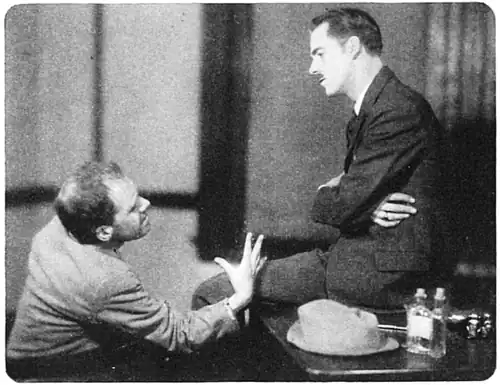
Scene showing the making of "Incident," filmed by the Undergraduate Motion Picture Club of Princeton University for PHOTOPLAY'S Contest. Earl Barnouw plays the leading role in this production
A MORE detailed report upon the contesting films will be presented later. However, it is possible now to say that the chief fault of the amateur makers of dramatic stories is lack of clarity.
The amateur directors fail to tell their story concisely and clearly. This fault could be remedied by showing the film from time to time to friends who know nothing about the story.
After weeks of work upon a film, the amateur, just as does the professional photoplay maker, loses his perspective. He begins to think he is clearly relating an incident when, in reality, he is just providing a confused slant upon it. At least several of the contest dramatic films failing to survive the preliminaries would have had a good chance for a prize had they been edited and had they been cut better and more expertly titled.
The big error in the amateur making of scenics, it seems from this contest, is lack of a basic idea. A lot of shots, made in haphazard fashion, fail to hold the interest. A good scenic is as difficult to create, edit and cut as a dramatic story. Perhaps more so.
The outstanding point of merit in almost all the contest films is the photography. Amateurs are getting some amazing effects, particularly with their sixteen millimeter cameras. Fade-outs, dissolves, moving camera effects, angle shots and striking shadow effects predominate. Amateurs know their cameras.
Richard de Fole and Malcolm Lee Harvey in an interesting scene from the Little Screen Player production of "Bonzabar the Beggar," submitted in the Photoplay contest. Mr. de Fole plays the title rôle
AT the University of Oregon a five to seven thousand foot standard width production is under way. This story, as yet untitled but put into scenario form by James Frank McBride, will relate the experiences of a typical freshman during his first year. Naturally it will have plenty of authentic collegiate atmosphere.
Five hundred and thirty students took screen tests for the important rôles, and, from these tests, the cast was chosen. Dorothy Burke was selected for the feminine lead. She is a brunette type and unusually attractive. Verne Elliott has the rôle of freshman hero.
Other leading roles will be played by Phyllis Van Kimmell, who is to do an unsophisticated freshman; Jewell Ellis, who will play an ultramodern co-ed; William Overstreet, as an athlete friend of the hero; and James Lyons, as the villain. The directors have the entire student body to call upon for extra roles.
The film has the full sanction of the university officials. Beatrice Milligan, James Raley and Carvel Nelson are the students in charge of the production, while George Godfrey is faculty advisor and general supervisor.

Left, Dorothy Burke, the feminine lead; below, William Overstreet, an important player; and, right. Phyllis Van Kimmell, the ingenue, of the new University of Oregon amateur film
THE Flower City Amateur Movie Club, which entered "At Your Service" in Photoplay's $2,000 contest, was organized in March, 1928, by Frank J. Buclhman. Since that time more than sixty have enrolled as active members.
Since the club's inception two screen plays, "Freshman Days" and "At Your Service," have been made by senior members of the club. "Three of a kind" was made by the junior members.
The organization is a member of the Amateur Cinema League of America and holds regular weekly meetings. The officers are: Frank J. Buelhman, president; E. A. Curtis, vice-president; William X. Cushing, business manager; R. M. Clemens, director; Lee G. Wright, secretary; and Joseph H. Appleton, publicity manager.
AT a recent meeting of the Metropolitan Motion Picture Club, the newly organized New York amateurs, an informal talk was given by Professor Carl Louis Gregory on amateur problems, dealing particularly with interior lighting and the use of filters. "H2O," an experimental film showing the movement and reflections of water under varying conditions, produced by Ralph Steiner, a club member, was shown. Over 150 members attended the meeting, which was presided over by Dr. Raymond L. Ditmars.
THE activities of the Washington Cinema Club in making a film record of the inauguration of President Herbert Hoover are worthy of unusual note. Plans were laid well in advance. Space was obtained in the official photographers' stand and arm bands, permitting members to work without restriction along the line of march, were obtained.
Two hundred and sixty feet of 16 millimeter film were obtained. The film was developed by the club members. Prints are being furnished each club member at a nominal cost.
MARKARD PICTURES, the amateur makers of the much talked about film, "Narrow Paths," announces that a new production, "Nothing to Declare," is in work. This will run 1,200 feet in 16 millimeter film. The story, adapted for the screen by Harry M. Lopez, deals with a crooked custom official who uses his position to blackmail wealthy evaders of custom duties. The photography will be in the hands of J. V. Martindale and Frank Packard. Markard, by the way, is a combination of these two names.
THE Hawthorne Photographic Club of Chicago, composed of members of the Western Elecric's Hawthorne Station, is conducting a scenario contest open to members.
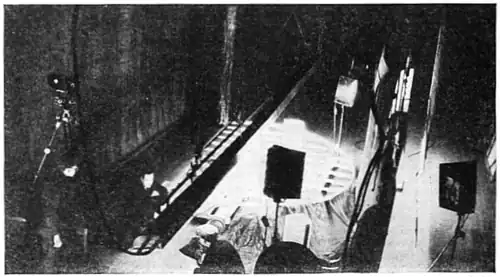
Scene from the Cumberland Cinema Club's production of Oscar Wilde's "Salome," submitted in the Photoplay contest. The Cumberland Club is composed of amateur enthusiasts of Vineland, N.J.