Page:Nature - Volume 1.pdf/249
and better executed work of the kind it has never been our good fortune to meet with, and it at once places its author first in the rank of English writers of Botanical Class-books.
Professor Oliver states in the preface that his book is in substance his "Lessons on Elementary Botany," adapted for use in India; but we find that it is this and a great deal more: for after following that excellent model in the part that relates to the structure of plants, and the functions of their organs, a larger portion of the book is taken up with concise descriptions of 116 principal natural orders of India, illustrated by a clear analysis of the parts of a very common Indian flower, insomuch that, if we were asked what is the best text-book for a student in this country who wishes to acquire more knowledge of botany than is needful for a mere pass examination, without at all setting aside the former work just mentioned, we do not know any to which we could so conscientiously direct attention, as almost all the plants in question may be easily found in any good botanic garden. Attached to each of the descriptions is a schedule of the floral characters on Henslow's plan, and a brief sketch of the principal matters of interest, structural, physiological, and economic, to be observed in Indian plants of the order, whilst the greater part are further accompanied by beautiful and original drawings and diagrams by Fitch, which delineate the floral organs graphically and naturally. We may add, too, that the more advanced and inquiring student has his attention occasionally directed to matters on which additional information is desired as, for example, in the genus Drosera, where our author writes "Some species exhibit a low sensibility or irritability in the leaves, which curl upon particles placed on their glandular hairs. Is this the case with Indian species? and do they appear to discriminate between organic and inorganic matter offered to them?"
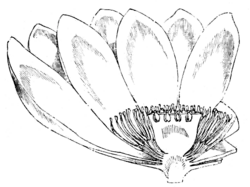
Vertical Section of flower of Nelumbium, showing the hypognous stamen and carpels singly immersed in a turbinate receptacle.
Or, again, in Campanulaceae: "Two small flowered Campanulas of Northern India exhibit the curious phenomenon of dimorphic flowers. Besides the flowers of usual form, there are smaller ones about the size of coriander seeds, which never open, but which nevertheless mature abundant seed. The latter must necessarily be self-fertilised, while the flowers of ordinary form are often, if not always, crossed by the pollen of other flowers of the same species. The part which these hermetically-sealed flowers play in the economy of plants is not yet well made out. They are found in isolated species and genera belonging to widely different natural orders, and it would be worth while to look for fresh examples among Indian weeds."
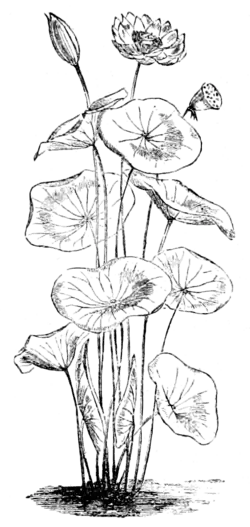
Sacred Lotus (Nelumbium speciosum), about one-tenth to one-fifteenth natural size.
We consider such suggestions of extreme importance, as some stimulus of this kind is wanted to urge students to something more than the requirements of the passing time. It is notorious that though great acuteness is often shown amongst the higher proficents in botany who come before public examiners, not one in a hundred goes a step beyond what is wanted to secure a certain class or scholarship. There must, we imagine, be something in the style of public teaching on such subjects which seems to check all real interest, much less to excite a spirit of love or enthusiasm for science itself, without which it is quite certain that we shall have no new fellow-workers.
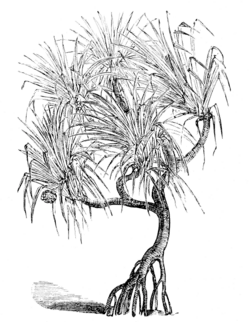
Screw Pine (Pandanus), showing aerial adventitious roots.
In conclusion, we would recommend a close study of the precision of our author's descriptions, and the clearness and terseness of his diction, to the writers of botanical text-books, as worthy of their imitation. These are qualities which improve the mind of the pupil more