Page:Anthology of Japanese Literature.pdf/267
This page has been proofread, but needs to be validated.
Plan of the Nō Stage
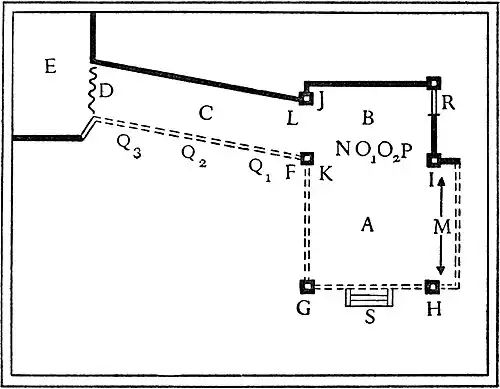
| A | Main Stage (Butai) |
| B | Rear Stage (Atoza) |
| C | Bridge (Hashigakari) |
| D | Curtain (Maku) |
| E | Mirror Room (Kagami-no-ma) |
| F | Shite’s Pillar (Shite-bashira) |
| G | Facing Pillar (Metsuke-bashira) |
| H | Waki’s Pillar (Waki-bashira) |
| I | Flute Pillar (Fue-bashira) |
| J | Stage Attendant’s Pillar (Kōken-bashira) |
| K | Name-Saying Seat (Nanoriza) |
| L | Kyōgen’s Seat (Kyōgen-za) |
| M | Chorus (Ji-utai) |
| N | Drummer (Taiko-kata) |
| O | Drummers (Tsuzumi-kata) |
| P | Flute Player (Fue-kata) |
| Q | Pine Trees (Matsu-no-ki) |
| R | Hurry Door (Kirido-guchi) |
| S | Steps to Audience (Shirasu-bashigo) |
- Shite: the protagonist, who usually makes two appearances, often the second time as a ghost.
- Waki: the deuteragonist, often an itinerant monk.
- Tsure: a companion of either the shite or waki.