Indian Shipping/Book 2/Chapter 4
CHAPTER IV.
Later Times.
With the rise of the British power following upon the decline of the Mogul Empire after Aurangzeb, Indian shipping naturally received a great impetus at the hands of Englishmen. It appears to be quite forgotten that for nearly two centuries and a half British India maintained a navy of respectable size and of admirable efficiency. This navy has behind it an interesting and inspiring record of many brilliant achievements and much solid and useful work, especially in marine surveying. Colonel the Hon. Leicester Stanhope, in 1827, said: "Never was there an instance of any ship of the Bombay Marine (as it was then named) having lowered her flag to an enemy of equal force." The history began in 1613, when a squadron was formed at Surat to afford protection from the aggressions of the Portuguese and of the pirates who infested the Indian seas. The naval establishment was put on a permanent footing in 1615, and it attained respectable dimensions by the second half of the 17th century. In 1669 the Court of Directors appointed Mr. W. Pett as their shipbuilder at Bombay, whither the establishment was previously removed. It was then designated as the Bombay Marine. A building-yard was maintained at Surat till 1735, when most of the work was transferred to Bombay, where the establishment had been greatly enlarged. This was the beginning of the association of the eminent Parsi shipbuilders with the Indian and Imperial Navy services. Lowjee Nassaranjee, the foreman of Surat shipyard, followed the establishment from Surat to Bombay. The history of this dockyard is that of the rise of a talented Parsi family. The size of the yard was increased in 1757. In 1771 Lowjee introduced into it his two grandsons, Framjee Manseckjee and Jamsetjee Bomenjee. In 1774 Lowjee died, succeeded by these two worthy followers, who soon built two ships of 900 tons. It was under the supervision of these talented Parsi shipbuilders that, in this yard, besides those for the Bombay Marine, there were built in the latter part of the 18th and earlier part of the 19th century for the Royal Navy nine ships of the line, seven frigates, and six smaller vessels. Thus, "in 1802, the Admiralty ordered men-of-war for the King's Navy to be constructed at this spot. They intended to have sent out a European builder, but the merits of Jumsetjee being made known to their lordships, they ordered him to continue as master-builder." The excellent construction of two frigates and a line-of-battle ship spread the fame of this worthy Parsi over England. The under-mentioned Parsis held successively the appointment of head builders in the Bombay Government Dockyard from 1736 up to 1837:—
|
From 1736 to 1774
. . . . . . . . . . . . . . . . . . . . . . . . . . . . . . . . . . . . . . . . . . . . . . . . . . . . . . . . . . . . . . . . . . . . . . . . . . . . . . . . . . . . . . . . . . . . . . . . . . . . . . . . . . . . . . . . . . . . . . . . . . . . . . . . . . . . . . . . . . . . . . . . . . . . . . . . . . . . . . . . . . . . . . . . . . . . . . . . . . . . . . . . . . . . . . . . . . . . . . . . . . . . . . . . . . . . . . . . . . . . . . . . . . . . . . . . . . . . . . . . . . . .
|
Lowjee |
|
From„ 1774 to„ 1783
. . . . . . . . . . . . . . . . . . . . . . . . . . . . . . . . . . . . . . . . . . . . . . . . . . . . . . . . . . . . . . . . . . . . . . . . . . . . . . . . . . . . . . . . . . . . . . . . . . . . . . . . . . . . . . . . . . . . . . . . . . . . . . . . . . . . . . . . . . . . . . . . . . . . . . . . . . . . . . . . . . . . . . . . . . . . . . . . . . . . . . . . . . . . . . . . . . . . . . . . . . . . . . . . . . . . . . . . . . . . . . . . . . . . . . . . . . . . . . . . . . . .
|
Manseckjee and Bomenjee |
|
From„ 1793 to„ 1805
. . . . . . . . . . . . . . . . . . . . . . . . . . . . . . . . . . . . . . . . . . . . . . . . . . . . . . . . . . . . . . . . . . . . . . . . . . . . . . . . . . . . . . . . . . . . . . . . . . . . . . . . . . . . . . . . . . . . . . . . . . . . . . . . . . . . . . . . . . . . . . . . . . . . . . . . . . . . . . . . . . . . . . . . . . . . . . . . . . . . . . . . . . . . . . . . . . . . . . . . . . . . . . . . . . . . . . . . . . . . . . . . . . . . . . . . . . . . . . . . . . . .
|
Framjee and Jamsetjee |
|
From„ 1805 to„ 1811
. . . . . . . . . . . . . . . . . . . . . . . . . . . . . . . . . . . . . . . . . . . . . . . . . . . . . . . . . . . . . . . . . . . . . . . . . . . . . . . . . . . . . . . . . . . . . . . . . . . . . . . . . . . . . . . . . . . . . . . . . . . . . . . . . . . . . . . . . . . . . . . . . . . . . . . . . . . . . . . . . . . . . . . . . . . . . . . . . . . . . . . . . . . . . . . . . . . . . . . . . . . . . . . . . . . . . . . . . . . . . . . . . . . . . . . . . . . . . . . . . . . .
|
Jamsetjee and Ruttonjee |
|
From„ 1811 to„ 1821
. . . . . . . . . . . . . . . . . . . . . . . . . . . . . . . . . . . . . . . . . . . . . . . . . . . . . . . . . . . . . . . . . . . . . . . . . . . . . . . . . . . . . . . . . . . . . . . . . . . . . . . . . . . . . . . . . . . . . . . . . . . . . . . . . . . . . . . . . . . . . . . . . . . . . . . . . . . . . . . . . . . . . . . . . . . . . . . . . . . . . . . . . . . . . . . . . . . . . . . . . . . . . . . . . . . . . . . . . . . . . . . . . . . . . . . . . . . . . . . . . . . .
|
Jamsetjee and Nowrojee |
|
From„ 1821 to„ 1837
. . . . . . . . . . . . . . . . . . . . . . . . . . . . . . . . . . . . . . . . . . . . . . . . . . . . . . . . . . . . . . . . . . . . . . . . . . . . . . . . . . . . . . . . . . . . . . . . . . . . . . . . . . . . . . . . . . . . . . . . . . . . . . . . . . . . . . . . . . . . . . . . . . . . . . . . . . . . . . . . . . . . . . . . . . . . . . . . . . . . . . . . . . . . . . . . . . . . . . . . . . . . . . . . . . . . . . . . . . . . . . . . . . . . . . . . . . . . . . . . . . . .
|
Nowrojee and Cursetjee |
The degree of efficiency which this dockyard reached under these Parsi shipbuilders will be also evident from the statement of a visitor, who, describing Bombay in 1775, said: "Here is a dockyard, large and well-contrived, with all kinds of naval stores deposited in proper warehouses: and … forges for making anchors. It boasts such a dry dock as is, perhaps, not to be seen in any part of Europe, either for size or convenient situation."[1]
Lieut.-Col. A. Walker[2] thus wrote in 1811 of the Bombay docks and Bombay-built ships:—"The docks that have recently been constructed at Bombay are capable of containing vessels of any force. Bombay is our grand naval arsenal in India." Bombay was possessed of great natural facilities for the construction of ships, for, "situated as she is between the forests of Malabar and Gujarat, she receives supplies of timber with every wind that blows." Besides, the teak-wood vessels of Bombay were greatly superior to the oaken walls of Old England. Lieut.-Col. A. Walker wrote, in 1811: "It is calculated that every ship in the Navy of Great Britain is renewed every twelve years. It is well known that teak-wood built ships last fifty years and upwards.[3] Many ships Bombay-built after running fourteen or fifteen years have been brought into the Navy and were considered as strong as ever. The Sir Edward Hughes performed, I believe, eight voyages as an Indiaman before she was purchased for the Navy. No Europe-built Indiaman is capable of going more than six voyages with safety." But Bombay-built ships were superior to those built elsewhere not only in point of durability but also in that of cheapness. "Ships built at Bombay," observes the same writer, "also are executed by one-fourth cheaper than in the docks of England, so that the English-built ships requiring to be renewed every twelve years, the expense is quadruple."
The East India Company also helped to build up the Bengal Marine, thus continuing, in a sense, the work of the Mogul Emperor in connection with the Nowwara. But a very calamitous event led them to revive shipbuilding in Bengal: it was the famine produced in the Carnatic by Hyder Ali's invasion in 1780, which necessitated the transport of grain from Bengal to the English settlements on the Coromandel coast. The first efforts in shipbuilding were made in districts like Sylhet, Chittagong, and Dacca. Mr. Lindsay, Collector of Sylhet in 1780, had one ship built of 400 tons burden, and also a fleet of twenty ships, which he sent to Madras loaded with rice on the occasion of the famine.[4] But Calcutta soon became the centre of regular shipbuilding. The earliest specimens of regular Calcutta-built ships were produced in the year 1781. From 1781 to 1800 inclusive, thirty-five ships, with a total tonnage of 17,020, were built on the Hugli, chiefly at Calcutta; in 1801, nineteen ships were built, of 10,079 tons; in 1813, twenty-one ships, 10,376 tons. Including the above, from 1801 to 1821 both inclusive, there were built on the Hugli 237 ships, of 105,693 tons, which, reckoned at an average cost of 200 rupees per ton, makes the enormous sum of two crores of rupees and upwards; a considerable part of which sum was absorbed in the payment of wages to native artificers and labourers, to the great benefit of the country.[5]
The first dry dock constructed at Calcutta was a small one at the Bankshall in 1790 for the Government pilot vessels; subsequent to which several large docks were constructed at Howrah and Sulkea; in 1803 the Kidderpore dock was founded by Mr. W. Waddell, the Company's first master-builder, who was succeeded by J. and R. Kyd, and who for nearly thirty years built and repaired all the Company's Bengal vessels and constructed a great many fine ships, twenty-four in number, and vessels for individuals.[6]
About the materials of which the Bengal ships were constructed, Antony Lambert thus wrote in 1802: They consist of teak timber and planks, imported from Pegu; saul and sisoo timber from Behar, Oudh, and the inexhaustible forests that skirt the hills which form the northern boundaries of Bengal and Behar. The ribs, knees, and breast-hooks or "the frame of the ship," are composed generally of sisoo timber, the beams and inside planks of saul, and the bottoms, sides, decks, keels, sternposts, etc., of teak. The excellence of teak for the purpose of shipbuilding and its durability are too well known to require any description, although Pegu teak is not reckoned equal to what grows on the Malabar coast and near Surat. Of sisoo and saul timber, the former is admirably adapted to shipbuilding from its size, form, and firm texture, and as it produces crooked timbers and knees of every shape and dimension for vessels of full forms and of any magnitude, even for a ship-of-war of the first rate; and that of the latter furnishes excellent beams, knees, and inside planks.
Lord Wellesley, the Governor-General of India, was able, in 1800, to thus testify to the growth and possibilities of Calcutta as a shipping centre:—
The port of Calcutta contains about 10,000 tons of shipping, built in India, of a description calculated for the conveyance of cargoes. From the quantity of private tonnage now at command in the port of Calcutta, from the state of perfection which the art of shipbuilding has already attained in Bengal (promising a still more rapid progress and supported by abundant and increasing supply of timbers), it is certain that this port will always be able to furnish tonnage to whatever extent may be required for conveying to the Port of London the trade of the private British merchants of Bengal.
From a "Register of Ships built on the Hugli from 1781-1839 (including Calcutta, Howrah, Sulkea, Cosipore, Tittaghar, Kidderpore, and Fort Gloucester)," it appears that the total number of ships built was 376. The greatest building years were 1801, 1813, and 1876, when 10,079, 10,376, and 8,198 tons respectively were put in.
The Indian Navy, which was thus created and built up by the efforts of the East India Company, took an active part in the first and second Burmese wars and the first China war. A great deal of its service was performed outside local Indian waters, in the Persian Gulf, in the Red Sea, and on the shores of East Africa. It also protected and facilitated the trading operations of Indian merchants with distant ports.
The decline of the Indian Marine began after 1840, no large ships having been built after that date. It was finally abolished in April, 1863, shortly after the assumption of the Government of India by the Crown.
A very interesting account, together with very fine sketches of the typical Indian (Hindu) ships that were in use in the earlier part of the 19th century, is given by a Frenchman, F. Baltazar Solvyns (1811) in his Les Hindous[7] (tome troisième). In his introduction to this work he remarks:—
In ancient times the Indians excelled in the art of constructing vessels, and the present Hindus can in this respect still offer models to Europe—so much so that the English, attentive to everything which relates to naval architecture, have borrowed from the Hindus many improvements which they have adopted with success to their own shipping. … The Indian vessels unite elegance and utility, and are models of patience and fine workmanship.
He has described some of the typical Indian vessels. A Pinnace or Yacht was a strongly masted ship, divided into two or three apartments, one for company, another for the beds, and a third as a cabinet, besides a place called varandah forwards for the servants. Ballasor, the principal entrance of the Hugli, is described as being frequented by different sorts of vessels, and particularly by large ships from Bombay, Surat, and other parts of the western coast. The vessels from the Ganges were called Schooners, which were very well fitted out and "able to make a voyage to Europe," their pilots being "very skilful." The Grab was a ship with three masts, a pointed prow, and a bowsprit; its crew consisting of a Nicodar or captain and a few clashies or Moorish sailors. The grabs were built at Bombay, their pointed prow signifying Hindu construction. The Bangles were the largest Indian boats, some of them carrying four thousand or five thousand maunds of rice. Brigs were ships that came from the coast of Coromandel and Malabar, bringing to Calcutta the produce of those countries. To the coast of Coromandel also belonged the Dony, with one mast, resembling a sloop. Its deck consisted of a few the planks fastened on each side. It was badly rigged. Pattooas, lastly, were those ships that differed from other vessels by their being clincher-built; "the boards are one upon the other, fastened by little pieces of iron in the form of cramps. The yard is always without sail, and the sails are hoisted and lowered by blocks."

PINNACE.
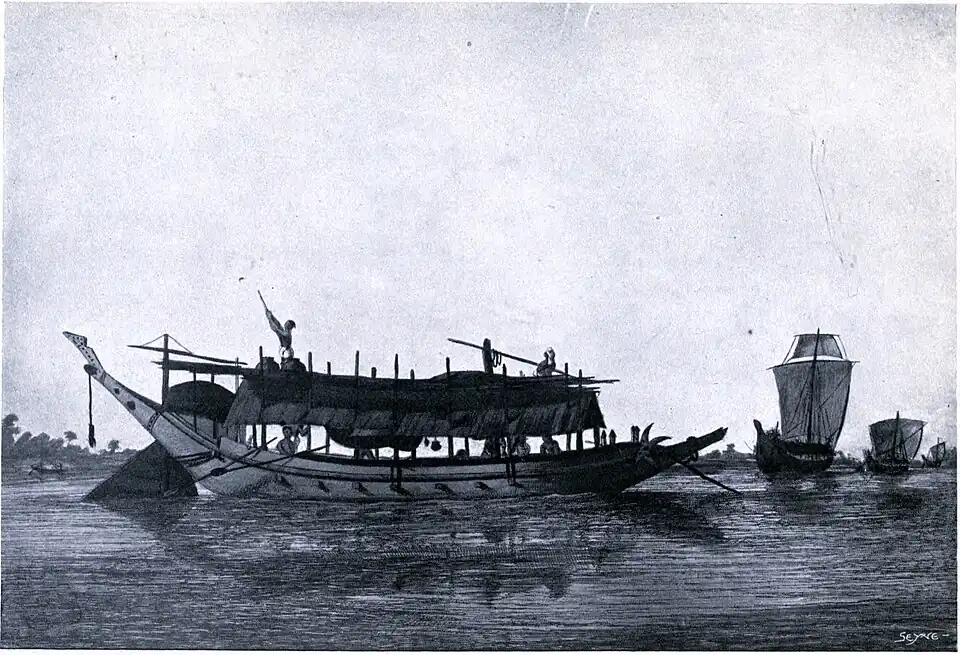
BANGLES.

GRAB.

PATTOOA.

DONY.
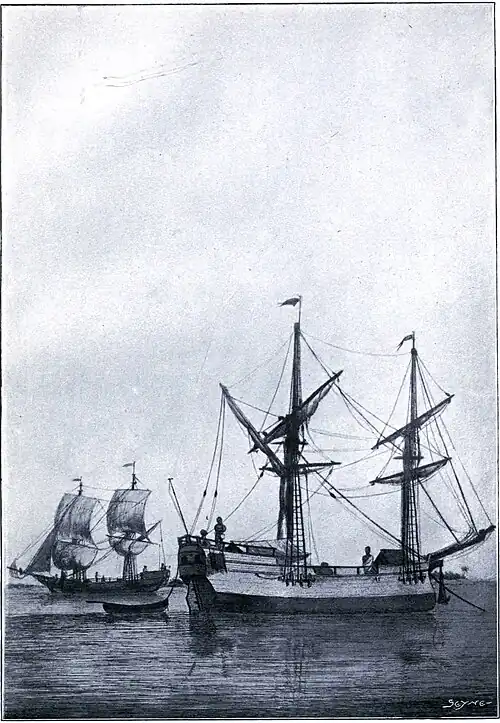
BRICK.
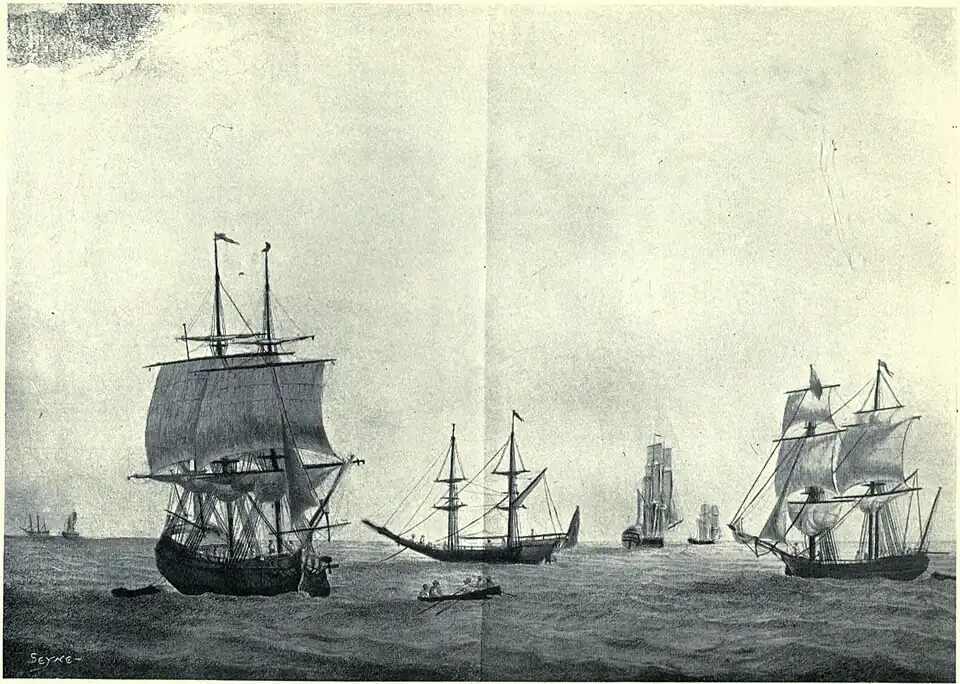
VIEW OF BALLASORE ROADS.
- ↑ The History of the Indian Navy, in two volumes, by Lieutenant C. R. Low, I.N.; Bombay Times, 18th May, 1839; Papers relating to Shipbuilding in India, by John Phipps (1840), late of the Master Attendant Office; Sir Cyprian Bridge on "India and the Navy," in the London Spectator of April 9th, 1910.
- ↑ Considerations on the Affairs of India, written in the year 1811 (445-vi., p. 316).
- ↑ The late Sister Nivēditā related to me the interesting and significant but hardly known fact that such of our old wooden ships as still survive (for the seasoned wood of which our ships are built has a definite length of life) have passed at second and third hand into the coast trade of North-western Europe, and are still to be met with in Norway, Scotland, Holland, and other little countries on the seaboard. And so the good old sail shipping which steam shipping has weeded out from everywhere else in the world, still lingers on in India, and to her is given the chance of reviving it and giving it back to a world which cannot outgrow its need.
- ↑ Assam District Gazetteer, vol. ii. (Sylhet), p. 155.
- ↑ Papers Relating to Shipbuilding in India, by John Phipps, Introduction.
- ↑ Ibid.
- ↑ This rare work is to be found in the splendid library of Mr. Abanindranath Tagore, the renowned Bengali artist, to whom I also owe the reproductions from the Sculptures of Borobudur. The French reprint was issued 1808-12; there is an earlier reprint published by Orme, London, 1804, but neither is complete. The original folio edition of 1799 has 250 coloured plates.