A History of Japanese Mathematics/Chapter 9
CHAPTER IX.
The eighteenth Century.
We have already spoken of the closing labors of Seki Kōwa, who died in 1708, and of Takebe Kenkō and Araki, and in Chapter X we shall speak of Ajima Chokuyen. There were many others, however, who contributed to the progress of mathematics from the time when Takebe made the yenri known to the days when Ajima gave a new impulse to the science, and of these we shall speak in this chapter. Concerning some of them we know but little, and concerning certain others a brief mention of their works will suffice. Others there are, however, who may be said to have done a work that was to that of Seki what the work of D'Alembert and Euler was to that of Newton. That is to say, the periods in Japan and Europe were somewhat analogous in a relative way, although the breadth of the work in the two parts of the world was not on a par. In some respects the period immediately following Seki was, save as to Takebe's work, one of relative quiet, of the gathering up of. the results that had been accomplished and of putting them into usable form, or of solving problems by the new methods. In the history of mathematics such a period usually and naturally follows an era of discovery.
So we have Nishiwaki Richyū publishing his Sampō Tengen Roku in 1714, setting forth in simple fashion the "celestial element" and the yendan algebra.[1] In 1722 Man-o Tokiharu published his Kiku Buntō Shū, in which he treated, among other topics, the spiral. In 1715 Hozumi Yoshin published his Kagaku Sampō, the usual type of problem book. In 1716 Miyake Kenryū published a similar work, the Guwō Sampō. He also wrote the Shojutsu Sangaku Zuye, of which an edition appeared in 1795 (Fig. 32). In this he seems to have had some idea of the prismatoid (Fig. 33). In 1718 Ogino Nobutomo wrote a work, the Kiku Gempo Chōken, that has come down to us in nine books in manuscript form,—a very worthy
Fig. 32. From Miyake Kenrū's Shojutsu Sangaku Zuye (1795 edition). general treatise. Inspired by Hozumi Yoshin's work, Aoyama Riyei published his Chūgaku Sampō in 1719, solving the problems of the Kagaku Sampō and proposing others. These latter were solved in turn by Nakane Genjun in his Kantō Sampō (1738), by Nakao Seisei in his Sangaku Bemmō, and by Iriye Shūkci in his Tangen Sampō (1759). Mention should also be made of an excellent work by Murai Mashahiro, the Ryōchi Shinan, of which the first part appeared in 1732. The work was a popular one and did much to arouse an interest
Fig. 33. From Miyake Kenryū's Shyutsu Sangaku Zuge (1795 edition).
in the new mathematics. The problems proposed by Nakane Genjun were answered by Kamiya Hōtei in his Kaisho Sampō (1743), by Yamamoto Kakuan in his Sansui, and by others. To the same style of mathematics were devoted Yamamoto's Yokyoku Sampō (1745) and Keiroku Sampō (1746), Takeda Saisei's Sembi Sampō (1746), Imai Kenter's Meigen Sampō (1764), and various other similar works, but by the close of the eighteenth century in Japan, as elsewhere, this style of book lost caste as representing a lower form of science than that in which the best type of mind found pleasure. Mention should also be made of Baba Nobutake's Shogaku Tenmon of 1706, a well-known work on astronomy, that exerted no little influence at this period (Fig. 34).
Of the writers of this general class one of the best was Nakane Genjun (1701—1761) whose Kanto Sampō (1738) attracted considerable attention. His father, Nakane Genkei (1661—1733), was born in the province of Ōmi, and studied under Takebe. He was at one time an office holder, but in earlier years he practiced as a physician at Kyōto. Ilis taste led him to study mathematics and astronomy as well, and he seems to have been a worthy instructor for his son, who thus received at second hand the teachings of Seki's greatest pupil. Some interesting testimony to his standing as a scholar is given in a story related of a certain feudal lord of the Kyōhō period (1716—1736), who asked a savant, one Shinozaki, who were his most celebrated contemporaries. Thereupon the savant replied: "Of philosophers, the most celebrated are Itō Jinsai and Ogyū Sorai; of astronomers, Nakane Genkei and Kurushima Kinai;[2] in calligraphy, Hosoi Kōtaku and Tsuboi Yoshitomo; in Shintōism, Nashimoto of Komo; in poetry Matsuki Jiroyemon; and as an actor, Ichikawa Danjyūrō. Of these, Nakane is not only versed in astronomy, but he is eminent in all branches of learning."[3]
Nakane the Elder also published several astronomical works, Fig. 34. From Baba Nobutake's Shogaku Tenmon (1706). and composed a treatise in which a new law of musical melodies was set forth.[4] Through the Chinese works and the Page:A history of Japanese mathematics (IA historyofjapanes00smitiala).pdf/180 Page:A history of Japanese mathematics (IA historyofjapanes00smitiala).pdf/181 Page:A history of Japanese mathematics (IA historyofjapanes00smitiala).pdf/182
Fig. 35. From Nakane Genjun's Kanja Ologi Zōshi (1741).
mathematics, and who died in 1758. Among Kōda's pupils were Iriye Shūkei, Chiba Saiyin (c. 1770), and Imai Kentei (1718—1780). Imai Kentei, who left several unpublished manuPage:A history of Japanese mathematics (IA historyofjapanes00smitiala).pdf/184 and multiplies the 372 into the absolute term (6726) and then subtracts 373 as often as possible, leaving a remainder 361.[5] This remainder is added to 6726 and the result is divided by 373, the quotient, 19, being a root.
Similarly, in the equation
,

Murai claims first to take the relation
,

and states that he multiplies 11 into the absolute term, subtracting 2284 from the product until he reaches a remainder, which is the root required, a process that is not at all clear. Of course the method is not valid, for in the equation

it gives 2 instead of 3 or 5 for the root. Murai must have been aware that his rule was good only for special cases, but
Fig. 36. From Murai Chūzen's Sampō Dōshi-mon (1781).
Fig. 37. The Pascal triangle as given in Muroi's Sampō Dōshi-mon (1781).
he makes no mention of this fact. Nevertheless he assisted in preparing the way for modern mathematics by discouraging the use of the sangi, which were already beginning to be looked upon as unwieldy by the best algebraists of his time.
Murai also wrote a Sampō Dōshi-mon, or Arithmetic for the Young (see Figs. 36—38), which was intended as a sequel Fig. 38. From Murai's Sampō-Dōthi-mon (1781).
to the Kanja Otogi Zōshi of Nakane Genjun. The work appeared in 1781, and contains numerous interesting pictures of primitive work in mensuration (Fig. 36), and the Pascal Page:A history of Japanese mathematics (IA historyofjapanes00smitiala).pdf/188 Page:A history of Japanese mathematics (IA historyofjapanes00smitiala).pdf/189 numbers , and in the figure. Then take as the central number, and from this, along



, arrange a series decreasing towards and increasing towards by the constant difference . Next fill the cells along the oblique lines through and and through 1 and , according to the same law. Now fill the cells along and the two parallels through and 1, and through and , by a series decreasing towards and increasing towards by the constant difference 1. The rest of the rule will be apparent by examining the following square:


| 22 | 47 | 16 | 41 | 10 | 35 | 4 |
| 5 | 23 | 48 | 17 | 42 | 11 | 29 |
| 30 | 6 | 24 | 49 | 18 | 36 | 12 |
| 13 | 31 | 7 | 25 | 43 | 19 | 37 |
| 38 | 14 | 32 | 1 | 26 | 44 | 20 |
| 21 | 39 | 8 | 33 | 2 | 27 | 45 |
| 46 | 15 | 40 | 9 | 34 | 3 | 28 |
Page:A history of Japanese mathematics (IA historyofjapanes00smitiala).pdf/191 Page:A history of Japanese mathematics (IA historyofjapanes00smitiala).pdf/192 Page:A history of Japanese mathematics (IA historyofjapanes00smitiala).pdf/193 Page:A history of Japanese mathematics (IA historyofjapanes00smitiala).pdf/194 Among the vassals of Lord Arima was a certain Honda Teiken (1734—1807), who was born in the province of Musashi. He is known in mathematics by another name, Fujita Sadasuke, which he assumed when he came to manhood, a name that acquired considerable renown in the latter half of the eighteenth century. As a youth he studied under Yamaji, and even when he was only nineteen years of age he became, on
Fig. 39. From Arima's Shūki Sampō (1769).
Yamji's recommendation, assistant to the astronomical department of the shogunate. For five years he labored acceptably in this work, but finally was compelled to resign on account of trouble with his eyes. Arima now extended to him a cordial invitation to accompany him to Yedo, whither he went for service every second year, and to act as teacher of arithmetic.[6] Here he published his Seiyō Sampō (1779), a work in three books, consisting of a well arranged and carefully selected set of problems in the tensan algebra. This book was so clearly written as to serve as a guide for teachers for a long time after its publication. In Fig. 40 is shown one of his problems relating to tangent spheres in a cone. Fujita also published several other works, including the Kaisei Tengen Shinan (1792),[7] and wrote numerous manuscripts that were eagerly sought by the mathematicians of his time, although of no great merit on the ground of originality. He died in 1807 at the age of seventy-two years, respected as one of the leading mathematicians of his day, although he did not merit any such standing in spite of his undoubted excellence as a teacher.
Fig. 40. From Fujita Sadasuke's Seiyō Sampō (1779).
Fujita's son Fujita Kagen (1765—1821) was also a mathematician of some prominence. He published in 1790 his Shimpeki Sampō (Mathematical Problems suspended before the Temple),[8] and in 1806 a sequel, the Zoku Shimpeki Sampō. The significance of the name is seen in the fact that the work contains a collection of problems that had been hung before various temples by certain mathematical devotees between 1767 and the time when Fujita wrote, together with rules for their solution. This strange custom of hanging problems before the temples originated in the seventeenth century, and continued for more than two hundred years. It may have arisen from a desire for the praise or approval of the gods, or from the fact that this was a convenient means of publishing a discovery, or from the wish to challenge others to solve a problem, as European students in the Middle Ages would post a thesis on the door of church. A few of these problems are here translated as specimens of the work of Japanese mathematicians at the close of the eighteenth century.
"There is a circle in which a triangle and three circles, A, B, C, are inscribed in the manner shown in the figure.
Given the diameters of the three inscribed circles, required the diameter of the circumscribed circle." The rule given may be abbreviated as follows:
Let the respective diameters be x, y, and z, and let xy = a Then from a ^ 2 take [(x - y) * z] ^ 2 Divide a by this remainder and call the result &. Then from (x + y) * s take a, and divide 0.5 by this remainder and add b, and then multiply by z and by a. The result is the diameter of the circumscribed circle. To this rule is appended, with some note of pride, the words: "Feudal District of Kakegawa in Yenshū Province, third month of 1795, Miyajima Sonobei Keichi, pupil of Fujita Sadasuke of the School of Seki"
Another problem is stated as follows: "Two circles are de-scribed, one inscribing and the other circumscribing a quadrilateral. Given the diameter of the circumscribed circle and the product of the two diagonals, required to find the diameter of the inscribed circle." The problem was solved by Ko-bayashi Kōshin in 1795, and the relation was established that
,

where i = the diameter of the inscribed circle, and c = the diameter of the circumscribed circle, and p = the given product.[9]
A third problem is as follows: "There is an ellipse in which five circles are inscribed as here shown. The two axes of
the ellipse being a and b it is required to find the diameter of the circle A''. The solution as given by Sano Ankō in 1787 may be expressed as follows:
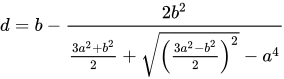
Another problem of similar nature is shown in Fig. 41, from the Zoku Shimpeki Sampō (1806).
A style of problem somewhat similar to one already mentioned in connection with Arima was studied in 1789 by Hata Fig. 41. From the Zoku Shimpeki Sampō (1806).
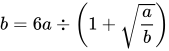
Jūdō, as follows: "There is a sphere in which are inscribed, as in the figure, two spheres A, two B, and two C, touching each
other as shown. Given the diameters of A and C, required to find the diameter of B." The solution given is
Contemporary with Fujita Sadasuke was Aida Ammei (1747—1817), who was born at Mogami, in north-eastern Japan. Like Seki, Aida early showed his genius for mathematics, and while still young he went to Yedo where he studied under a certain Okazaki, a disciple of the Nakanishi school, and also under Honda Rimei, although he used later to boast that he was a self-made mathematician, and to assume a certain conceit that hardly became the scholar. Nevertheless his ability was such and his manner to his pupils was so kind that he attracted to himself a large following, and his school, to which he gave the boastful title of Superior School, became the most popular that Japan had seen, save only Seki's. Aida wrote, so his pupils say, about thousand pamphlets on mathematics, although only a relatively small number of his contributions are now extant. He died in 1817 at the age of seventy years.[10]
One of Aida's works, the Tōsci Finkōki (1784) deserves special mention for its educational significance. In this he discarded the inherited problems to a large extent and substituted for them genuine applications to daily life. The result was a great awakening of interest in the teaching of mathematics, and the work itself was very successful.
Soon after the publication of this work there arose an unfortunate controversy between Aida and Fujita Sadasuke, at that time head of the Seki School. The story goes[11] that Aida had at one time asked to be admitted to this school, but that Fujita in an imperious fashion had told him that first he must make haste to correct an error in his solution of a problem that he had hung in the Shintō shrine on Atago hill in Shiba, Tōkyō. Aida promptly declined to change his solution and thus cut himself off from the advantages of study in the Seki school. While Aida admits having visited Fujita he says that he did so only to test the latter's ability, not for the purpose of entering the school.
Page:A history of Japanese mathematics (IA historyofjapanes00smitiala).pdf/201 Page:A history of Japanese mathematics (IA historyofjapanes00smitiala).pdf/202 thousands of books in Japan, the fate of destruction by fire.[12] Of the contents of the Sampō Kokon Tsūran (1795) already mentioned, only a brief note need be given. In Book VI Aida gives the value of as follows:


He gives a series for the length of an arc x in terms of the chord c and height h thus:

where
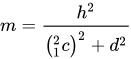
and d is the diameter of the circle. In the same work he gives a formula for the area of a circular segment of one base:

Aida also gave a solution of a problem found in Ajima's Fukyū Sampō, as follows: The side of an equilateral triangle is given as an integer n. It is required to draw the lines S1, S2, . . ., parallel to one side, such that the p's, q's and s's as shown in the figure shall all have integral values.
Ajima had already solved this before Aida tried it, and this is, in substance, his solution: Decompose n into two factors, a and b, which are either both odd or both even. If this cannot be done a solution is impossible. The rules are now, as expressed in formulas, as follows:
Page:A history of Japanese mathematics (IA historyofjapanes00smitiala).pdf/204 Page:A history of Japanese mathematics (IA historyofjapanes00smitiala).pdf/205 to the mensuration of the circle, of some slight improvement in the various processes, of the rather arrogant supremacy of the Seki school, and of a bitter feud between the independents and the conservatives in the teaching of mathematics. And this is a fair characterization of most of the latter half of the century. There was, however, one redeeming feature, and this is found in the work of Ajima Chokuyen, of whom we shall speak in the next chapter.
- ↑ Endo, Book II, pp. 57, 59.
- ↑ Or Kurushima Yoshita.
- ↑ K. Kano's article in the Honchō Sūgaku Kōenshū, 1908, p. 11.
- ↑ This was the Ritsugen Hakti, a work on the description of measures.
- ↑ Briefly, , and with a remainder 361.
- ↑ Kawakita, in the Honchō Sūgaku Kōenshū, 1905, р. 8.
- ↑ We follow Endō. Hayashi gives 1793.
- ↑ There was a second edition in 1796, with some additions.
- ↑ For the case of a square of side 2 we have .
- ↑ As stated upon his monument. See also C. Kawakita in the Honchō Sūgaku Kōenshū, 1908.
- ↑ This account is digested from the works of various writers who were drawn into the controversy.
- ↑ Kawakita's article in the Honchō Sūgaku Kōensku, p. 13.


