A History of Japanese Mathematics/Chapter 12
CHAPTER XII.
Wada Nei.
It will be recalled that in the second half of the eighteenth century Ajima added worthily to the yenri theory, bringing for the first time to the mathematical world of Japan a knowledge of a kind of integral calculus for the quadrature of areas and the cubature of volumes. The important work thus started by him was destined to be transmitted through his pupil, Kusaka Sei,[1] to a worthy successor of whom we shall now speak at some length.
Wada Yenzō Nei (1787-1840),[2] a samurai of Mikazuki in the province of Harima, was born in Yedo. His original name was Kōyama Naoaki, and in early life he served in Yedo in the Buddhist temple called by the name Zōjōji. He then changed his name for some reason, and is generally known in the scientific annals of his country as Wada Nei. After leaving the temple life he took up mathematics under the tutelage of Lord 'Tsuchimikado, hereditary calendar-maker to the Court of the Mikado. He first studied pure mathematics under a certain scholar of the Miyagi school, and then under Kusaka Sci. As has already been mentioned, this Kusaka compiled the Fukyū Sampō from the results of his contact with Ajima, thus bringing into clear light the teaching of his master. Although it must be confessed that he did not have the genius of Ajima, nevertheless Kusaka was a remarkable teacher, giving to mathematics a charm that fascinated his pupils and that inspired them to do very commendable work. Money had no attraction for him, and he lived a life of poverty, dying in 1839 at the age of seventy-five years.[3]
As to Wada, no book of his was ever published, and all of his large number of manuscripts, which were in the keeping of Lord Tsuchimikado, were consumed by fire,[4] that great and ever-present scourge of Japan that has destroyed so much of her science and her letters. Eking out a living by fortune-telling and by teaching penmanship, as well as by giving instruction in mathematics,[5] selling some of his manuscripts to gratify his thirst for liquor, Wada's life had little of happiness save what came as the reward of his teaching. He claimed to have had among his pupils some of the most distinguished mathematicians of his day,[6] men who came to him to learn in secret, recognizing his genius as an investigator and as a teacher.[7]
It will be recalled that Ajima had practiced his integration by cutting a surface into what were practically equal elements and summing these by a somewhat laborious process, and then passing to the limit for n = ∞. In a similar manner he found the volumes of solids. In every case some special series had to be summed, and it was here that the operation became tedious. Wada therefore set about to simplify matters by constructing a set of tables to accomplish the work of the modern table of integrals. Since his expression for "to integrate" was the Japanese word "to fold" (tatami), these aids to calculation were called "folding tables" (jo-hyō), and of these he is known to have left twenty-one, arranged in pamphlet form and bearing distinctive names.[8]
In 1818 Wada wrote the Yenri Shinkō in two books, published only in manuscript. In this he begins by computing the area of a circle in the following manner:
The diameter is first divided into 2n equal parts. Then, drawing the lines as shown in the figure, it is evident that
Page:A history of Japanese mathematics (IA historyofjapanes00smitiala).pdf/235 Page:A history of Japanese mathematics (IA historyofjapanes00smitiala).pdf/236 rule employed being not unlike the present one of equating. a differential coefficient to zero, although no explanation was given for the method. Naturally it had attracted the attention of many mathematicians of the Seki school, but no one had ventured upon any discussion of the reasons underlying the rule. The question is still an open one as to where Seki obtained the method. In the surreptitious intercourse with the West it would be just such a rule that would tend to find its way through the barred gateway, it being more difficult to communicate a whole treatise. At any rate the rule was known in the early days of the Seki school, and it remained unexplained for more than a century, and until Wada took up the question.[9] He not only gave the reason for the rule, but carried the discussion still further, including in his theory the subject of the maximum and minimum values of infinite series.[10] In this way he was able to apply the theory to questions involved in the yenri where, as we have seen, infinite series are always found.In 1825 Wada wrote a work entitled Iyen Sampō[11] in which The treated of what he calls "circles of different species." He says that "if the area of a square be multiplied by the moment of circular area[12] it is altered[13] into a circle, and we have the area (of this circle). If the area of a rectangle be multiplied by the moment of circular area it is altered into an ellipse, and we have the area (of this ellipse). If the volume of a cube or a cuboid be multiplied by the moment of the spherical volume,[14] it is altered into a sphere or a spheroid, and we have its volume. These are processes that are well known. It is possible to generalize the idea, however, applying these processes to the isosceles trapezium, to the rectangular pyramid, and so on, obtaining circles and spheres of different forms."
For example, given an ellipse inscribed in the rectangle ABCD as here shown. Take Y Y' the midpoints of DC and AB, respectively and construct the isosceles triangle ABY.
Draw any line parallel to AB cutting the ellipse in P and Q, and the triangle in M and N, as shown. Now take two points P', Q' on PQ, symmetric with respect to YY' and such that AB : MN = PQ : P'Q'. Then the locus of P' and Q' becomes a curve of the form shown in the figure, touching AY and BY at their mid-points X' and X, and the line AB at Y'. If now we let YY' = a and X'X = b we may consider three species of curve,[15] namely for a > b, a = b, a < b.
Wada then, finds the area inclosed by this curve to be the process being similar to the one employed for the other curvilinear figures. He also generalizes the proposition by taking an isosceles trapezium instead of the isosceles triangle ABY, the area being found, as before, to be where a and b are YY' and X'X in the new figure.

Wada also devoted his attention to the study of roulettes, being the first mathematician in Japan who is known to have considered these curves. It is told how he one time hung before the temple of Atago, in Yedo, the results of his studies of this subject, although doing so in the name of one of his pupils. The problem and the solution are of sufficient interest to be quoted in substantially the original form.[16]
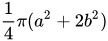
"There is a wheel with center A as in the figure, on the circumference of which is the center of a second wheel B, while on the circumference of B is the center of a third wheel, C. Beginning when the center C is farthest from the center A, the center B moves along the circumference of A, to the right, while the center C moves along the circumference of B, also to the right, the motions having the same angular velocity so that C and B return to their initial positions at the same time. Let the locus described by C be known as the ki-yen (the tortoise circle). Given the diameters of the wheels A and B, where the maximum of the latter should be half of the former, required to find the area of the ki-yen.
"Answer should be given according to the following rule: Take the diameter of the wheel B; square it and double; add the square of the diameter of A; multiply by the moment of the circular area, and the result is the area of the ki-yen.
"A pupil of Wada Yenzō Nei, the founder of new theories in the yeuri, sixth in succession of instruction in the School of Seki."[17]
Wada's work in the domain of maxima and minima was carried on by a number of his contemporaries or immediate
successors, among whom none did more for the theory than Kemmochi Yōshichi Shōkō. His contribution[18] to the subject is called the Yenri Kyoku-sū Shōkai (Detailed account of the Circle-Principle method of finding Maxima and Minima), and contains two problems. The first of these problems is to find the shortest circular arc of which the altitude above its chord is unity. For this he gives two solutions, each too long to be given in this connection. His second problem is to construct a right triangle A B C with hypotenuse equal to unity, such that the arc A A' described with C' as a center, as in the figure, shall be the maximum, and to find the length of this maximum arc.[19]
- ↑ Endō, Book III, p. 127. Sce p. 172.
- ↑ Koide, Yeuri Sankyō, preface. See Chapter XIV.
- ↑ Endō, Book III, p. 121; C. Kawakita's article in the Honchō Sūgaku Kôeushū, p. 17; Koide, Yenri Saukyō, preface.
- ↑ Koide, Yenri Sankyō, MS. of 1842, preface.
- ↑ Endō, Book III, p. 128.
- ↑ The original list on some waste paper is now in the possession of N. Okamoto. The list includes the names of Shiraishi, Kawai, Uchida, Saitō, and Ushijima, with many others.
- ↑ See also Endō, Book III, p. 86.
- ↑ Endō, Book III, p. 74.
- ↑ It is found in his manuscript entitled Tekijin Hō-kyū-hō.
- ↑ Endō, Book III, p. 83.
- ↑ On Circles of different species.
- ↑ I. e., by We would say, . The Japanese, however, always considered the diameter instead of the radjus.
- ↑ This seems the best word by which to express the Japanese form.
- ↑ I. e., by .
- ↑ Wada calls these the seitō-yen (flourishing flame-shaped circle), hōsha-yen, and suitō-yen (fading flame-shaped circle).
- ↑ From the original. See also Endō, Book III, p. 103.
- ↑ The rule is equivalent to saying that the area is , where and are the diameters of A and B. Possibly this pupil was Koide Shūki. Wada's detailed solution is lost.
- ↑ Unpublished, and exact date unknown.
- ↑ In Kemmochi's work there are certain transcendental equations which are solved by an approximation method known in Japan by the name Kanrui-jutsu, possibly due to Saitō Gigi or his father. Kemmochi certainly learned it from him. He also wrote a work usually attributed to Iwai Jūyen, the Sampō yenri hio shaku, one of the first to explain the Kwatsu-jutsu method.
It should be mentioned that the cycloid had been considered before Wada's time hy Shizuki Tadao, who discussed it in his Rekishō Shinsho (1800).