A History of Japanese Mathematics/Chapter 11
CHAPTER XI.
The Opening of the Nineteenth Century.
The nineteenth century opened in Japan with one noteworthy undertaking, the great survey of the whole Empire. At the head of this work was Inō Chūkei,[1] a man of high ability in his line, and one whose maps are justly esteemed by all cartographers. Until he was fifty years of age he lived the life of a prosperous farmer. While not himself a contributor to pure mathematics, he came in later life under the influence of the astronomer Takahashi Shiji[2] (1765—1804) and at the solicitation of this scholar he began the work that made him known as the greatest surveyor that Japan ever produced. Takahashi seems to have become acquainted with Western astronomy and spherical trigonometry through his knowledge of the Dutch language. He had also studied astronomy while serving as a young man in the artillery corps at Osaka, his teacher having been a private astronomer and diligent student named Asada Gōryū (1732—1799), by profession a physician. This Asada was learned in the Dutch sciences,[3] and is sometimes said to have invented a new ellipsograph.[4] In 1795 he was called to Page:A history of Japanese mathematics (IA historyofjapanes00smitiala).pdf/219 Page:A history of Japanese mathematics (IA historyofjapanes00smitiala).pdf/220 Sakabe's treatise was published in fifteen Books, the last one appearing in 1815. One of the first peculiarities of the work that strikes the reader is the new arrangement of the sangi, which it will be recalled were differently placed for alternate digits by all early writers. Sakabe remarks that "it is ancient usage to arrange these sometimes horizontally and sometimes vertically, . . . but this is far from being a praiseworthy plan, it being a tedious matter to rearrange whenever the places of the digits are moved forwards or backwards." He adds: "I therefore prefer to teach my pupils in my own way, in spite of the ancient custom. Those who wish to know the shorter method should adopt this modern plan."
Sakabe classifies quadratic equations according to three types, much as such Eastern writers as Al-Khowarazmi and Omar Khayyam had done long before, and as was the custom until relatively modern times in Europe. His types were as follows:
and for these he gives rules that are equivalent to the formulas
and
He takes, as will be seen, only the positive roots, neglecting the question of imaginaries, a type never considered in pure Japanese mathematics.[5] Among his one hundred ninety-six problems is one in Book VI to find the smallest circle that can be touched internally by a given ellipse at the end of its minor axis, and the largest one that can be touched externally by a given ellipse at the end of its major axis. To solve the latter part he takes a sphere inscribed in a cylinder and cuts it by a plane through a point of contact, and concludes that the diameter of the maximum circle is where a is the minor axis and b is the major axis. For the other case he finds the diameter to be .


Sakabe gives some attention to indeterminate equations. Thus in solving (Problem 104) the equation
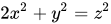
he takes any even number for x and separates into two factors, m and n, then taking


which shows that the first root lies between A'' prime prime and A''', since
A'' < B'' and A''' > B'''.
Furthermore
which is the first approximation.
In the same way the approximate second root is 7.21. The rest of the computation is along lines previously known and already described.
In 1820 an architect named Hirauchi Teishin[6] published a work entitled Sampō Hengyō Shinan,[7] and later the Shoka Kiku Yokai,[8] both intended for men of his profession and for engineers. Much use is made of graphic computation, as in the extraction of the cube root by the use of line intersections. In 1840 Hirauchi wrote another work, the Sampō Chokujutsu Seikai,[9] in which he treated of the geometric properties of figures rather than of their mensuration. While the book had no special merit, it is worthy of note as being a step towards pure geometry, a subject that had been generally neglected in Japan, as indeed in the whole East.
It often happens in the history of mathematics, as in history in general, that some particular branch seems to show itself spontaneously and to become epidemic. It was so with algebra in medieval China, with trigonometry among the Arabs, with the study of equations in the sixteenth century Italian algebra, and with the calculus in the seventeenth century. So it was with the study of geometry in Japan. In the same year that Hirauchi brought out his first little work (1820), Yoshida Jūku published his Kikujutsu Dzukai[10] in which he attempted the solution of a considerable number of problems by the use of the ruler and compasses. It is true that this study had already been begun by Mizoguchi, and had been carried on by Murata Kōryū under whom Yoshida had studied, but the latter was the first of the Mizoguchi school[11] to bring the material together into satisfactory form.
About this time there lived in Ōsaka a teacher named Takeda Shingen, who published in 1824 his Sampō Benran,[12] in which the fan problems of the period appear (Fig. 42), and whose school exercised considerable influence in the western provinces. He also wrote the Shingen Sampō, a work that was published by his son in 1844. The old epigram which he adopted "There is no reason without number, nor is there number without reason," is well known in Japan.
It is, however, with the early stages of geometry that we are interested at this period, and the next noteworthy writer upon the subject was Hashimote Shōhō, who published his Sampō Tenzan Shogakushō[13] in 1830. The particular feature of interest in his work is the geometric treatment of the center of gravity of a figure. One of his problems is to find by geometric drawing the center of gravity of a quadrilateral, and the figure is given, although without explanation.[14]
This problem of the center of gravity now began to attract a good deal of attention in Japan. Perhaps the first real study[15] of the question was made by Takahashi Shiji, since a manuscript entitled Tōkō Sensei Chojutsu Mokurokus[16] mentions a work of his upon this subject. Since this writer was acquainted with the Dutch language and science, he doubtless received his inspiration from this source. His son Takahashi Keihō[17] (1786-1830) was, like himself, on the Astronomical Board of
Fig. 42. From Takeda Shingen's Sampō Benran (1824).
the Shogunate, and was imprisoned from 1828 until his death in 1830, for exchanging maps with Siebold, whose work is mentioned in Chapter XIV.
Of the other minor writers of the opening of the nineteenth century the most prominent was Hasegawa Kan,[18] who published his Sampō Shinsho (New Treatise on Mathematics) in 1830 under the name of one of his pupils. Hasegawa Kan was himself a pupil, and indeed the first and best-known pupil, of Kusaka Sei, the same who had studied under the celebrated. Ajima, and hence he had good mathematical ancestry. His work was a compendium of mathematics, containing the soroban arithmetic, the "Celestial Element" algebra, the tenzan algebra, the yenri, and a little work on geometry, including some study of roulettes (Fig. 43). So well written was it that it became the most popular mathematical treatise in
Fig. 43. From Hasegawa Kan's Sampō Shinsho (1849 edition).
the country and brought to its author much repute as a skilled compiler. Nevertheless the publication of this work led to great bitterness on the part of the Seki school, inasmuch as it made public the final secrets of the yenri that had been so jealously preserved by the members of this educational sect.[19] His act caused his banishment from among the disciples of Seki,[20] but it ended the ancient regime of secrecy in matters mathematical. Hasegawa died in 18 3 8 at the age of fifty-six years.[21]
Among the noteworthy features of the Sampō Shinsho mention should be made of the reversion of series[22] in one of the geometric problems, and of the device of using limiting forms for the purpose of effecting some of the solutions. One of his algebraic-geometric problems is this: Given the diameters of the three escribed circles of a triangle to find the diameter of the inscribed circle. By considering the case in which the three escribed circles are equal, as one of the limits of form, Hasegawa gets on track of the general solution, a device that is commonly employed when we first consider a special case and attempt to pass from that to the general case in geometry. The principle met with severe criticism, it being obvious that we cannot reason from the square as a limit back to a rectangle on the one hand and a rhombus on the other. Nevertheless Hasegawa was very skilful in its use, and in 1835 he wrote another treatise upon the subject, the Sampō Kyoku-gyō Shi-nan[23], published under the name of his pupil,[24] Akita Yoshiichi of Yedo.
It thus appears that the opening years of the nineteenth century were characterized by a greater infiltration of western learning, by some improvement in the tensan algebra, and by the initial steps in pure geometry. None of the names thus far mentioned is especially noteworthy, and if these were all we should feel that Japanese mathematics had taken several steps backward. There was, however, one name of distinct importance in the early years of the century, and this we have reserved for a special chapter,—the name of Wada Nei.
- ↑ Or Inō Tadanori, Inō Tatayoshi, whose life and works are now (1913) being studied by Mr. R. Ōtani.
- ↑ Or Takahashi Shigetoki, Takahashi Yoshitoki, Takahashi Munetoki.
- ↑ As only physicians and interpreters were at this time.
- ↑ A different instrument was invented by Aida Ammei, who left a manuscript work of twenty books upon the ellipse. There is also a manuscript written by Hazama Jūshin in 1828, entitled Dayen Kigen (A description of the ellipse) in which it is claimed that the ellipsograph in question was invented by the writer's father, Hazama Jūfū (or Shigetomi) who lived
- ↑ Seki knew that there are equations with no roots, the mushō shiki (equations without roots), but of the nature of the imaginary he seems to have been ignorant. In Kawai's Kaishiki Shimpō (1803) the statement is made that there may be a mushō (without root), that is, a root that is neither positive nor negative, but nothing is said as to the nature of such a root.
- ↑ Also known by his earlier name of Fukuda Teishin.
- ↑ Also transliterated Sampō-Henkei-shinan. Literally, Treatise on the Hengyō method, Hengyō meaning the changing of forms.
- ↑ Exact notes on direct mathematical methods.
- ↑ Literally, A short treatise on the line methods.
- ↑ Illustrated treatise on the line method. His works are thought by some to have been written by Hasegawa.
- ↑ Endō, Book III, p. 91.
- ↑ Mathematical methods conveniently revealed. He is sometimes known by his familiar name, Tokunoshin.
- ↑ Tenzan method for beginners.
- ↑ Endō, Book III, p. 107, gives a conjectural explanation. He is of the opinion that both the problem and the solution come from European sources.
- ↑ The germ of the theory is found in Seki's writings.
- ↑ List of Master Tōkō's writings, Tōkō being his nout de plume.
- ↑ Or Takahashi Kageyasu.
- ↑ Or Hasegawa Hiroshi.
- ↑ The yenri here described is not the same as that of Ajima or Wada.
- ↑ Endō attributes his banishment to his having appropriated to his own use the money collected for printing Ajima's Fukyū Sampō.
- ↑ Professor Hayashi gives the dates 1792-1832. But see Endō, Book II, p. 12, and Kawakita's article in the Honchō Sūgaku Kōrnshū, р. 17.
- ↑ An essentially similar problem, in connection with a literal equation of infinite degree, seems to have been first studied by Wada Nei.
- ↑ Treatise on the method of limiting forms.
- ↑ A custom of Hasegawa's. See the note on Hirauchi, above.