Star Trek: Captain's Chair (WizKids)
Star Trek: Captain's Chair is a deckbuilding game published by WizKids, designed by Nigel Buckle and Dávid Turczi. It was first released in Q1 of 2025.
Introduction
- From wizkids.com
- In Star Trek: Captain's Chair, you will go head-to-head with an opponent, each stepping into the shoes of an iconic captain from across Star Trek's galaxy and history. Command ships, crew, and away teams, while you manage resources and alliances!
- Each of the six captains come with their own unique, asymmetric deck of cards, themed to that captain's personality strategies, allies, and assets. Each deck creates different strategic directions, based on what common cards are available and what strategy your opponent deploys.
- True to Star Trek, antagonism will not win every game. You will need to pursue diplomacy, exploration, and science, with different captains excelling at different paths.
- With hundreds of unique, deeply thematic cards, you'll want to explore the galaxy again and again!
- The chair is yours, Captain!
Gameplay
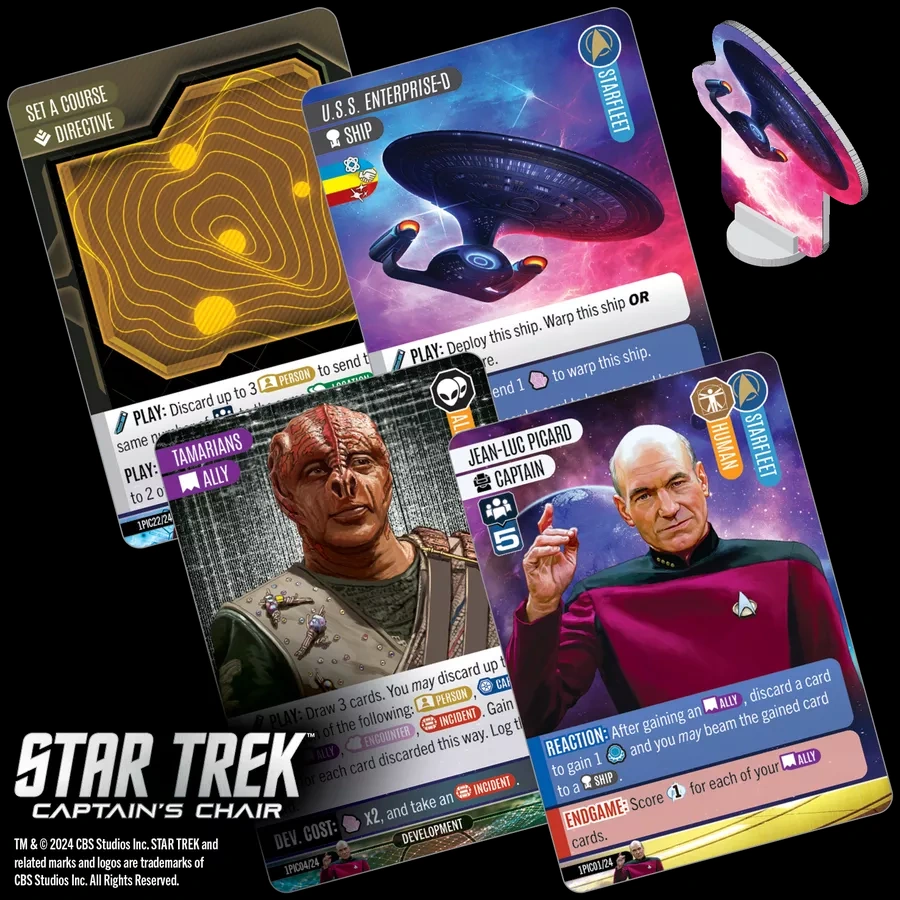
A few examples of cards from the Picard deck
The core gameplay of Star Trek: Captain's Chair features each player starting with a pre-built deck unique to their chosen Captain. Similar to other games in the deckbuilding genre (Imperium, Dominion, etc.) you start with a base deck but modify it throughout gameplay by adding new cards from the common decks and/or removing cards to make your own deck more consistent and focused. As you play cards or otherwise expend them, they are generally discarded and once your deck is empty, you add a new card from your Captain's Reserve or Development pools and then re-shuffle. Some cards can be "logged" (removed from play), but will otherwise still contribute their points.
The goal of the game is to be the Captain with the most Victory Points when the game ends, points that are earned through multiple ways including from valuable cards, the Glory you acquire and Missions that you have completed. You also deploy ships, promote individuals to a Duty Officer and take control of Locations to setup a tableau of effects and abilities that can combine with one another to accelerate your deck before the opposing Captain can do the same.
Along with your base deck, you can acquire cards from Common Card pools: Ships, Persons, Cargo or Allies. Encounters are powerful and generally high-value cards that you can also acquire, but are difficult to gain. Conversely, during the game you may be forced to add Incident cards which are worth negative points and clog up your deck, forcing you to try and find a way to remove them.
In addition to building your deck, you also send out ships or Away Teams to "neutral" (uncontrolled) locations to attempt to bring them under your control before your opponent can. Cards can be "beamed" onto ships or locations to either trigger game effects or help increase your deck's efficiency. You also can complete missions, specific game situations unique to your Captain that you can try to arrange to gain additional points and unlock additional scoring opportunities.
Game length is listed between one and two hours, and there is a maximum amount of turns that can be taken via the Stardate cards, each of which holds an amount of Glory that, when they run out, the endgame is triggered.
In addition to supporting two players, the game also features a specially designed solo mode, allowing you to pit your chosen Captain against a bot, each with their own unique methods of automation. There is also The Five Year Mission, a solo-only campaign that has you take the same Captain against each of the others in the core box, with the difficulty scaling based on your performance.
Content
The game features two (one released, one unreleased) core boxes, each featuring six captains with their own unique decks with which to play. There is also an unreleased expansion, that requires one of the two core boxes to play, which adds three additional captains.
Core Products
- Star Trek: Captain's Chair (Dávid Turczi, Nigel Buckle) [2025]
- Star Trek: Captain's Chair - To Boldy Go (Adam & Dávid Turczi, Nigel Buckle) [Unreleased, ETA: Q4 2025]
Expansions
A core box is required to utilize the content of an expansion as it does not contain the core components.
- Star Trek: Captain's Chair - Second Contact (Adam & Dávid Turczi, Nigel Buckle) [Unreleased, ETA: Q4 2025]
- Carol Freeman
- Christopher Pike (Strange New Worlds timeframe)
- William T. Riker (Lower Decks timeframe)
Card Types
There are ten types of cards in the game, all of which can be featured within a Captain's starting deck or the Common Cards that are acquired through course of play. Each card may have active, triggered or passive effects, a series of traits on them identifying their race and abilities, Focus icons (Science, Military or Diplomacy) as well as any Victory Points they may be inherently worth. Card types marked with an asterisk (*) also have their own Common Card pool and thus are able to be acquired fairly easily.
Captain
The Captain card reflects the particular persona your deck is built around. It is always in play and cannot be typically moved or beamed elsewhere. Examples: Picard, Sela
Location
A representation of a celestial object, usually a space station or planet. They can be neutral (up for grabs) or controlled by a player, usually with a one-time effect when control is achieved. Locations are controlled by having the most presence there, via deployed Ships and Away Teams. Examples: Bajor, Rura Penthe.
Ship*
Spacecraft that when deployed can warp to Locations to help establish control. They can also typically hold beamed cards. Though a ship can also represent stations (such as Deep Space 9, which cannot warp). Examples: USS Enterprise-D, I.R.W. Goraxus.
Person*
A specific being that can be played for their effect or promoted to Duty Officer which will normally grant a useful ability or passive effect (such as increased hand size). Examples: Riker, Harry Mudd
Ally*
A group of beings or generic member of a particular species that can be leveraged for an effect. They are played for an ability and do not typically stay deployed. Examples: Bolians, Halkan Council
Cargo*
An object, such as a weapon, tool or device. They have one-time effects but some can also be deployed. Examples: Plasma manifold system, Phaser
Directive
A one-time event that is played and then discarded. There are some that appear in many different decks as well as normally at least one Captain-specific card. Examples: "Utilize", "Make It So"
Encounter
These unique cards are the most varied and can represent special situations, powerful artifacts or mythic locations. They are typically worth a lot of Victory Points, have powerful effects and can be difficult to obtain. Examples: Iconian gateway, V'ger
Incident
These are negative cards that represent stressful situations or conflicts, and are worth negative Victory Points. Captains can be forced to draw them from various game effects; each has a unique way of removing them from your deck, usually requiring having a certain trait (like "Engineer" or "Ambassador") in play. Examples: Red alert, Energy drain
Status
Cards that add additional passive game effects to your Captain.
Referenced Material
As of the first Core Box, Star Trek: Captain's Chair features content from a wide swath of the Star Trek milieu, including material from:
- Television
- Film
External Links
- Official Website – WizKids store page
- BGG – Board Game Geek entry