Salvage therapy
| Salvage therapy | |
|---|---|
| Other names: Rescue therapy | |
 |
Salvage therapy, also known as rescue therapy, is a form of therapy given after an ailment does not respond to standard therapy.[1] The most common diseases that require salvage therapy are HIV and various cancers. The term is not clearly defined; it is used both to mean a second attempt and a final attempt.[2] Salvage therapy drugs or drug combinations have, in general, much more severe side effects than the standard line of therapy. This is often true of a drug of last resort.
Uses
HIV
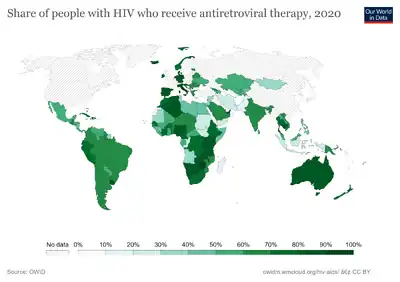
Antiretroviral drugs (ARVs) are given to slow down the HIV reproduction, which in turn increases quality of life and survival.[4]
If the patient's viral load (the amount of HIV in the blood) rebounds after being suppressed by ARVs, the virus has likely developed resistance to the ARVs. As more and more mutations conferring drug resistance develop in the HIV's genome, it becomes difficult to select an ARV that will meaningfully suppress HIV replication and keep the patient's viral load low. Salvage therapy, in this context, is the attempt to contain the replicating HIV once the usual line of treatments have been exhausted.[5]
When at least one regimen containing protease inhibitors has failed in a patient, the subsequent attempts to treat the HIV infection may be referred to as salvage therapy.[6]
Cancers
Salvage chemotherapy is a treatment that is given after the cancer has not responded to other chemotherapy regimens.[7]
See also
References
- ↑ "Definition of Salvage therapy". MedicineNet.com. 2006. Archived from the original on 2012-08-07. Retrieved 2006-10-26.
- ↑ "HIV Therapy 2006". Flying Publisher. 2006. Archived from the original on 2019-05-16. Retrieved 2006-10-26.
- ↑ "Salvage therapy" (PDF). UCSD. Retrieved 5 June 2025.
- ↑ "Antiretroviral Therapy (ART)". World Health Organization. 2006. Archived from the original on 2019-07-20. Retrieved 2006-10-26.
- ↑ "SALVAGE THERAPY". The AIDS InfoNet. 2006. Archived from the original on 2006-10-05. Retrieved 2006-10-26.
- ↑ "HIV Medicine 15th Edition". Flying Publisher. 2007. Archived from the original on 2019-06-07. Retrieved 2024-02-12.
- ↑ "NCI Dictionary of Cancer Terms". Archived from the original on 2018-01-23. Retrieved 2024-02-12.