Rapid influenza diagnostic test
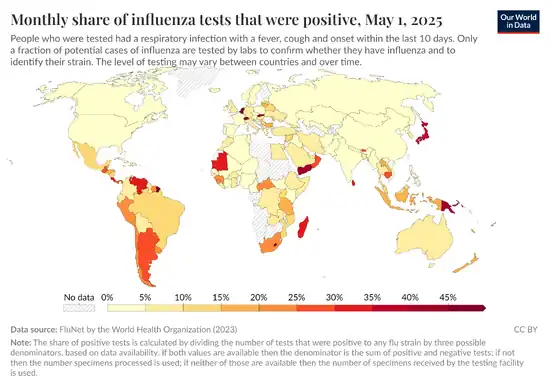
A rapid influenza diagnostic test (RIDT) tells whether a person has a current influenza infection by detecting the influenza viral nucleoprotein antigen. Commercially available RIDTs can provide results within 30 minutes. These results can be observed by a color change or other visual signals.[3][4] For clinicians, RIDTs serve as a first-line test that can be confirmed (especially if negative) by traditional diagnostic tests. RIDTs also allow clinicians to promptly start antiviral treatment in high-risk populations, to formulate effective infection control measures, and to make informed decisions regarding diagnostic investigations.[5][6] RIDTs have been shown to reduce chest radiography and blood tests in ambulatory care settings, but not antibiotic prescribing, or time in the emergency department.[7]
According to a study, an H1N1 rapid test had a sensitivity of 66 %, corresponding to a false-negative probability of 34 % in detecting H1N1.[8]
Sample collection
RIDT accuracy may be dependent on collection technique used to obtain the sample. Samples used for RIDT include respiratory specimens such as throat, nose, and nasopharyngeal secretions, as well as aspirate or washings collected from the trachea.[9]
See also
References
- ↑ "Flunet". www.who.int. Retrieved 30 June 2025.
- ↑ "Influenza Data Explorer". Our World in Data. Retrieved 30 June 2025.
- ↑ Vemula SV, Zhao J, Liu J, Wang X, Biswas S, Hewlett I (April 2016). "Current Approaches for Diagnosis of Influenza Virus Infections in Humans". Viruses. 8 (4): 96. doi:10.3390/v8040096. PMC 4848591. PMID 27077877.
- ↑ "Rapid Influenza Diagnostic Tests | Seasonal Influenza (Flu) | CDC". www.cdc.gov. 2017-04-07. Archived from the original on 2024-09-21. Retrieved 2018-09-08.
- ↑ "Accuracy of Rapid Influenza Diagnostic Tests: A Meta Analysis". www.annals.org. 2012-04-03. Archived from the original on 2020-04-30. Retrieved 2018-11-01.
- ↑ Chartrand C, Pai M (June 2012). "How accurate are rapid influenza diagnostic tests?". Expert Review of Anti-Infective Therapy. 10 (6): 615–7. doi:10.1586/eri.12.49. PMID 22734950.
- ↑ Lee, Joseph J; Verbakel, Jan Y; Goyder, Clare R; Ananthakumar, Thanusha; Tan, Pui San; Turner, Phillip J; Hayward, Gail; Van den Bruel, Ann (4 October 2018). "The clinical utility of point-of-care tests for influenza in ambulatory care: A systematic review and meta-analysis". Clinical Infectious Diseases. 69 (1): 24–33. doi:10.1093/cid/ciy837. PMC 6579962. PMID 30285232.
- ↑ Louie JK, Guevara H, Boston E, Dahlke M, Nevarez M, Kong T, Schechter R, Glaser CA, Schnurr DP (May 2010). "Rapid influenza antigen test for diagnosis of pandemic (H1N1) 2009". Emerging Infectious Diseases. 16 (5): 824–6. doi:10.3201/eid1605.091797. PMC 2954007. PMID 20409373.
- ↑ "Use of Influenza Rapid Diagnostic Tests" (PDF). Special Programme for Research and Training in Tropical Diseases. World Health Organization. 2010. Archived (PDF) from the original on 2022-06-16. Retrieved 2024-12-06.
Further reading
- "Interim Guidance for the Detection of Novel Influenza A Virus Using Rapid Influenza Diagnostic Tests". H1N1 Flu. Centers for Disease Control and Prevention. 2009-08-10. Archived from the original on 2009-11-24. Retrieved 2009-11-23.