Klebsiella electrica
| Klebsiella electrica | |
|---|---|
 | |
| Species R. planticola from the same genus | |
Scientific classification  | |
| Domain: | Bacteria |
| Kingdom: | Pseudomonadati |
| Phylum: | Pseudomonadota |
| Class: | Gammaproteobacteria |
| Order: | Enterobacterales |
| Family: | Pectobacteriaceae |
| Genus: | Klebsiella |
| Species: | K. electrica |
| Binomial name | |
| Klebsiella electrica (Kimura et al. 2014) Ma et al. 2022[1] | |
| Synonyms | |
|
Raoultella electrica Kimura et al. 2014 | |
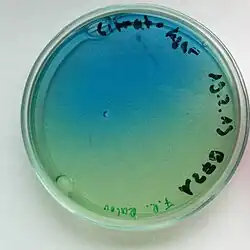
Klebsiella electrica is a Gram-negative, non-spore-forming, rod-shaped bacterium of the genus Klebsiella. It was formerly known as Raoultella electrica before being reclassified in 2022 based on phylogenomic evidence.[1] The type strain of K. electrica was isolated from anodic biofilms of a microbial fuel cell fed with glucose.[2]
Type strain
The type strain of Klebsiella electrica, 1GB, is a facultative anaerobic and chemo-organotrophic bacterium capable of both respiratory and fermentative metabolism. It can utilize a wide variety of sugars as carbon and energy sources.[2]
Description
K. electrica cells are Gram-negative, non-spore-forming, rod-shaped, facultative anaerobic, and non-motile. Their width is approximately 0.3–0.4 μm, and their length ranges from 3.0 to 6.0 μm. They grow optimally at 37 °C and are also capable of growth at 41 °C. Unlike Klebsiella pneumoniae, K. electrica strains can grow at 10 °C but not at 5 °C.[2] These bacteria are Voges–Proskauer positive. Their ability to produce histamine has not been confirmed.[3]
Taxonomy
Klebsiella electrica was originally described as Raoultella electrica in 2014.[2] In 2021, a phylogenomic study by Ma et al. demonstrated that species of the genus Raoultella were nested within the genus Klebsiella, sharing a monophyletic lineage, high average amino acid identity (AAI), and conserved signature indels. Based on this evidence, the authors proposed the reunification of the two genera.[1] The corrigendum in 2022 formalized the taxonomic reclassification of R. electrica as Klebsiella electrica comb. nov.
The species epithet electrica (from Latin electrum, "amber") refers to the electricity-generating microbial environment from which it was isolated—anodic biofilms of a microbial fuel cell in Sapporo, Japan.[2][4]
Pathogenicity
The pathogenic potential of K. electrica is currently unknown.[3] However, the bacterium was isolated from chicken eggs in Jaipur, India, displaying a multidrug resistance profile.[5]
References
- 1 2 3 Ma, Yuanyuan; Wu, Xiuqin; Li, Shuying; Tang, Lie; Chen, Mingyue; An, Qianli (2022). "Corrigendum to "Proposal for reunification of the genus Raoultella with the genus Klebsiella and reclassification of Raoultella electrica as Klebsiella electrica comb. nov."". Research in Microbiology. 173 (6–7) 103924. doi:10.1016/j.resmic.2022.103924. PMID 35816932.
- 1 2 3 4 5 Kimura, Z. I.; Chung, K. M.; Itoh, H.; Hiraishi, A.; Okabe, S. (April 2014). "Raoultella electrica sp. nov., isolated from anodic biofilms of a glucose-fed microbial fuel cell". International Journal of Systematic and Evolutionary Microbiology. 64 (Pt 4). Microbiology Society: 1384–1388. doi:10.1099/ijs.0.058826-0. PMID 24449794.
- 1 2 Appel, Tobias M.; Quijano-Martínez, Natalia; De La Cadena, Elsa; Mojica, María F.; Villegas, María Virginia (2021). "Microbiological and Clinical Aspects of Raoultella spp". Frontiers in Public Health. 9 686789. Bibcode:2021FrPH....986789A. doi:10.3389/fpubh.2021.686789. PMC 8365188. PMID 34409007.
- ↑ "NBRC 109676: Raoultella electrica Kimura et al. 2014". NBRC Culture Collection. 2013.
- ↑ Jain, A. K.; Yadav, R. (2018). "First report of isolation and antibiotic susceptibility pattern of Raoultella electrica from table eggs in Jaipur, India". New Microbes and New Infections. 21: 95–99. doi:10.1016/j.nmni.2017.11.004. PMC 5773470. PMID 29379605.