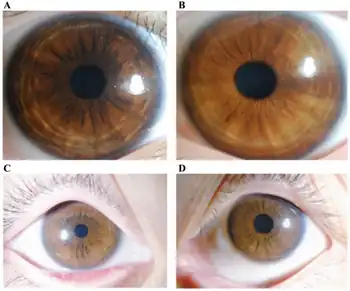
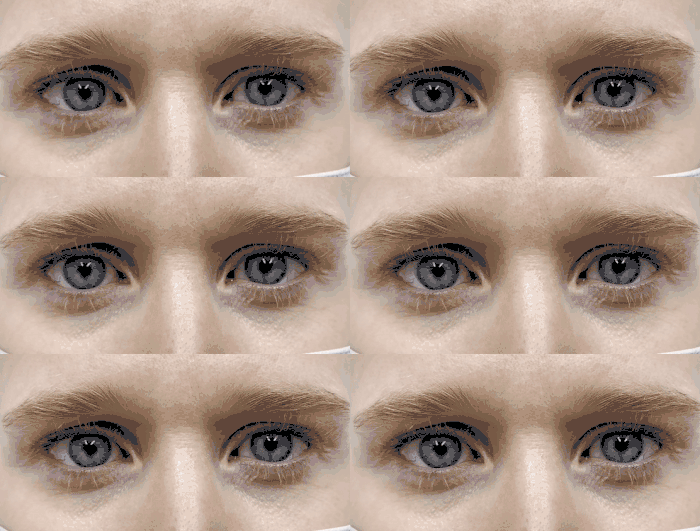
Ocular albinism is a form of albinism which, in contrast to oculocutaneous albinism, presents primarily in the eyes.[1] There are multiple forms of ocular albinism, which are clinically similar.[2]: 865
Both known genes are on the X chromosome. When the term "autosomal recessive ocular albinism" ("AROA") is used, it usually refers to mild variants of oculocutaneous albinism rather than ocular albinism, which is X-linked.[3]
Also known as Nettleship–Falls syndrome,[4][5][6] is the most common variety of ocular albinism. OA1 is usually associated with nystagmus, and difficult to otherwise detect in females; males show more readily observable symptoms.
Also known as Forsius–Eriksson syndrome[8][9] or "Åland eye disease", mostly affects males, though females are often carriers and can sometimes be symptomatic; it is frequently linked with protanopic dichromacy (a form of color blindness) and with night blindness (nyctalopia).
↑E. Nettleship. On some hereditary diseases of the eye. Transactions of the Ophthalmological Societies of the United Kingdom, 1908-1909, 29: 57-198.
↑H. F. Falls. Sex-linked ocular albinism displaying typical fundal changes in the female heterozygote. American Journal of Ophthalmology, Chicago, 1951, 34: 41-50.
↑Forsius H, Eriksson AW (April 1964). "[A new eye syndrome with X-chromosomal transmission. a family clan with fundus albinism, fovea hypoplasia, nystagmus, myopia, astigmatism and dyschromatopsia.]". Klin Monatsbl Augenheilkd (in Deutsch). 144: 447–57. PMID 14230113.
↑Winship IM, Babaya M, Ramesar RS (November 1993). "X-linked ocular albinism and sensorineural deafness: linkage to Xp22.3". Genomics. 18 (2): 444–5. doi:10.1006/geno.1993.1495. PMID 8288253.