Occupational cancer
| Occupational cancer | |
|---|---|
| Other names: Workplace cancer[1] | |
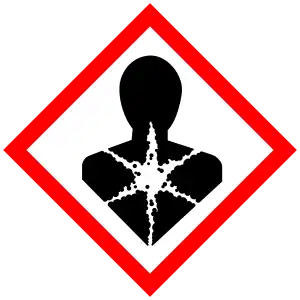 | |
| Label for substances dangerous to human health. | |
 | |
| Specialty | Oncology, occupational safety |
| Usual onset | >10 yrs from exposure[2] |
| Causes | Chemicals, radiation, shift work[1][3] |
| Prevention | Decreased use of certain chemicals, limiting exposure[4][2] |
| Frequency | 2 to 8% of cancers[5] |
| Deaths | 350,000 in 2016[4] |
Occupational cancers are cancers at least partly caused by exposures at work.[1][4] Types commonly include lung cancer including mesothelioma, bladder cancer, and leukemia.[6] The period between exposure and onset of cancer is often more than 10 years.[2]
Risk factors include certain chemicals, radiation, and possibly shift work.[1][3] Chemicals include asbestos, second hand smoke, silica dust, arsenic, radon, benzene, and diesel fumes.[7][4][6] Other factors include frequency, amount, duration, and how the exposure occurs.[8] Professions more commonly affected include farmers, miners, painters, firefighters, and manufacturers of aluminium and rubber.[1][5]
Prevention involves decreasing the use of certain chemicals and if this is not possible limiting exposure to these substances, a process known as hierarchy of controls.[4][2][9] This often involves regulation and protective equipment.[2] Agencies often specify maximum allowed exposures and may put in place routine monitoring.[8] International Agency for Research on Cancer (IARC) and American Conference of Governmental Industrial Hygienists (ACGIH) have classifications for a substances risk.[8]
Occupational cancer represents 2 to 8% of cancers[5] and are responsible for about 3.5 to 5% of cancer deaths (350,000 in 2016).[10][4] Males are more commonly affected than females.[10] In the developed world they represent just over half of work related deaths.[11] They were first identified in the 1700s by Percivall Pott among people who clean chimneys.[4]
Risks
Occupational exposure to chemicals, dusts, radiation, and certain industrial processes have been tied to occupational cancer. Exposure to cancer-causing chemicals (carcinogens) may cause mutations that allow cells to grow out of control, causing cancer. Carcinogens in the workplace may include chemicals like anilines, chromates, dinitrotoluenes, arsenic and inorganic arsenic compounds, beryllium and beryllium compounds, cadmium compounds, and nickel compounds.[12] Dusts that can cause cancer leather or wood dusts, asbestos,[13] crystalline forms of silica, coal tar pitch volatiles, coke oven emissions, diesel exhaust and environmental tobacco smoke.[12] sunlight; radon gas; and industrial, medical, or other exposure to ionizing radiation can all cause cancer in the workplace. Industrial processes associated with cancer include aluminum production; iron and steel founding; and underground mining with exposure to uranium or radon. Shift work, which can disturb the circadian rhythm, has also been identified as a risk factor for some forms of cancer, in particular for breast cancer. [14][15][16]
Other risk factors for cancer include:[17][18][19]
- Personal characteristics such as age, sex, and race
- Family history of cancer
- Being overweight or having obesity
- Diet and personal habits such as tobacco use and alcohol consumption
- The presence of certain medical conditions or past medical treatments, including chemotherapy, radiation treatment, or some immune-system suppressing drugs
- Certain infectious agents (viruses, bacteria, parasites) including human papillomaviruses, Epstein–Barr virus, hepatitis B virus, hepatitis C virus, and helicobacter pylori
- Exposure to cancer-causing agents in the environment (for example, sunlight, radon gas, air pollution)
Firefighting
Firefighters have shown higher rates of certain types of cancer (respiratory, digestive, and urinary systems), and of all cancers combined, when compared to the general U.S. population.[20] This is linked to many aspects of the firefighting occupation such as exposure to smoke and other products of combustion that are known carcinogens, as well as being exposed to chemicals in the gear worn to protect the firefighter. [21]
Due to the lack of central and comprehensive sources of data, research on cancer rates amongst firefighters has been challenging.[22][23][24][25] On July 7, 2018, Congress passed the Firefighter Cancer Registry Act of 2018 requiring the National Institute for Occupational Safety and Health of the Centers for Disease Control and Prevention to create the National Firefighter Registry designed to collect data on cancer rates among U.S. firefighters.[26][27][28]
Construction
Construction workers are at a higher risk of developing cancer from exposures at work compared to other occupations.[29][30][31]
The increased levels of dust and chemicals like asbestos at construction sites leads to workers being exposed. These long term exposures have been linked to the development of lung cancer.[30] Other factors related to construction work can also put the workers at an elevated risk of cancer such as sun exposure. Construction workers are often required to spend long hours working in the sun. Long periods of exposure to radiation from the sun can cause skin cancer.[31][32]
Agriculture
Agricultural workers face higher rates of cancer development due to exposures on the job.[33]
Similar to construction workers, agricultural workers are exposed too many chemicals including known carcinogens. Workers in the agricultural field are also subject to long periods of exposure to radiation from the sun. All of these factors combine put the workers at and increased risk of developing cancers such as prostate cancer, multiple myeloma, and melanoma of the skin.[33]
Types
Common cancers due to work:[13]
| Cancer | Source | Examples of Occupations |
|---|---|---|
| Bladder | Benzidine, beta-naphthylamine,
4-aminobiphenyl, arsenic |
Rubber, leather, paving, roofing,
printing and textile industries; paint/ dyeing products; chimney sweeping; machinists; hairdressers and barbers; truck drivers |
| Kidney | Cadmium, trichloroethylene, herbicides,
wood dust |
Painting; metalworking; petroleum,
plastics, and textile industries |
| Larynx | Asbestos, wood dust, paint fumes | Metal working; petroleum, rubber,
plastics, and textile industries |
| Leukemia | Formaldehyde, benzene, ethylene
oxide, pesticides |
Rubber manufacturing; oil refining;
shoemaking, funeral embalming |
| Liver | Arsenic, vinyl chloride, aflatoxins | Plastic manufacturing |
| Lung | Radon, secondhand smoke, asbestos,
arsenic, cadmium, chromium compounds, diesel exhaust, sulfur mustard |
Rubber manufacturing, paving,
roofing, painting, chimney sweeping, iron and steel foundry work, welding |
| Lymphoma | Benzene, 1, 3-butadiene, ethylene
oxide, herbicides, insecticides |
Rubber manufacturing, painting,
hairdresser or barber |
| Mesothelioma | Asbestos | Mining, railroad, automotive,
plumbing, painting and construction industries; factory workers |
| Nasal cavity and sinus | Mustard gas, nickel dust, chromium
dust, leather dust, wood dust, radium |
Textile and baking industry, flour
milling, nickel refining, furniture and cabinet builders, shoemaking |
| Skin | Arsenic, coal tars, paraffin, certain oils,
sunlight |
Chimney sweeping; outside jobs that
involve a lot of sun exposure |
Prevention
Many occupational cancers are preventable. Personal protective gear, workplace controls, and worker education can prevent exposure to carcinogens in the workplace. Tobacco smoking has also been shown to increase the risk of work-related cancers; decreasing or abstaining from smoking can decrease cancer risk.[13]
Agencies like the US Food and Drug Administration, Environmental Protection Agency, the International Agency for Research on Cancer (IARC) and Occupational Safety and Health Administration have developed safety standards and limits for chemical and radiation exposure.[13] International Labour Organization has also adopted Occupation Cancer Convention (C139) in 1979 for improvement of workplace safety conditions.
Epidemiology
An estimated 48,000 cancers are diagnosed yearly in the US that come from occupational causes; this represents approximately 4-10% of total cancer in the United States.[34] It is estimated that 19% of cancers globally are attributed to environmental exposures (including work-related exposures).[35] It is estimated that there are approximately 120,000 work-related cancer cases annually in the EU due to exposure to carcinogens at work.[36]
References
- ↑ 1.0 1.1 1.2 1.3 1.4 "Workplace cancer". www.cancer.org.au. Cancer Council. Retrieved 31 May 2025.
- ↑ 2.0 2.1 2.2 2.3 2.4 "Occupational cancers". www.hseni.gov.uk. Health and Safety Executive. Retrieved 1 June 2025.
- ↑ 3.0 3.1 "Cancer risks in the workplace". Cancer Research UK. 24 March 2015. Retrieved 1 June 2025.
- ↑ 4.0 4.1 4.2 4.3 4.4 4.5 4.6 "Work-related cancer". oshwiki.osha.europa.eu. OSHwiki | European Agency for Safety and Health at Work. Retrieved 31 May 2025.
- ↑ 5.0 5.1 5.2 CDC (2025-03-26). "Occupational Cancer". Cancer. Archived from the original on 2024-09-14. Retrieved 2025-05-31.
- ↑ 6.0 6.1 Pandey, KR (5 May 2007). "Occupational cancer kills more than 200,000 people a year". BMJ (Clinical research ed.). 334 (7600): 925. doi:10.1136/bmj.39202.548588.DB. PMID 17478820.
- ↑ "Preventing occupational cancer". IOSH. Archived from the original on 19 March 2025. Retrieved 31 May 2025.
- ↑ 8.0 8.1 8.2 Government of Canada, Canadian Centre for Occupational Health and Safety (24 June 2025). "CCOHS: Occupational Cancer". www.ccohs.ca. Retrieved 28 July 2025.
- ↑ Government of Canada, Canadian Centre for Occupational Health and Safety (24 June 2025). "CCOHS: Hazard and Risk - Hierarchy of Controls". www.ccohs.ca. Archived from the original on 9 July 2025. Retrieved 28 July 2025.
- ↑ 10.0 10.1 Weiderpass, Elisabete; Schubauer-Berigan, Mary; Schüz, Joachim (5 July 2024). "GLOBAL CANCER BURDEN DUE TO OCCUPATIONAL EXPOSURES". Occupational Medicine. 74 (Supplement_1): 0–0. doi:10.1093/occmed/kqae023.0001. Archived from the original on 14 September 2024. Retrieved 13 September 2024. Archived 14 September 2024 at the Wayback Machine
- ↑ "Work-related cancer". osha.europa.eu. Safety and health at work EU-OSHA. Archived from the original on 3 March 2022. Retrieved 1 June 2025.
- ↑ 12.0 12.1 "Carcinogen List". National Institute for Occupational Safety and Health. 2 May 2012. Archived from the original on 30 January 2014. Retrieved 5 January 2014. Archived 20 May 2024 at the Wayback Machine
- ↑ 13.0 13.1 13.2 13.3 "Occupation and Cancer" (PDF). American Cancer Society. January 2016. Archived from the original (PDF) on 20 May 2016. Retrieved 12 February 2016. Archived 30 October 2010 at the Wayback Machine
- ↑ Fritschi L (July 2009). "Shift work and cancer". BMJ. 339: b2653. doi:10.1136/bmj.b2653. PMID 19605423. S2CID 36132408.
- ↑ Stevens RG, Hansen J, Costa G, Haus E, Kauppinen T, Aronson KJ, et al. (February 2011). "Considerations of circadian impact for defining 'shift work' in cancer studies: IARC Working Group Report". Occupational and Environmental Medicine. 68 (2): 154–162. doi:10.1136/oem.2009.053512. PMID 20962033. S2CID 16553063. Archived from the original on 2024-09-14. Retrieved 2024-09-12. Archived 2024-09-14 at the Wayback Machine
- ↑ Megdal SP, Kroenke CH, Laden F, Pukkala E, Schernhammer ES (September 2005). "Night work and breast cancer risk: a systematic review and meta-analysis". European Journal of Cancer. 41 (13): 2023–2032. doi:10.1016/j.ejca.2005.05.010. PMID 16084719.
- ↑ "CDC - Cancer Policy - NIOSH Workplace Safety and Health Topic". www.cdc.gov. Archived from the original on 2019-08-31. Retrieved 2016-02-12. Archived 2019-08-31 at the Wayback Machine
- ↑ "Risk Factors and Cancer | CDC". www.cdc.gov. 2021-12-01. Archived from the original on 2020-01-03. Retrieved 2022-03-14. Archived 2020-01-03 at the Wayback Machine
- ↑ "Risk Factors for Cancer - National Cancer Institute". www.cancer.gov. 2015-04-29. Archived from the original on 2022-03-14. Retrieved 2022-03-14. Archived 2022-03-14 at the Wayback Machine
- ↑ Daniels RD, Kubale TL, Yiin JH, Dahm MM, Hales TR, Baris D, et al. (June 2014). "Mortality and cancer incidence in a pooled cohort of US firefighters from San Francisco, Chicago and Philadelphia (1950-2009)". Occupational and Environmental Medicine. 71 (6): 388–397. doi:10.1136/oemed-2013-101662. PMC 4499779. PMID 24142974.
- ↑ "Wear and Tear May Cause Firefighter Gear to Release More 'Forever Chemicals'". NIST. 2024-01-16. Archived from the original on 2024-07-18. Retrieved 2024-09-12. Archived 2024-07-18 at the Wayback Machine
- ↑ Daniels, Robert D; Kubale, Travis L; Yiin, James H; Dahm, Matthew M; Hales, Thomas R; Baris, Dalsu; Zahm, Shelia H; Beaumont, James J; Waters, Kathleen M; Pinkerton, Lynne E (June 2014). "Mortality and cancer incidence in a pooled cohort of US firefighters from San Francisco, Chicago and Philadelphia (1950–2009)". Occupational and Environmental Medicine. 71 (6): 388–397. doi:10.1136/oemed-2013-101662. ISSN 1351-0711. PMC 4499779. PMID 24142974.
- ↑ Tsai, Rebecca J.; Luckhaupt, Sara E.; Schumacher, Pam; Cress, Rosemary D.; Deapen, Dennis M.; Calvert, Geoffrey M. (May 6, 2015). "Risk of cancer among firefighters in California, 1988-2007". American Journal of Industrial Medicine. 58 (7): 715–729. doi:10.1002/ajim.22466. ISSN 0271-3586. PMC 4527530. PMID 25943908. Archived from the original on September 14, 2024. Retrieved September 12, 2024. Archived September 14, 2024, at the Wayback Machine
- ↑ Lee, David J.; Koru-Sengul, Tulay; Hernandez, Monique N.; Caban-Martinez, Alberto J.; McClure, Laura A.; Mackinnon, Jill A.; Kobetz, Erin N. (April 2020). "Cancer risk among career male and female Florida firefighters: Evidence from the Florida Firefighter Cancer Registry (1981-2014)". American Journal of Industrial Medicine. 63 (4): 285–299. doi:10.1002/ajim.23086. ISSN 1097-0274. PMID 31930542. S2CID 210191181. Archived from the original on 2024-01-29. Retrieved 2024-09-12. Archived 2024-01-29 at the Wayback Machine
- ↑ Ma, Fangchao; Fleming, Lora E.; Lee, David J.; Trapido, Edward; Gerace, Terence A. (September 2006). "Cancer incidence in Florida professional firefighters, 1981 to 1999". Journal of Occupational and Environmental Medicine. 48 (9): 883–888. doi:10.1097/01.jom.0000235862.12518.04. ISSN 1076-2752. PMID 16966954. S2CID 45179842. Archived from the original on 2024-09-17. Retrieved 2024-09-12. Archived 2024-09-17 at the Wayback Machine
- ↑ "Firefighter Cancer Registry Act of 2018 (2018 - H.R. 931)". GovTrack.us. Archived from the original on February 8, 2022. Retrieved May 9, 2022. Archived February 8, 2022, at the Wayback Machine
- ↑ "National Firefighter Registry". U.S. National Institute for Occupational Safety and Health. 2022-09-19. Archived from the original on 2022-10-17. Retrieved 2022-11-08. Archived 2022-10-17 at the Wayback Machine
- ↑ "The National Firefighter Registry: An update on the plan to track firefighter cancer". FireRescue1. Archived from the original on April 7, 2022. Retrieved September 30, 2022. Archived April 7, 2022, at the Wayback Machine
- ↑ Dement, John M.; Ringen, Knut; Hines, Stella; Cranford, Kim; Quinn, Patricia (January 29, 2020). "Lung cancer mortality among construction workers: implications for early detection". Occupational and Environmental Medicine. 77 (4): 207–213. doi:10.1136/oemed-2019-106196. ISSN 1470-7926. PMID 31996473. Archived from the original on April 8, 2024. Retrieved September 12, 2024. Archived April 8, 2024, at the Wayback Machine
- ↑ 30.0 30.1 "Construction Workers at Increased Risk for Life-Threatening Lung Disease, Study Finds". Duke Duke Department of Family Medicine and Community Health. 2023-04-20. Archived from the original on 2024-04-08. Retrieved 2024-04-08. Archived 2024-04-08 at the Wayback Machine
- ↑ 31.0 31.1 D.O, John J. Pierce (2023-07-07). "Increased Cancer Rates Among Construction Workers". Preventative Diagnostic Center. Archived from the original on 2024-09-14. Retrieved 2024-04-08. Archived 2024-09-14 at the Wayback Machine
- ↑ "HSM MAGAZINE - Skin cancer risk for construction workers". www.hsmsearch.com. Archived from the original on 2024-04-08. Retrieved 2024-04-08. Archived 2024-04-08 at the Wayback Machine
- ↑ 33.0 33.1 Togawa, Kayo; Leon, Maria E.; Lebailly, Pierre; Beane Freeman, Laura E.; Nordby, Karl-Christian; Baldi, Isabelle; MacFarlane, Ewan; Shin, Aesun; Park, Sue; Greenlee, Robert T.; Sigsgaard, Torben; Basinas, Ioannis; Hofmann, Jonathan N.; Kjaerheim, Kristina; Douwes, Jeroen (August 27, 2021). "Cancer incidence in agricultural workers: Findings from an international consortium of agricultural cohort studies (AGRICOH)". Environment International. 157: 106825. doi:10.1016/j.envint.2021.106825. ISSN 1873-6750. PMC 8484858. PMID 34461377.
- ↑ "Occupational Cancer". National Institute for Occupational Safety and Health. 2 May 2012. Archived from the original on 8 March 2020. Retrieved 5 January 2014. Archived 8 March 2020 at the Wayback Machine
- ↑ "Environmental and occupational cancers". World Health Organization. Archived from the original on December 4, 2013. Retrieved 2016-02-12. Archived 2013-12-04 at the Wayback Machine
- ↑ "Work-related cancer | Safety and health at work EU-OSHA". osha.europa.eu. Archived from the original on 2022-03-03. Retrieved 2022-03-14. Archived 2022-03-03 at the Wayback Machine
External links
- Firefighters and Cancer Archived 2024-09-14 at the Wayback Machine, National Firefighter Protection Association.
- Firefighters Cancer Foundation Australia Archived 2024-07-20 at the Wayback Machine.
- Firefighter Cancer Support Network Archived 2024-09-14 at the Wayback Machine (FCSN).
- Occupational Cancer in the Fire Service Archived 2024-02-22 at the Wayback Machine, Commonwealth of Massachusetts.
- National Firefighter Registry Archived 2022-10-17 at the Wayback Machine (NFR) for Cancer, National Institute for Occupational Safety and Health (NIOSH), USA
- Stop carcinogens at work Archived 2024-09-14 at the Wayback Machine, EU OSHA. The site shares information to help prevent workers from being exposed to carcinogens in the workplace.
- Occupational Cancer Archived 2024-09-14 at the Wayback Machine, NIOSH.
- NIOSH Pocket guide to chemical hazards, Appendix A- NIOSH Potential Occupational Carcinogens Archived 2024-05-20 at the Wayback Machine.