Johns Hopkins School of Medicine
 | |
| Type | Private medical school |
|---|---|
| Established | 1893 |
Parent institution | Johns Hopkins University |
| President | Ronald J. Daniels |
| Dean | Theodore DeWeese |
Academic staff | 2,980+ full-time 1,270+ part-time[1] |
| Students | 480 (M.D. and M.D.-Ph.D)[2] 1,400 total[3] |
| Location | Baltimore , Maryland , U.S. |
| Campus | Urban |
| Website | hopkinsmedicine.org |
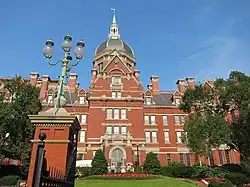
The Johns Hopkins University School of Medicine (JHUSOM) is the medical school of Johns Hopkins University, a private research university in Baltimore, Maryland. Established in 1893 following the construction of the Johns Hopkins Hospital, Hopkins became a model for modern medical education.[4] The school is recognized as a major center of biomedical research and is consistently ranked as one of the top medical schools in the United States.[5][6][7][8]
The School of Medicine is located in Baltimore, Maryland, where it shares a campus in East Baltimore with the School of Nursing, Bloomberg School of Public Health, and Johns Hopkins Hospital, the school's primary teaching hospital.[9] As part of the larger Johns Hopkins Medicine health system, the school is also affiliated with numerous regional hospitals and medical centers including the Johns Hopkins Bayview Medical Center, Johns Hopkins Howard County Medical Center, Suburban Hospital in Montgomery County, Sibley Memorial Hospital in Washington, D.C.[10]
History
Before his death in 1873, Baltimore financier and philanthropist Johns Hopkins appointed a 12-member board of trustees to carry out his vision for a university and hospital that would be linked to each other by a medical school, which was at the time a radical idea.
Construction of the Johns Hopkins Hospital began in 1877 with the razing of the site formerly occupied by the city's mental asylum, and took twelve years to complete. By the time the hospital opened in 1889, only six of the original twelve trustees appointed by Hopkins were still alive. Despite having already recruited the necessary faculty, the board no longer had enough funds to establish the medical school.[11]
Four of the original trustee's daughters, led by Mary Elizabeth Garrett, started a nationwide fundraising campaign to secure funding for the medical school. The campaign was stipulated on the condition that the remaining trustees agree to open the medical school to both men and women, as women were generally excluded from medical education in the 1890s. When the Johns Hopkins University School of Medicine officially opened its doors in 1893, there were three women in its first class.[12]
The founding physicians of the JHUSOM were pathologist William Henry Welch (1850–1934), the first dean of the school, Canadian internist William Osler (1849–1919), author of The Principles and Practice of Medicine (1892), surgeon William Stewart Halsted (1852–1922), who revolutionized surgery by insisting on subtle skill and technique and strict adherence to aseptic technique, and gynecological surgeon Howard Atwood Kelly (1858–1943), credited with establishing gynecology as a specialty and among the first to use radium in the treatment of cancer.[13]
Facilities
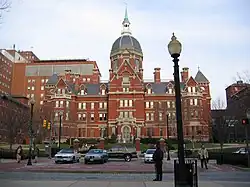
The School of Medicine, along with the Johns Hopkins Hospital (the School of Medicine's primary teaching hospital), Johns Hopkins Children's Center, Bloomberg School of Public Health, and School of Nursing, are located on the Johns Hopkins Medical Campus in East Baltimore.[14]
The wider Johns Hopkins Medicine system includes several other regional medical centers, including Johns Hopkins Bayview Medical Center on Eastern Avenue in East Baltimore, Howard County General Hospital in Columbia, Suburban Hospital in Bethesda, Sibley Memorial Hospital in Washington, D.C., and Johns Hopkins All Children's Hospital in St. Petersburg, Florida.[15] Together, they form an academic health science center.
Rankings and reputation
According to the Flexner Report, Hopkins has served as the model for American medical education.[16]
Its major teaching hospital, the Johns Hopkins Hospital, was ranked the top hospital in the United States every year from 1991 to 2011 by U.S. News & World Report.[17] In 2024, U.S. News & World Report ranked Hopkins #2 medical school in the U.S. for Research, and #92 for Primary Care. U.S. News also ranked Hopkins #1 in Anesthesiology, #1 in Internal Medicine, #2 in Obstetrics and Gynecology, #4 in Pediatrics, #3 in Psychiatry, tied at #3 in Radiology, and #1 in Surgery.[18][19]
Academics
Colleges Advisory Program
Upon matriculation, medical students at Johns Hopkins School of Medicine are divided into four colleges named after Hopkins faculty members who have had an impact in the history of medicine, Florence Sabin, Vivien Thomas, Daniel Nathans, and Helen Taussig. The colleges were established in 2005.[20]
In each incoming class, 30 students are assigned to each college, and each college is further subdivided into six molecules of five students each. Each molecule is advised and taught by a faculty advisor, who instructs them in Clinical Foundations of Medicine, a core first-year course, and continues advising them throughout their four years of medical school. The family within each college of each molecule across the four years who belong to a given advisor is referred to as a macromolecule. Every year, the colleges compete in the "College Olympics" in late October, a competition that includes athletic events and sports, as well as art battles and dance-offs.[21]
Governance
The Johns Hopkins University School of Medicine is led by Ronald J. Daniels, president of Johns Hopkins University, and Theodore DeWeese, dean of the medical faculty and chief executive officer of Johns Hopkins Medicine. Kevin Sowers serves as president of Johns Hopkins Health System and executive vice president of Johns Hopkins Medicine.
Notable people
Nobel laureates
As of 2024, 29 Nobel laureates have been affiliated with Johns Hopkins University as faculty, fellows, residents, or graduates, with 17 out of the 29 being associated with the School of Medicine specifically, including 15 out of the university's 18 laureates for the Nobel Prize in Physiology or Medicine and 2 out of the university's 6 laureates for the Nobel Prize in Chemistry. Two laureates, Peter Agre and Gregg Semenza, are current faculty at the School of Medicine.[22]
The 1985 Nobel Peace Prize was awarded to International Physicians for the Prevention of Nuclear War (IPPNW). Two of the six founding members of the organization, Bernard Lown (M.D. 1945) and James E. Muller (M.D. 1969) were graduates of the Johns Hopkins School of Medicine.[23]
- Gregg L. Semenza – Professor of Genetic Medicine (1990–present), Nobel Prize in Physiology or Medicine, 2019
- William Kaelin Jr. – Resident, Nobel Prize in Physiology or Medicine, 2019
- Carol Greider – Bloomberg Distinguished Professor (2014–2020), Nobel Prize in Physiology or Medicine, 2009
- Richard Axel – M.D. 1971, Nobel Prize in Physiology or Medicine, 2004
- Peter Agre – Bloomberg Distinguished Professor (2014–present), M.D. 1974, Nobel Prize in Chemistry, 2003
- David H. Hubel – Neuroscience Fellow (1958–59), former resident, Nobel Prize in Physiology or Medicine, 1981
- Torsten Wiesel – Assistant Professor (1958–59), Nobel Prize in Physiology or Medicine, 1981
- Hamilton O. Smith – Professor of Microbiology (1973–1998), M.D. 1956, Nobel Prize in Physiology or Medicine, 1978
- Daniel Nathans – Professor of Molecular Biology and Genetics (1967–1999), Nobel Prize in Physiology or Medicine, 1978
- Haldan Keffer Hartline – M.D. 1927, Nobel Prize in Physiology or Medicine, 1967
- Francis Peyton Rous – M.D. 1905, Nobel Prize in Physiology or Medicine, 1966
- Vincent du Vigneaud[24] – National Research Council Fellow (1927-28) Nobel Prize in Chemistry, 1955
- Joseph Erlanger – Associate Professor of Physiology (1904–06), M.D. 1899, Nobel Prize in Physiology or Medicine, 1944
- Herbert Spencer Gasser – M.D. 1915, Nobel Prize in Physiology or Medicine, 1944
- George Minot[25] – Resident, Nobel Prize in Physiology or Medicine, 1934
- George Whipple – Associate Professor in Pathology (1910–14), M.D. 1905, Nobel Prize in Physiology or Medicine, 1934
Notable faculty
- John Jacob Abel, pharmacologist, founder and chair of the first department of pharmacology in the U.S.
- Alfred Blalock, developed field of cardiac surgery, including the Blalock–Taussig shunt
- Max Brödel, medical illustrator who illustrated for Harvey Cushing, William Halsted, and Howard Atwood Kelly
- William R. Brody, former radiologist-in-chief, former president of Johns Hopkins University (1996–2009), former president of the Salk Institute (2009–2015)
- Ben Carson, pediatric neurosurgeon, presidential candidate, former U.S. Secretary of Housing and Urban Development
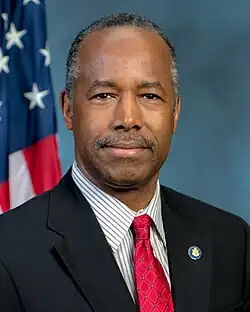
Pediatric neurosurgeon and politician Ben Carson was a faculty member at the School of Medicine from 1984 to his retirement in 2013. He later went on to run as a candidate in the 2016 Republican Party presidential primaries and serve as United States Secretary of Housing and Urban Development. - Harvey Cushing, considered the "father of modern neurosurgery" who identified Cushing's syndrome and the Cushing ulcer
- Walter Dandy, neurosurgeon and the namesake of the Dandy–Walker syndrome
- William Halsted, considered the "father of modern surgery" and one of four founders of Johns Hopkins Medicine
- Howard A. Howe, polio researcher
- Kay Redfield Jamison, psychologist and psychiatry professor and author of An Unquiet Mind[26]
- Leo Kanner, "father of child psychiatry" who first described autism in Autistic Disturbances of Affective Contact, published in 1943
- Howard Kelly, physician credited with establishing gynecology as a specialty
- William B. Kouwenhoven, electrical engineer who developed the external defibrillator and helped develop cardiopulmonary resuscitation
- Marty Makary, Commissioner of the U.S. Food and Drug Administration (FDA)
- Paul R. McHugh, former psychiatrist-in-chief at Johns Hopkins
- Victor A. McKusick, developed the field of medical genetics, namesake of McKusick-Nathans Institute of Genetic Medicine, and founder of OMIM, Albert Lasker Special Achievement Award
- Adolf Meyer, first psychiatrist-in-chief at Johns Hopkins
- John Money, psychologist and sexologist who pioneered gender identity research, coining the terms gender role and sexual orientation
- Vernon Mountcastle, neuroscientist and Lasker Award winner
- William Osler, considered the "father of modern medicine", discovered Osler–Weber–Rendu syndrome, a hereditary hemorrhagic telangiectasia
- Solomon H. Snyder, neuroscientist, Albert Lasker Award for Basic Medical Research for his research on the opioid receptor
- Vivien Thomas, the surgical technician and one of the namesakes of the Blalock-Taussig-Thomas shunt. Thomas, an African-American, did not initially receive credit due to racial discrimination. His story was detailed in the 2004 HBO documentary Something the Lord Made[27]
- Bert Vogelstein, oncologist and pioneer in cancer genetics, first explained the role of p53 in cancer
- William H. Welch, pathologist known as the dean of American Medicine, and the first Dean of Johns Hopkins School of Medicine
- Elias Zerhouni, radiologist and former director of the National Institutes of Health
Notable alumni
- Fuller Albright, endocrinologist who discovered Albright's hereditary osteodystrophy and McCune–Albright syndrome
- Dorothy Hansine Andersen, identified cystic fibrosis and Andersen's disease
- John Auer, physiologist and pharmacologist, namesake of the Auer rod in acute myeloid leukemia
- Denton Cooley, cardiovascular surgeon
- Joseph F. Fraumeni Jr., described Li–Fraumeni syndrome
- Ernest William Goodpasture, pathologist who described Goodpasture syndrome
- Andy Harris, U.S. Congressman
- Tinsley R. Harrison, cardiologist and editor of the first five editions of Harrison's Principles of Internal Medicine
- Harry Klinefelter, rheumatologist, endocrinologist, and namesake of Klinefelter syndrome
- Leroy Hood, invented automated DNA and protein sequencing, Lasker Award winner
- Maclyn McCarty, his 1944 experiment helped demonstrate that genes were made of DNA, rather than protein, first recipient of the Albert Lasker Special Achievement Award
- Wilder Penfield, pioneer of epilepsy neurosurgery who developed the cortical homunculus
- Peter Pronovost, former anesthesiology faculty, Time 100 in 2008, authored over 800 articles and book chapters on patient safety, advisor to the World Health Organization's World Alliance for Patient Safety
- Mark M. Ravitch, surgeon who pioneered modern surgical staples
- Dorothy Reed Mendenhall, pathologist and namesake of Reed–Sternberg cell in Hodgkin's lymphoma
- David Sabatini, former Howard Hughes Investigator and molecular biologist who discovered mTOR, the mammalian target of rapamycin
- Florence Sabin, first woman to hold a full professorship at a medical school, Albert Lasker Public Service Award for public health activism in her home state Colorado
- Mark Schlissel, president emeritus of the University of Michigan
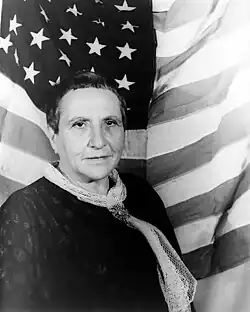
- Gertrude Stein, novelist, poet, and playwright
- Rochelle Walensky, Director of the United States Centers for Disease Control and Prevention (CDC)
Philanthropy
In July 2024, businessman and former New York City mayor Michael Bloomberg announced a $1 billion gift to his alma mater Johns Hopkins University to make tuition free for all medical school students whose families make under $300,000 a year, beginning in the fall of 2024.[28][29]
In popular culture
- The ABC documentary series Hopkins takes a look at the life of the medical staff and students of the Johns Hopkins Hospital and Health System.[30] This new series is a sequel to the 2000 ABC special Hopkins 24/7. Both Hopkins and Hopkins 24/7 were awarded the Peabody Award.[31]
- The movie Something the Lord Made is the story of two men – an ambitious white surgeon, head of surgery at the Johns Hopkins Hospital and a gifted black carpenter turned lab technician – who defied the racial strictures of the Jim Crow South and together pioneered the field of heart surgery.[32]
References
- ↑ "Fast Facts: Johns Hopkins Medicine" (PDF). Hopkins Medicine. Archived (PDF) from the original on March 26, 2020. Retrieved March 26, 2020.
- ↑ "Meet the Johns Hopkins University School of Medicine Class of 2025!". hopkinsmedicine.org. Johns Hopkins University. Retrieved March 16, 2024.
- ↑ "Hopkins Pocket Guide 2007" (PDF). Archived from the original (PDF) on November 2, 2013. Retrieved July 3, 2009.
- ↑ ""Father of Modern Medicine": The Johns Hopkins School of Medicine, 1889-1905". William Osler - Profiles in Science. March 13, 2019. Retrieved September 24, 2025.
- ↑ "History of Medical Innovation at Johns Hopkins". www.hopkinsmedicine.org. Archived from the original on April 20, 2025. Retrieved May 22, 2025.
- ↑ "Medical School Rankings (2025)". Admit.org. Retrieved May 22, 2025.
- ↑ Shemmassian, Shirag. "Top 10 Best Medical Schools in the US: How to Get In (2025)".
- ↑ "World University Rankings by Subject 2025: Medical and Health". Times Higher Education (THE). January 15, 2025. Retrieved May 22, 2025.
- ↑ "Our Campuses". Johns Hopkins University. Retrieved May 22, 2025.
- ↑ "Our Locations". www.hopkinsmedicine.org. Archived from the original on May 10, 2025. Retrieved May 22, 2025.
- ↑ "History of The Johns Hopkins Hospital". www.hopkinsmedicine.org. Retrieved June 7, 2024.
- ↑ "Women Gaining Access to Medical Education". www.hopkinsmedicine.org. Retrieved June 7, 2024.
- ↑ "The Founding Physicians". www.hopkinsmedicine.org. Retrieved June 7, 2024.
- ↑ "Welcome to The Johns Hopkins Hospital". www.hopkinsmedicine.org. Retrieved June 9, 2024.
- ↑ Fisher, Andy (December 5, 2019). "Johns Hopkins Medicine: Patient Care Locations". Johns Hopkins Medicine. Archived from the original on March 31, 2019. Retrieved November 2, 2011.
- ↑ Ludmerer, Kenneth. The Development of American Medical Education from the Turn of the Century to the Era of Managed Care Archived 2008-07-24 at the Wayback Machine . Accessed July 8, 2007
- ↑ U.S. News Best Hospitals: the Honor Roll Archived 2012-08-09 at the Wayback Machine. Retrieved on 2012-10-9.
- ↑ "Focusing on Outcomes for Students: A Preview of the 2023-2024 U.S. News Best Medical Schools: Research Rankings". usnews.com. U.S. News & World Report. Archived from the original on April 17, 2023. Retrieved April 18, 2023.
- ↑ "Johns Hopkins University". usnews.com. U.S. News & World Report. Retrieved March 16, 2024.
- ↑ Stewart, RW; Barker, AR; Shochet, RB; Wright, SM (2007). "The new and improved learning community at Johns Hopkins University School of Medicine resembles that at Hogwarts School of Witchcraft and Wizardry". Medical Teacher. 29 (4): 353–7. doi:10.1080/01421590701477423. PMID 17786750. S2CID 34265553.
- ↑ "About Us". www.hopkinsmedicine.org. Retrieved June 9, 2024.
- ↑ "Nobel Prize winners". Johns Hopkins University. Retrieved June 10, 2024.
- ↑ "IPPNW: A brief history - International Physicians for the Prevention of Nuclear War". www.ippnw.org. July 8, 2020. Retrieved June 10, 2024.
- ↑ "Vincent du Vigneaud – Biographical". NobelPrize.org. Retrieved September 26, 2025.
- ↑ "George R. Minot – Biographical". NobelPrize.org. Retrieved September 26, 2025.
- ↑ "Kay Redfield Jamison, PhD". profiles.hopkinsmedicine.org. Retrieved June 11, 2024.
- ↑ "Something the Lord Made - Rotten Tomatoes". Rotten Tomatoes. January 16, 2007. Archived from the original on November 16, 2020. Retrieved February 1, 2021.
- ↑ Svrluga, Susan (July 8, 2024). "$1 billion gift to make Johns Hopkins medical school free for most". The Washington Post. Retrieved July 8, 2024.
- ↑ Blake, Jessica. "A $1B Donation to Johns Hopkins Makes Med School Free for Most". Inside Higher Ed. Retrieved July 9, 2024.
- ↑ "ABC Hopkins". Archived from the original on January 7, 2009.
- ↑ Abc Documentary "Hopkins" Wins Prestigious Peabody Award Archived 2009-09-27 at the Wayback Machine. Hopkinsmedicine.org (2009-04-02). Retrieved on 2011-04-03.
- ↑ Something the Lord Made – An HBO Film Archived 2009-07-09 at the Wayback Machine. Hopkinsmedicine.org. Retrieved on 2011-04-03.
External links


Johns Hopkins University | |||||
|---|---|---|---|---|---|
| Schools |
|  | |||
| Buildings |
| ||||
| History |
| ||||
| Publications |
| ||||
| Athletics |
| ||||
| Student life |
| ||||
| Related |
| ||||
| |||||
