Hammer toe
| Hammer toe | |
|---|---|
| Other names: Contracted toe | |
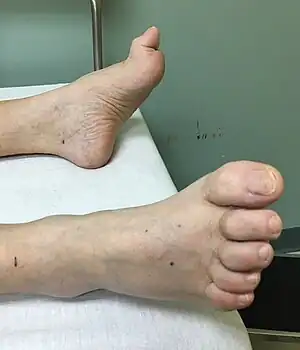 | |
| Human feet with hammer toes | |
 | |
| Specialty | Orthopedics |
| Symptoms | Pain and callous formation[1] |
| Complications | Limping[1] |
| Risk factors | Diabetes, high-heels, bunions, flat feet, inflammatory arthritis, family history[1] |
| Diagnostic method | Based on symptoms and examination[2] |
| Differential diagnosis | Claw toe, mallet toe, turf toe, gout, metatarsal stress fracture[1] |
| Treatment | Wider shoes, insoles, surgery[1] |
| Frequency | Relatively common[1] |
Hammer toe is a deformity at the middle toe joint, mostly commonly of the second toe, making it resemble a hammer.[3][2] Symptoms may include pain and callous formation.[1] Walking and wearing shoes often worsen symptoms.[1] Initially the joint is flexible but over time may become rigid.[3] Toes three to five may also be affected.[2]
Risk factors include diabetes, high-heels, bunions, flat feet, inflammatory arthritis, and family history.[1] Those with Charcot-Marie-Tooth disease are also commonly affected.[1] The underlying mechanism involves a muscle imbalance which bends the middle toe joints forwards.[3] Diagnosis is based on symptoms and examination, with X-rays to determine the degree of abnormality.[2]
Initial management includes wider shoes, insoles, and buddy taping.[1][2] Pain medication maybe used.[2] If this is insufficient improvement surgery maybe an option.[1] Outcomes are generally good; though, up to 10% of people have a reoccurrence following surgery.[1]
Hammer toe is relatively commons, affected up to 20% of people.[4] It becomes more common with age.[1] Women are affected more than fives times as often as men.[1][4] Joint fusion as a treatment was first carried out in 1910 by Soule.[5]
Signs and symptoms
Symptoms include:[6]
- Blisters
- Callosities
- Ulcerations
- Irritated skin dorsally
-
.png) Hammer toe deformity of the left second toe
Hammer toe deformity of the left second toe -
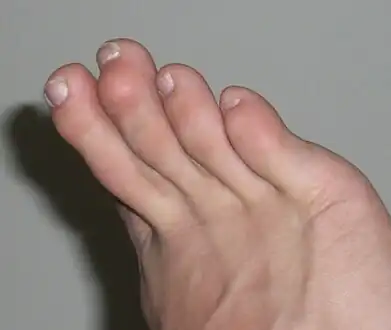 A mallet toe is evident on the 3rd digit.
Causes
Hammertoes and clawtoes have multiple causes.[7][8] Hammer toe most frequently results from wearing poorly fitting shoes that can force the toe into a bent position, such as high heels or shoes that are too short or narrow for the foot. Having the toes bent for long periods of time can cause the muscles in them to shorten, resulting in the hammer toe deformity. This is often found in conjunction with bunions or other foot problems (e.g., a bunion can force the big toe to turn inward and push the other toes).[9]
The toe muscles work in pairs; if the muscles pulling in one direction are much weaker than those pulling in the other direction, the imbalance can bend the toe. If the bend persists, then as the tendons and ligaments tighten (as they do if not stretched), the bend may become permanent.[9] Ill-fitting shoes are especially likely to push the toes out of balance.[10]
Toe deformities can also be caused by muscle, nerve, or joint damage, resulting from conditions such as osteoarthritis, rheumatoid arthritis, stroke, Charcot–Marie–Tooth disease, complex regional pain syndrome or diabetes.[9] Hammer toe can also be found in Friedreich's ataxia (GAA trinucleotide repeat).
Risks
Older people are more likely to develop hammer toes.[9] Women are at higher risk, due to women's shoes.[10] Injuries to the toes, and being born with a big toe that is short in comparison to the second toe, increase risk.[9] Arthritis and diabetes may also increase the risk of foot deformities.[9]
Diagnosis
In terms of the diagnosis Xrays are done.[6]
Differential
Some have used the terms hammer toe, mallet toe, and claw toe to mean the same things.[4]
Mallet toe involves a forward bend at the distal interphalangeal joint.[1]
Claw toe is a bending back of the proximal phalanx at the metatarsophalangeal joint, combined with forward bending of both the proximal and distal interphalangeal joints.[1] Often multiple toes are involved.[1]
Treatment

In many cases, conservative treatment consisting of physical therapy and new shoes with soft, spacious toe boxes is enough to resolve the condition, while in more severe or longstanding cases hammertoe surgery[11] may be necessary to correct the deformity. The patient's doctor may also prescribe some toe exercises that can be done at home to stretch and strengthen the muscles. For example, the individual can gently stretch the toes manually, or use the toes to pick things up off the floor.
References
- ↑ 1.00 1.01 1.02 1.03 1.04 1.05 1.06 1.07 1.08 1.09 1.10 1.11 1.12 1.13 1.14 1.15 1.16 1.17 Goransson, M; Constant, D (January 2025). "Hammertoe". StatPearls. PMID 32644694.
- ↑ 2.0 2.1 2.2 2.3 2.4 2.5 "Hammer Toe Deformity - Musculoskeletal and Connective Tissue Disorders". Merck Manual Professional Edition. Archived from the original on 9 April 2025. Retrieved 18 October 2025.
- ↑ 3.0 3.1 3.2 "Hammer Toe: Comprehensive Guide". www.orthoinfo.org. OrthoInfo - AAOS. Retrieved 18 October 2025.
- ↑ 4.0 4.1 4.2 Haskell, Andrew; Coughlin, Michael J. (23 March 2023). Coughlin and Mann's Surgery of the Foot and Ankle - E-Book. Elsevier Health Sciences. p. 304. ISBN 978-0-323-83385-1.
- ↑ Olsen, E; King, J; Pollock, JR; Squires, M; Meremikwu, R; Walton, D (January 2023). "Hammer Toe Correction with Proximal Interphalangeal Joint Arthrodesis". JBJS essential surgical techniques. 13 (1). doi:10.2106/JBJS.ST.21.00046. PMID 38274283.
- ↑ 6.0 6.1 Goransson, Miranda; Constant, Dustin (2022). "Hammertoe". StatPearls. StatPearls Publishing. Archived from the original on 30 January 2023. Retrieved 23 February 2023.
- ↑ Chadwick, C; Saxby, TS (December 2011). "Hammertoes/Clawtoes: metatarsophalangeal joint correction". Foot and Ankle Clinics. 16 (4): 559–71. doi:10.1016/j.fcl.2011.08.006. PMID 22118229.
- ↑ Ellington, JK (December 2011). "Hammertoes and clawtoes: proximal interphalangeal joint correction". Foot and Ankle Clinics. 16 (4): 547–58. doi:10.1016/j.fcl.2011.08.010. PMID 22118228.
- ↑ 9.0 9.1 9.2 9.3 9.4 9.5 "Hammer toe and mallet toe – causes". Mayo Clinic. Archived from the original on 2009-02-24. Retrieved 2009-01-30.
- ↑ 10.0 10.1 Sabrina Felson. "Understanding Hammertoes -- the Basics". WebMD. Archived from the original on 2023-02-20. Retrieved 2023-02-10. Reviewed March 31, 2019
- ↑ "Benefits and Risks of Hammertoe Surgery". Archived from the original on 2017-08-11. Retrieved 2017-06-29.
External links
- Hammer Toe – American Academy of Orthopedic Surgeons Archived 2017-10-28 at the Wayback Machine
- Hammer Toes – American Podiatric Medical Association Archived 2012-05-08 at the Wayback Machine
- Aetna Clinical Policy Bulletin: Hammertoe Repair Guidelines for surgical repair Archived 2013-02-15 at the Wayback Machine
| Classification | |
|---|---|
| External resources |