Influenza A virus subtype H5N9
| Influenza (flu) |
|---|
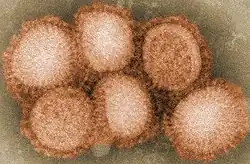 |
H5N9 is a subtype of the species Influenza A virus (sometimes called bird flu virus). Wild aquatic birds are the primary host of the influenza A virus, which is enzootic (continually present) in many bird populations.[1][2]
Outbreaks
A highly pathogenic strain of H5N9 caused an outbreak in 1966 in Ontario and Manitoba, Canada in turkeys, resulting in the slaughter of approximately 8,000 birds.[3][4]
In 1999 an H5 influenza A virus was isolated from a mallard in the Netherlands.[5]
In 2008 An H5N9 virus was isolated from poultry in Aomori, Japan.[6]
In December 2015 an H5N9 virus infected a flock of 500 ducks raised for fatty liver production experienced a 5% mortality in Arrosès, France.[7]
In 2025 another highly pathogenic strain caused an outbreak in a duck farm in Merced County, California, forcing the culling of over 118,000 ducks. This strain may have arisen from recombination of H5N1 from the current 2020–2025 H5N1 outbreak and a subtype bearing N9.[8]
Sources
- ↑ Li YT, Linster M, Mendenhall IH, Su YC, Smith GJ (December 2019). "Avian influenza viruses in humans: lessons from past outbreaks". British Medical Bulletin. 132 (1): 81–95. doi:10.1093/bmb/ldz036. PMC 6992886. PMID 31848585.
- ↑ Joseph U, Su YC, Vijaykrishna D, Smith GJ (January 2017). "The ecology and adaptive evolution of influenza A interspecies transmission". Influenza and Other Respiratory Viruses. 11 (1): 74–84. doi:10.1111/irv.12412. PMC 5155642. PMID 27426214.
- ↑ "WHO". Archived from the original on March 7, 2004. Retrieved February 12, 2006.
- ↑ Lang, G; Narayan, O; Rouse, B T; Ferguson, A E; Connell, M C (July 1968). "A new influenza A virus infection in turkeys II. A highly pathogenic variant, a/turkey/ontario 772/66". The Canadian Veterinary Journal. 9 (7): 151–160. ISSN 0008-5286. PMC 1697254. PMID 5690802.
- ↑ Munster, V. J.; Wallensten, A.; Baas, C.; Rimmelzwaan, G. F.; Schutten, M.; Olsen, B.; Osterhaus, A. D.; Fouchier, R. A. (October 2005). "Mallards and highly pathogenic avian influenza ancestral viruses, northern Europe". Emerging Infectious Diseases. 11 (10): 1545–1551. doi:10.3201/eid1110.050546. PMC 3366752. PMID 16318694.
- ↑ Yu, Yang; Wang, Xingbo; Jin, Tao; Wang, Hailong; Si, Weiying; Yang, Hui; Wu, Jiusheng; Yan, Yan; Liu, Guang; Sang, Xiaoyu; Wu, Xiaopeng; Gao, Yuwei; Xia, Xianzhu; Yu, Xinfen; Pan, Jingcao (August 3, 2015). "Newly Emergent Highly Pathogenic H5N9 Subtype Avian Influenza A Virus". Journal of Virology. 89 (17): 8806–8815. doi:10.1128/jvi.00653-15. PMC 4524050. PMID 26085150.
- ↑ "Studies on fatty liver production from aged geese and ducks. II, fatty acid composition of liver and some chemical aspects". Egyptian Journal of Animal Production. 23 (1): 113–118. January 1, 1983. doi:10.21608/ejap.1983.131536. ISSN 2735-3028.
- ↑ Cooke, Emily (February 3, 2025). "US reports 1st outbreak of 'highly pathogenic' H5N9 virus in poultry. Should we worry?". LiveScience. New York: Future US, Inc. Retrieved February 5, 2025.