Cis-Urocanic acid
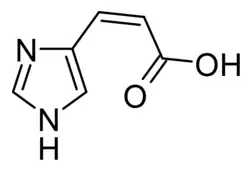 | |
| Identifiers | |
|---|---|
IUPAC name
| |
| CAS Number | |
| PubChem CID | |
| ChemSpider | |
| UNII | |
| ChEBI | |
| ChEMBL | |
| CompTox Dashboard (EPA) | |
| Chemical and physical data | |
| Formula | C6H6N2O2 |
| Molar mass | 138.126 g·mol−1 |
| 3D model (JSmol) | |
SMILES
| |
InChI
| |
cis-Urocanic acid (cis-UCA) is a chemical compound produced by ultraviolet irradiation of trans-urocanic acid, a metabolite naturally formed in the body from histidine. cis-Urocanic acid is suspected of involvement in the development of skin cancer. It acts as an immunosuppressant through action as an agonist of the 5-HT2A receptor, and blocking this receptor has been shown to reduce cis-UCA mediated photocarcinogenesis.[1][2][3] However the immunomodulatory effects of cis-UCA are complex and also involve other pathways, and at low levels it shows antiinflammatory actions and may be protective against UV damage in the cornea and retina.[4][5][6][7][8][9] Measuring cis-UCA has been proposed as a sensitive method to detect sub-erythemal response to UVB, and thus a means to assess the UVR protection of suncreams.[10]
References
- ↑ Walterscheid JP, Nghiem DX, Kazimi N, Nutt LK, McConkey DJ, Norval M, et al. (November 2006). "Cis-urocanic acid, a sunlight-induced immunosuppressive factor, activates immune suppression via the 5-HT2A receptor". Proceedings of the National Academy of Sciences of the United States of America. 103 (46): 17420–17425. doi:10.1073/pnas.0603119103. PMC 1859944. PMID 17085585.
- ↑ Shen L, Ji HF (September 2009). "Molecular basis for cis-urocanic acid as a 5-HT(2A) receptor agonist". Bioorganic & Medicinal Chemistry Letters. 19 (18): 5307–5309. doi:10.1016/j.bmcl.2009.07.143. PMID 19683920.
- ↑ Menezes AC, Raposo S, Simões S, Ribeiro H, Oliveira H, Ascenso A (March 2016). "Prevention of Photocarcinogenesis by Agonists of 5-HT1A and Antagonists of 5-HT2A Receptors". Molecular Neurobiology. 53 (2): 1145–1164. doi:10.1007/s12035-014-9068-z. PMID 25589005. S2CID 14282500.
- ↑ Norval M, El-Ghorr AA (September 2002). "Studies to determine the immunomodulating effects of cis-urocanic acid". Methods. 28 (1): 63–70. doi:10.1016/s1046-2023(02)00210-4. PMID 12231189.
- ↑ Schwarz T (December 2005). "Mechanisms of UV-induced immunosuppression" (PDF). The Keio Journal of Medicine. 54 (4): 165–71. doi:10.2302/kjm.54.165. PMID 16452825.
- ↑ Ullrich SE (August 2007). "Sunlight and skin cancer: lessons from the immune system". Molecular Carcinogenesis. 46 (8): 629–633. doi:10.1002/mc.20328. PMC 2661262. PMID 17443748.
- ↑ Lucas RM, Byrne SN, Correale J, Ilschner S, Hart PH (October 2015). "Ultraviolet radiation, vitamin D and multiple sclerosis". Neurodegenerative Disease Management. 5 (5): 413–424. doi:10.2217/nmt.15.33. PMID 26477548.
- ↑ Korhonen E, Bisevac J, Hyttinen JM, Piippo N, Hytti M, Kaarniranta K, et al. (April 2020). "UV-B-Induced Inflammasome Activation Can Be Prevented by Cis-Urocanic Acid in Human Corneal Epithelial Cells". Investigative Ophthalmology & Visual Science. 61 (4): 7. doi:10.1167/iovs.61.4.7. PMC 7401861. PMID 32271889.
- ↑ Korhonen E, Piippo N, Hytti M, Kaarniranta K, Kauppinen A (October 2023). "Cis-urocanic acid improves cell viability and suppresses inflammasome activation in human retinal pigment epithelial cells". Biochemical Pharmacology. 216 115790. doi:10.1016/j.bcp.2023.115790. PMID 37683842.
- ↑ Keurentjes AJ, Jakasa I, van Dijk A, van Putten E, Brans R, John SM, et al. (January 2022). "Stratum corneum biomarkers after in vivo repeated exposure to sub-erythemal dosages of ultraviolet radiation in unprotected and sunscreen (SPF 50+) protected skin". Photodermatology, Photoimmunology & Photomedicine. 38 (1): 60–68. doi:10.1111/phpp.12717. PMID 34278599.