Baclofen toxicity
| Baclofen toxicity | |
|---|---|
| Other names: Baclofen poisoning, baclofen overdose | |
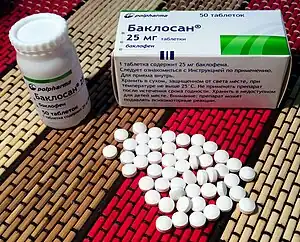 | |
| Russian baclofen 25 mg tablets with the warning "this drug may cause psychomotor retardation" | |
 | |
| Specialty | Toxicology |
| Symptoms | Confusion, slow heart rate, low blood pressure, increased saliva[1] |
| Complications | Coma, seizures[1] |
| Usual onset | Within 2 to 4 hrs[2] |
| Causes | >200 mg in and adult[2] |
| Risk factors | poor kidney function[1] |
| Differential diagnosis | Sepsis, intracranial bleed, low blood sugar, low thyroid, opioid overdose, adrenal crisis, brain death[1][3] |
| Treatment | Supportive care (intubation), activated charcoal[1][2] |
| Prognosis | Often resolves over 1 to 2 days[3] |
| Frequency | ~5,000 reported cases (USA, 2020)[3] |
Baclofen toxicity, also known as baclofen poisoning, is a life threatening condition due to excessive baclofen.[3] Symptoms often include slow heart rate, low blood pressure, increased saliva, low body temperature, and confusion.[1] Though the heart rate may be fast and the blood pressure high.[2] Other complications may include coma or seizures.[1]
In adults a dose of more then 200 mg generally results in problems within 2 hours.[2] This can occur by mouth or via an intrathecal pump.[3] Risk factors include poor kidney function, particularly a GFR less than 30 ml/min.[1] If a person has no symptom more than four hours after exposure toxicity is unlikely to occur.[2] Blood levels for baclofen are generally not availiable.[3]
Management involves supportive care such as intubation.[1] After intubation activated charcoal may be used.[2] Dialysis may be recommended in those with kidney problems.[1] Seizures are treated with benzodiazepines while low blood pressure may be managed with intravenous fluids and norepinephrine.[2] Symptoms often resolves over 1 to 2 days.[3] Following recovery baclofen generally requires restarting or withdrawal may occur.[2]
In 2020 nearly five thousand overdoses were documented by the America's Poison Centers with four deaths.[3] About 20% receiving the medication via a pump develop problems at some point.[3] In those who overdose intentionally, the typical age is around 35 and slightly over half are women.[3]
References
- ↑ 1.00 1.01 1.02 1.03 1.04 1.05 1.06 1.07 1.08 1.09 "Baclofen: therapy, intoxication, & withdrawal". EMCrit Project. Archived from the original on 21 June 2024. Retrieved 12 October 2024.
- ↑ 2.0 2.1 2.2 2.3 2.4 2.5 2.6 2.7 2.8 Long, Neil (7 March 2019). "Baclofen toxicity". Life in the Fast Lane • LITFL. Archived from the original on 22 June 2024. Retrieved 12 October 2024.
- ↑ 3.00 3.01 3.02 3.03 3.04 3.05 3.06 3.07 3.08 3.09 Dease, NM; Kershner, EK; Wills, BK (January 2024). "Baclofen Toxicity". StatPearls. PMID 35593857. Archived from the original on 2023-11-25. Retrieved 2024-10-09.