BK virus
| BK virus | |
|---|---|
| Other names: BK virus infection[1] | |
  | |
| |
 | |
| Specialty | Infectious disease |
| Symptoms | No symptoms, or may have trouble urinating[5] |
| Risk factors | Organ transplant, immune system[6] |
| Diagnostic method | Blood and Urine test[7] |
| Differential diagnosis | Cytomegalovirus infection, Herpes infection[8] |
| Treatment | Lower does of anti-rejection drug(and cidofovir)[9] |
BK virus (BK virus infection), also known as Human polyomavirus 1[10], is a member of the polyomavirus family. Past infection with the BK virus is widespread, but significant consequences of infection are uncommon, with the exception of the immunocompromised and the immunosuppressed. BK virus is an abbreviation of the name of the first patient, from whom the virus was isolated in 1971 .[11][12][13]
Treatment for Bk virus infection includes antiviral medications, such as cidofovir and leflunomide(among other)[14]
Signs and symptoms
The BK virus rarely causes disease but is typically associated with patients who have had a kidney transplant; many people who are infected with this virus are asymptomatic. If symptoms do appear, they tend to be mild: respiratory infection or fever. These are known as primary BK infections. Although without any clinical symptoms, footprints of BK virus have been detected in specimens from females affected by spontaneous abortion.[15] Serum antibodies against BK virus have also been found in spontaneous abortion affected women as well as in women who underwent voluntary interruption of pregnancy.[16]
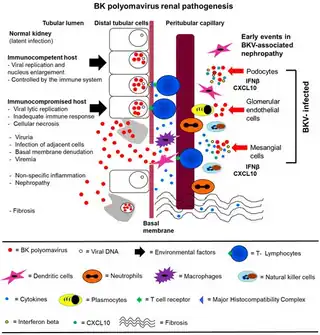
The virus then disseminates to the kidneys and urinary tract where it persists for the life of the individual. It is thought that a high percentage of the population contains a latent form of this virus, which remains latent until the body undergoes some form of immunosuppression. Typically, this is in the setting of kidney transplantation or multi-organ transplantation. Presentation in these immunocompromised individuals is much more severe. Clinical manifestations include renal dysfunction, and an abnormal urinalysis revealing renal tubular cells and inflammatory cells.[17][18]
Cause
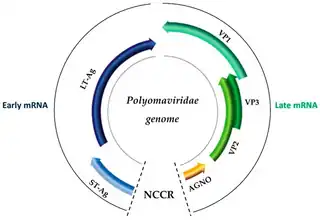
Similarly to JC virus and SV40, BK virus has a small, non-enveloped, icosahedral capsid with a diameter of 45–50 nm.[19] The capsid is made up of viral proteins VP1, VP2, and VP3. The capsid proteins have T=7 arrangement. The icosahedral structure contains 72 pentamers of the major capsid protein VP1, 360 molecules in total. Each penton is bound the minor capsid proteins VP2 or VP3 on the inside of the virus while VP1 protein shell is on the outside.[20]
Transmission
It is not known how this virus is transmitted, except that it spreads from person to person, and not from an animal source. It has been suggested that this virus may be transmitted through respiratory fluids or urine, since infected individuals periodically excrete virus in the urine. A survey of 400 healthy blood donors was reported as showing that 82% were positive for IgG against BK virus.[21]
Risk factors

In some renal transplant patients, the necessary use of immunosuppressive drugs has the side-effect of allowing the virus to replicate within the graft, a disease called BK nephropathy.[22]
From 1–10% of renal transplant patients progress to BK virus associated nephropathy (BKVAN) and up to 80% of these patients lose their grafts. The onset of nephritis can occur as early as several days post-transplant to as late as 5 years.[6]
It is also associated with ureteral stenosis and interstitial nephritis. In bone marrow transplant recipients it is notable as a cause for hemorrhagic cystitis.[23][18][24]
BK viremia load > 185 000 copies/ml at the time of first positive BKV diagnosis - to be the strongest predictor for BKVAN (97% specificity and 75% sensitivity). In addition the BKV peak viral loads in blood reaching 223 000 copies/ml at any time was found to be predictive for BKVAN (91% specificity and 88% sensitivity) .[25]
Diagnosis
This virus can be diagnosed by a BKV blood test or a urine test for decoy cells, in addition to carrying out a biopsy in the kidneys. PCR techniques are often carried out to identify the virus.[26]
-
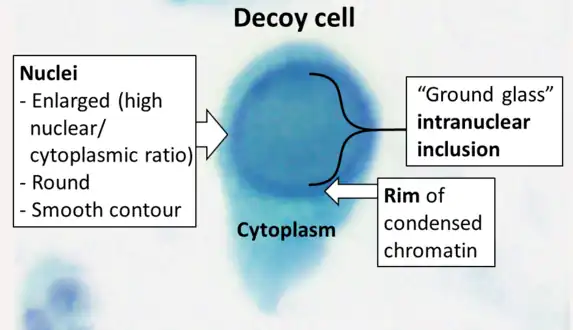 Cytology of a polyomavirus infected cell, using Papanicolaou stain. The high nuclear to cytoplasmic ratio makes it resemble cancer (thus the name "decoy cell") but the inclusion body reveals its viral pathophysiology.
 -
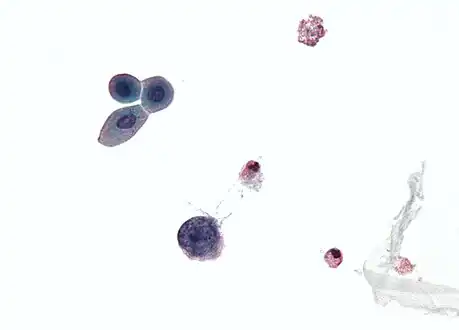 Micrograph showing a polyomavirus infected cell — large (blue) cell below-center-left. Urine cytology specimen.
Differential diagnosis

As to the DDx we find the following should be considered:[27][8]
- JCPyV
- Human adenovirus
- CMV
- Herpes simplex virus
Treatment
The cornerstone of therapy is reduction in immunosuppression. A recent surge in BKVAN correlates with use of potent immunosuppressant drugs, such as tacrolimus and mycophenolate mofetil (MMF). Studies have not shown any correlation between BKVAN and a single immunosuppressive agent but rather the overall immunosuppressive load.[28][7]
- Withdrawal of MMF or tacrolimus
- Replacement of tacrolimus by cyclosporine
- Overall reduction of immunosuppressive load
Other therapeutic options include Leflunomide, Cidofovir, IVIG, and the fluoroquinolones. Leflunomide, a pyrimidine synthesis inhibitor is now generally accepted as the second treatment option behind reduction of immunosuppression.[29]
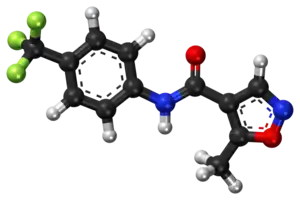
Leflunomide in BKVAN
The rationale behind using leflunomide in BKVAN comes from its combined immunosuppressive and antiviral properties. Two studies consisting of 26 and 17 patients who developed BKVAN on a three-drug regimen of tacrolimus, MMF, and steroids had their MMF replaced with leflunomide 20–60 mg daily. 84 and 88% of patients, respectively had clearance or a progressive reduction in viral load and a stabilization or improvement of graft function. In a study conducted by Teschner et al. in 2009, 12/13 patients who had their MMF exchanged with leflunomide cleared the virus by 109 days.[30] [31][29][32]
Epidemiology
In terms of the prevalence BKPyV is rather common and has been detected in a significant proportion of population. Studies have shown that a large percentage of adults have antibodies to BKPyV, indicating past infection[33]
History
The BK virus was first isolated in 1971 from the urine of a renal transplant patient, initials B.K. The BK virus is similar to another virus called the JC virus (JCV), since their genomes share 75% sequence similarity. Both of these viruses can be identified and differentiated from each other by carrying out serological tests using specific antibodies or by using a PCR-based genotyping approach.[34][35]
See also
References
- ↑ "BK Virus Infection (Concept Id: C1096691) - MedGen - NCBI". www.ncbi.nlm.nih.gov. Retrieved 7 February 2025.
- ↑ Alcendor, Donald J. (17 September 2019). "BK Polyomavirus Virus Glomerular Tropism: Implications for Virus Reactivation from Latency and Amplification during Immunosuppression". Journal of Clinical Medicine. 8 (9): 1477. doi:10.3390/jcm8091477. ISSN 2077-0383. PMC 6780320. PMID 31533282.
- ↑ Zhou, Xianfeng; Zhu, Chunlong; Li, Hui (2023). "BK polyomavirus: latency, reactivation, diseases and tumorigenesis". Frontiers in Cellular and Infection Microbiology. 13. doi:10.3389/fcimb.2023.1263983. ISSN 2235-2988. PMC 10525381. PMID 37771695.
- ↑ Chancharoenthana, Wiwat; Leelahavanichkul, Asada (March 2022). "Innate Immunity Response to BK Virus Infection in Polyomavirus-Associated Nephropathy in Kidney Transplant Recipients". Transplantology. 3 (1): 20–32. doi:10.3390/transplantology3010003. ISSN 2673-3943.
- ↑ Humans, IARC Working Group on the Evaluation of Carcinogenic Risks to (2013). "BK POLYOMAVIRUS". Malaria and Some Polyomaviruses (SV40, BK, JC, and Merkel Cell Viruses). International Agency for Research on Cancer. Retrieved 21 February 2025.
- ↑ 6.0 6.1 6.2 Favi, Evaldo; Puliatti, Carmelo; Sivaprakasam, Rajesh; Ferraresso, Mariano; Ambrogi, Federico; Delbue, Serena; Gervasi, Federico; Salzillo, Ilaria; Raison, Nicholas; Cacciola, Roberto (6 February 2019). "Incidence, risk factors, and outcome of BK polyomavirus infection after kidney transplantation". World Journal of Clinical Cases. 7 (3): 270–290. doi:10.12998/wjcc.v7.i3.270. ISSN 2307-8960. PMC 6369392. PMID 30746369.
- ↑ 7.0 7.1 7.2 Sawinski, D.; Goral, S. (1 February 2015). "BK virus infection: an update on diagnosis and treatment". Nephrology Dialysis Transplantation. 30 (2): 209–217. doi:10.1093/ndt/gfu023. Archived from the original on 26 April 2025. Retrieved 20 February 2025.
- ↑ 8.0 8.1 Lusco, Mark A.; Fogo, Agnes B.; Najafian, Behzad; Alpers, Charles E. (December 2016). "AJKD Atlas of Renal Pathology: Polyomavirus Nephropathy". American Journal of Kidney Diseases. 68 (6): e37 – e38. doi:10.1053/j.ajkd.2016.10.007. PMID 27884285.
- ↑ Christiadi, Daniel; Karpe, Krishna M; Walters, Giles D (28 May 2019). "Interventions for BK virus infection in kidney transplant recipients". Cochrane Database of Systematic Reviews. 2019 (5): CD013344. doi:10.1002/14651858.CD013344. ISSN 1465-1858. PMC 6536757.
- ↑ "Taxonomy browser (Betapolyomavirus hominis)". www.ncbi.nlm.nih.gov. Archived from the original on 4 February 2025. Retrieved 18 February 2025.
- ↑ Chong, Stephanie; Antoni, Michelle; Macdonald, Andrew; Reeves, Matthew; Harber, Mark; Magee, Ciara N. (July 2019). "BK virus: Current understanding of pathogenicity and clinical disease in transplantation". Reviews in Medical Virology. 29 (4): e2044. doi:10.1002/rmv.2044. ISSN 1099-1654. PMID 30958614.
- ↑ Reploeg, Mark D.; Storch, Gregory A.; Clifford, David B. (15 July 2001). "BK Virus: A Clinical Review". Clinical Infectious Diseases. 33 (2): 191–202. doi:10.1086/321813. ISSN 1058-4838. PMID 11418879.
- ↑ Kuppachi, Sarat; Thomas, Beje; Kokko, Kenneth E. (1 June 2013). "BK Virus in the Kidney Transplant Patient". The American Journal of the Medical Sciences. 345 (6): 482–488. doi:10.1097/MAJ.0b013e31826c64ef. ISSN 0002-9629. PMID 23698093. Retrieved 16 February 2025.
- ↑ Gorriceta, June Hayrelle; Lopez Otbo, Amy; Uehara, Genta; Posadas Salas, Maria Aurora (18 December 2023). "BK viral infection: A review of management and treatment". World Journal of Transplantation. 13 (6): 309–320. doi:10.5500/wjt.v13.i6.309. PMC 10758681. PMID 38174153.
- ↑ Tagliapietra A, Rotondo JC, Bononi I, Mazzoni E, Magagnoli F, Maritati M (2019). "Footprints of BK and JC polyomaviruses in specimens from females affected by spontaneous abortion". Hum Reprod. 34 (3): 433–440. doi:10.1093/humrep/dey375. hdl:11392/2397214. PMID 30590693. S2CID 58621197. Archived from the original on 30 September 2020. Retrieved 8 December 2023.
- ↑ Tagliapietra A, Rotondo JC, Bononi I, Mazzoni E, Magagnoli F, Maritati M (2019). "Footprints of BK and JC polyomaviruses in specimens from females affected by spontaneous abortion". Hum Reprod. 34 (3): 433–440. doi:10.1002/jcp.27490. hdl:11392/2397717. PMID 30590693. S2CID 53106591. Archived from the original on 30 September 2020. Retrieved 8 December 2023.
- ↑ Gupta G, Shapiro R, Thai N, Randhawa PS, Vats A (August 2006). "Low incidence of BK virus nephropathy after simultaneous kidney pancreas transplantation". Transplantation. 82 (3): 382–8. doi:10.1097/01.tp.0000228899.05501.a7. PMID 16906037. S2CID 12310204.
- ↑ 18.0 18.1 Kant, Sam; Dasgupta, Alana; Bagnasco, Serena; Brennan, Daniel C. (25 July 2022). "BK Virus Nephropathy in Kidney Transplantation: A State-of-the-Art Review". Viruses. 14 (8): 1616. doi:10.3390/v14081616. ISSN 1999-4915. PMC 9330039. PMID 35893681.
- ↑ Hurdiss, Daniel L.; Morgan, Ethan L.; Thompson, Rebecca F.; Prescott, Emma L.; Panou, Margarita M.; Macdonald, Andrew; Ranson, Neil A. (April 2016). "New Structural Insights into the Genome and Minor Capsid Proteins of BK Polyomavirus using Cryo-Electron Microscopy". Structure. 24 (4): 528–536. doi:10.1016/j.str.2016.02.008. PMC 4826271. PMID 26996963.
- ↑ Ambalathingal, George R.; Francis, Ross S.; Smyth, Mark J.; Smith, Corey; Khanna, Rajiv (April 2017). "BK Polyomavirus: Clinical Aspects, Immune Regulation, and Emerging Therapies". Clinical Microbiology Reviews. 30 (2): 503–528. doi:10.1128/CMR.00074-16. ISSN 0893-8512. PMC 5355639. PMID 28298471.
- ↑ Egli A; Infanti L; Dumoulin A; et al. (2009). "Prevalence of polyomavirus BK and JC infection and replication in 400 healthy blood donors". J Infect Dis. 199 (6): 837–46. doi:10.1086/597126. PMID 19434930.
- ↑ Fishman, J. A. (2002). "BK Virus Nephropathy — Polyomavirus Adding Insult to Injury". New England Journal of Medicine. 347 (7): 527–530. doi:10.1056/NEJMe020076. PMID 12181409.
- ↑ Pahari, Amitava; Rees, Lesley (1 August 2003). "BK virus-associated renal problems—clinical implications". Pediatric Nephrology. 18 (8): 743–748. doi:10.1007/s00467-003-1184-3. ISSN 1432-198X.
- ↑ Moss, Julia E.; Muller, William J. (9 February 2024). "BK virus-associated hemorrhagic cystitis in pediatric stem cell transplantation: a case report and scoping review". Frontiers in Pediatrics. 11. doi:10.3389/fped.2023.1267678. ISSN 2296-2360. PMC 10884191. PMID 38406625.
- ↑ Elfadawy, NS; Flechner, SM; Xiaobo, L; Schold, J; Tian, D; Srinivas, TR; Poggio, E; Fatica, R; Avery, R; Mosaad, SB (2013). "The impact of surveillance and rapid reduction in immunosuppression to control BK virus-related graft injury in kidney transplantation". Transplant International. 26 (8): 822–32. doi:10.1111/tri.12134. PMID 23763289.
- ↑ Bista, BR; Ishwad, C; Wadowsky, RM; Manna, P; Randhawa, PS; Gupta, G; Adhikari, M; Tyagi, R; Gasper, G (2007). "Development of a Loop-Mediated Isothermal Amplification Assay for Rapid Detection of BK Virus". Journal of Clinical Microbiology. 45 (5): 1581–7. doi:10.1128/JCM.01024-06. PMC 1865893. PMID 17314224.
- ↑ Siguier, M.; Sellier, P.; Bergmann, J. -F. (1 May 2012). "BK-virus infections: A literature review". Médecine et Maladies Infectieuses. 42 (5): 181–187. doi:10.1016/j.medmal.2012.04.011. ISSN 0399-077X. PMID 22621826. Archived from the original on 27 April 2024. Retrieved 15 February 2025.
- ↑ 28.0 28.1 Saleh, Ahmed; El Din Khedr, Mohamed Salah; Ezzat, Abeer; Takou, Anna; Halawa, Ahmed (November 2020). "Update on the Management of BK Virus Infection". Experimental and Clinical Transplantation: Official Journal of the Middle East Society for Organ Transplantation. 18 (6): 659–670. doi:10.6002/ect.2019.0254. ISSN 2146-8427. PMID 32552624. Archived from the original on 4 February 2025. Retrieved 14 February 2025.
- ↑ 29.0 29.1 Santeusanio, Andrew D.; Lukens, Benjamin E.; Eun, Judy (15 December 2017). "Antiviral treatment of BK virus viremia after kidney transplantation". American Journal of Health-system Pharmacy: AJHP: Official Journal of the American Society of Health-System Pharmacists. 74 (24): 2037–2045. doi:10.2146/ajhp160585. ISSN 1535-2900. PMID 29222360. Archived from the original on 6 February 2025. Retrieved 17 February 2025.
- ↑ Teschner, S.; Gerke, P.; Geyer, M.; Wilpert, J.; Krumme, B.; Benzing, T.; Walz, G. (2009). "Leflunomide therapy for polyomavirus-induced allograft nephropathy: efficient BK virus elimination without increased risk of rejection". Transplantation Proceedings. 41 (6): 2533–2538. doi:10.1016/j.transproceed.2009.06.099. ISSN 1873-2623. PMID 19715969. Archived from the original on 11 December 2024. Retrieved 18 February 2025.
- ↑ Schneidewind, Laila; Neumann, Thomas; Dräger, Desiree L.; Kranz, Jennifer; Hakenberg, Oliver W. (October 2020). "Leflunomide in the treatment of BK polyomavirus associated nephropathy in kidney transplanted patients - A systematic review". Transplantation Reviews (Orlando, Fla.). 34 (4): 100565. doi:10.1016/j.trre.2020.100565. ISSN 1557-9816. PMID 32611496. Archived from the original on 4 February 2025. Retrieved 18 February 2025.
- ↑ Launay, M.; Baudouin, V.; Guillemain, R.; Maisin, A.; Flodrops, H.; Douez, E.; Mavoungou, S.; Jullien, V.; Billaud, E. M. (2018). "Leflunomide for BKvirus: Report of Seven Kidney-Transplanted Children". International Journal of Organ Transplantation Medicine. 9 (4): 178–183. ISSN 2008-6482. PMC 6409091. PMID 30863521.
- ↑ Knowles, Wendy A. (2006). "Discovery and epidemiology of the human polyomaviruses BK virus (BKV) and JC virus (JCV)". Polyomaviruses and Human Diseases. Advances in Experimental Medicine and Biology. Vol. 577. pp. 19–45. doi:10.1007/0-387-32957-9_2. ISBN 978-0-387-29233-5. ISSN 0065-2598. PMID 16626025. Archived from the original on 3 February 2025. Retrieved 17 February 2025.
- ↑ Gardner SD, Field AM, Coleman DV, Hulme B (June 1971). "New human papovavirus (B.K.) isolated from urine after renal transplantation". Lancet. 1 (7712): 1253–7. doi:10.1016/s0140-6736(71)91776-4. PMID 4104714.
- ↑ "BK and JC Virus DNA Standard Reference Materials". NIST. Archived from the original on 2 February 2025. Retrieved 21 February 2025.
Further reading
- "BK virus". Am. J. Transplant. 4 (Suppl 10): 89–91. November 2004. doi:10.1111/j.1600-6135.2004.00730.x. PMID 15504220. S2CID 30891138.
- Blanckaert K, De Vriese AS (December 2006). "Current recommendations for diagnosis and management of polyoma BK virus nephropathy in renal transplant recipients". Nephrol. Dial. Transplant. 21 (12): 3364–7. doi:10.1093/ndt/gfl404. PMID 16998219.
External links
| Classification |
|
|---|