AZD-1940
 | |
| Clinical data | |
|---|---|
| Other names | AZD1940; ART-2713; ART2713; NEO-1940; NEO1940 |
| Routes of administration | Oral |
| Legal status | |
| Legal status | |
| Identifiers | |
IUPAC name
| |
| CAS Number | |
| PubChem CID | |
| ChemSpider | |
| UNII | |
| CompTox Dashboard (EPA) | |
| Chemical and physical data | |
| Formula | C20H29F2N3O2S |
| Molar mass | 413.53 g·mol−1 |
| 3D model (JSmol) | |
SMILES
| |
InChI
| |
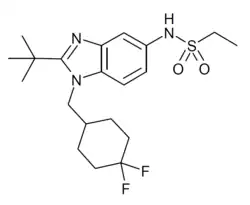
AZD-1940, also known as ART-2713 or NEO-1940, is a drug developed by AstraZeneca, that is a peripherally selective cannabinoid agonist which binds with high affinity to both the CB1 and CB2 receptors.[1] It was developed for the treatment of neuropathic pain, but while it showed good peripheral selectivity in animal studies,[2] in human clinical trials it failed to show sufficient analgesic efficacy and produced unexpectedly strong side effects associated with central cannabinoid activity, and so was discontinued from further development.[3][4]
See also
References
- ↑ "ART 2713". AdisInsight. 15 September 2025. Retrieved 30 September 2025.
- ↑ Schou M, Varnäs K, Jucaite A, Gulyás B, Halldin C, Farde L (April 2013). "Radiolabeling of the cannabinoid receptor agonist AZD1940 with carbon-11 and PET microdosing in non-human primate". Nuclear Medicine and Biology. 40 (3): 410–4. doi:10.1016/j.nucmedbio.2012.10.011. PMID 23352602.
- ↑ Kalliomäki J, Segerdahl M, Webster L, Reimfelt A, Huizar K, Annas P, et al. (January 2013). "Evaluation of the analgesic efficacy of AZD1940, a novel cannabinoid agonist, on post-operative pain after lower third molar surgical removal". Scandinavian Journal of Pain. 4 (1): 17–22. doi:10.1016/j.sjpain.2012.08.004. PMID 29913883. S2CID 49302159.
- ↑ Kalliomäki J, Annas P, Huizar K, Clarke C, Zettergren A, Karlsten R, Segerdahl M (March 2013). "Evaluation of the analgesic efficacy and psychoactive effects of AZD1940, a novel peripherally acting cannabinoid agonist, in human capsaicin-induced pain and hyperalgesia". Clinical and Experimental Pharmacology & Physiology. 40 (3): 212–8. doi:10.1111/1440-1681.12051. PMID 23324098. S2CID 1630384.