3156: Planetary Rings
| Planetary Rings |
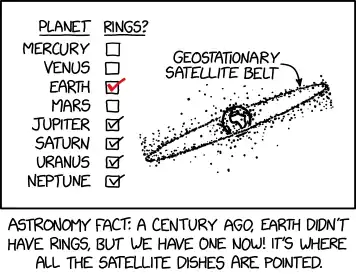 Title text: If you don't know where you are on Earth, the angle of satellite dishes can help constrain your latitude. If some of them are pointing straight up, you're probably near the Equator, right under the ring. |
Explanation

|
This is one of 53 incomplete explanations: This page was created by an off-axis satellite dish. Don't remove this notice too soon. If you can fix this issue, edit the page! |
A planetary ring is a disc of small objects and other material orbiting a planet. The most well known are the rings of Saturn, which were discovered by Galileo Galilei, but all the gas giant planets in the Solar System have rings, as do some minor planets and moons.
Earth does not have a natural ring system, although it's theorized that it may have had one in the distant past. However, since the 1950s (slightly over 68 years before this comic's publication), we have launched many artificial satellites into Earth orbit. The ones specifically in geostationary orbit (the first of these being launched in 1964) are in the equatorial plane (as are some with different orbital periods), so they can be considered to constitute an artificial ring system. (Other satellites operate within various other orbital planes, including geosynchronous orbits that are not strictly geostationary, creating various other halo-like clouds.)

Satellite dishes are used to communicate with most of these devices. If they are stationary that means they are pointed at a geostationary satellite in middle and low latitudes, or a Molniya orbit satellite constellation in higher latitudes. Not all dishes are pointed at the geostationary orbit, but in that case, if they are used for communicating with satellites in other orbits or with space probes, they must move continuously to track the satellite/probe. There are motorized dishes that can move between some number of pre-programmed positions to select which geostationary satellite to use at a given moment, so if a dish moves, that doesn't prove that it isn't using geostationary satellites. Also, there are antennas which can "point" at different directions by electronic means, without physically moving (e.g. Starlink user terminals).
In terms of mass, Earth's ring system is tiny compared to other planetary ring systems in the Solar System. In descending order of mass, these are Saturn (1019 kg [1]), Uranus (1016 kg [2]), Jupiter (between 1011 and 1016 kg [3]), Neptune (1015 kg [4]). Assuming 580 satellites (active and inactive, 1/2° slots) in geostationary orbit [5] and a typical mass of 1,000 kg, Earth's ring system has a mass of 5.8x10⁵ kg (580,000 kg).
Transcript
- [On the left side of the single panel, a table with words in one column and checkboxes in the second:]
- [Two Column headers, underlined:]
- Planet
- Rings?
- [Table entries, by line:]
- Mercury [Unticked checkbox]
- Venus [Unticked checkbox]
- Earth [Originally unticked checkbox, now with a red tick added]
- Mars [Unticked checkbox]
- Jupiter [Ticked checkbox]
- Saturn [Ticked checkbox]
- Uranus [Ticked checkbox]
- Neptune [Ticked checkbox]
- [On the right side of the single panel, an illustration of the Earth from space, with Africa most obvious and centrally in view. Many dots represent satellites, a lot of them close into the Earth but an even more significant number of them are in a very wide and tilted ellipse depicting a large circular orbit seen from a highly oblique angle. A labeled arrow points to the ellipse:]
- Geostationary satellite belt
- [Caption below the panel:]
- Astronomy fact: A century ago, Earth didn't have rings, but we have one now! It's where all the satellite dishes are pointed.
 Add comment
  Create topic (use sparingly)
  Refresh
 Discussion
Is my draft right? It's hard to understand a comic that hasn't yet got an explanation! RadiantRainwing (talk) 16:21, 17 October 2025 (UTC)
- I came here to say this is one of those xkcds that really doesn't need explaining. I do like the bit about "although it's theorized that [Earth] may have had [a natural planetary ring system] in the past," it's additional information I wouldn't think about just reading the panel. 64.201.132.210 17:48, 17 October 2025 (UTC)
- I think you did a good job, you gave depth to the terms used, added related facts, and included comparisons netween the listed rings. 64.114.211.102 18:17, 17 October 2025 (UTC)
Can't wait until our ring evolves via kessler syndrome. 64.114.211.102 18:17, 17 October 2025 (UTC)
- I can't wait for the stage after that: Carcinization. 149.22.90.216 23:10, 17 October 2025 (UTC)
I added two notes, but I don't have time now to learn the syntax to make proper notes, so they are just in the middle of the text. I will try to do it later, if someone else doesn't do it. Rps (talk) 18:33, 17 October 2025 (UTC)
Earth's historical rings: Rings of Earth 191.101.157.126 19:20, 17 October 2025 (UTC)
Mars also has a ring, although it consists of just 2 very large objects. SDSpivey (talk) 21:43, 17 October 2025 (UTC)
- Nope. Mars has TWO rings. Deimos orbits at three times the distance and four times the period of Phobos. Two rings with one large object each. And if you are taking an areocentric perspective, there's a much more massive ring 1.5 AU away. 181.214.218.33 22:46, 17 October 2025 (UTC)
Regarding the title text: One of those bits of information that aids navigation has long been where on a tree the moss grows (should you be in an area with trees, obviously, and otherwise be without a compass or can see the Sun to do the watch-dial trick (with an analogue watch, or a bit of imagination)). Back in the '90s, I noted that I could augment that, in an urban environment, from the rise in houses having satellite dishes (BSB 'squarials' and Sky dishes, originally, here in the UK) all pointing pretty much directly south. (With enough local knowledge, you might even be able to compare them to TV aerials and possibly triangulate to where you were within a larger urban area - assuming you were 'somewhat lost, but not totally lost'.) And, even today, I find them a reassuring extra bit of info when I'm skirting through the suburbs of cities, knowing that I'm not being twisted too far awa from my chosen direction (working with my in-head memory of the map I'd planned with, which can occasionally get nudged off from reality by an inconvenient twist and turn of road).
Though I must say, I've never ever considered latitude-enumeration as an additional factor. Apart from anything else, the design of the dish normally has the 'receiver arm' sitting at an off-axis focal point, so you need to project out at the complimentary 'up-angle' from the exact angle the dish itself points. But, anyway, I'm not sure I ever could have distinguished 55°N from 60°N, by eye, even sighting upon a centre-axis dish's direction. And yet I'd surely already know if I was as far south as Edinburgh or actually somewhere as far north as Lerwick, before checking out the local dishes... ;) 2.98.65.8 21:48, 17 October 2025 (UTC)
I don't understand why it says "If some of them are pointing straight up, you're probably near the Equator". Surely, if you're on Earth, they're pointing straight down. 86.20.197.254 (talk) 18:12, 18 October 2025 (please sign your comments with ~~~~)
- Well, the satellite dishes need to point up to get signal from up there in the sky. MinersHavenM43 (talk) 18:17, 18 October 2025 (UTC)
- Sounds like 86...254 thinks "satellite dishes" are the transmitting/transceiving dishes upon the satellites, not the receiving/transceiving dishes aimed at them. 2.98.65.8 18:40, 18 October 2025 (UTC)
Add comment